


Datadog Interview Questions: 7 from Real Interviews

Datadog's software-engineering process typically starts with a recruiter or hiring-manager screen. Technical interviews may include coding, system design, debugging, or a deep dive into a past project. The format varies by team, and some roles include a take-home project or executive call. Datadog's current guidelines also cover the company's use of AI, so ask your recruiter which AI tools will be available before the process begins.
What to Expect: Datadog Interview Process
Datadog's candidate guide lists a phone or Zoom interview, a multistage face-to-face interview, an optional take-home project, and an optional executive interview. For engineering roles, expect clean code, production trade-offs, and observability-focused design. One senior engineer's 2025 process included a medium-difficulty coding interview, an observability debugging exercise, and a design interview covering ingestion, fan-out, backpressure, and failure alerts.
How to Prepare and Pass Datadog Interviews
If your coding skills and distributed-systems knowledge are current, plan four to six weeks. Otherwise, allow eight weeks to relearn the basics of concurrency and system design.
- Practice reasoning about production issues. Explain failure modes, memory growth, retry logic, and monitoring without prompting, and add small tests as you code.
- Know the telemetry path. Trace telemetry from ingestion through storage and queries to alerts.
- Prepare two incident stories: one about a risky release and one about a failure that couldn't be fixed with a rollback.
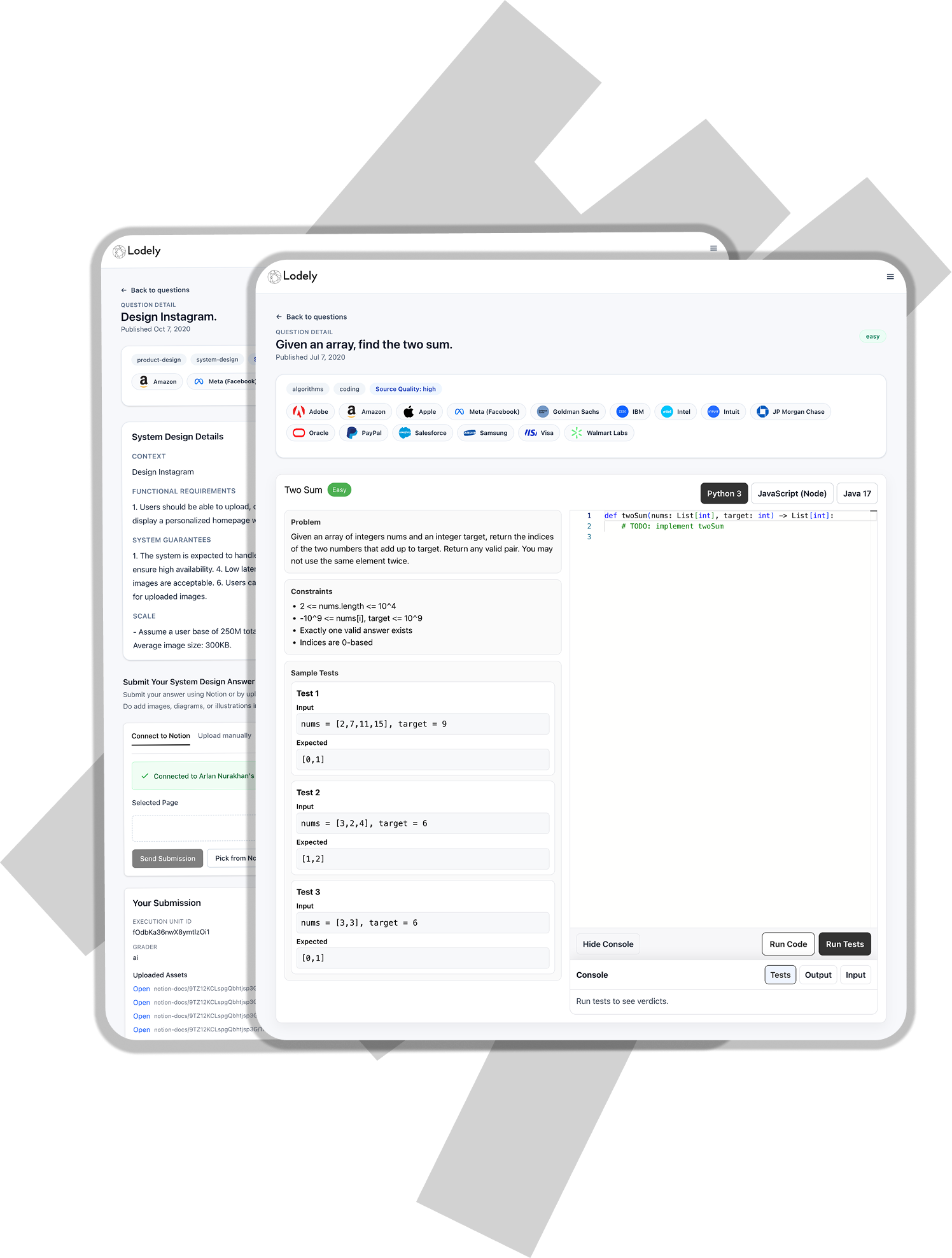
Use Lodely for a focused practice set of Datadog questions with detailed editorials.
Datadog Interview Breakdown
Implement a Windowed Average
function windowedAverageOperations(operations, arguments)- Implement a time-based key-value store with operations: put(key,value,timestamp) and getAvg(key,window,currentTimestamp). getAvg returns floor(average) of values for that key with timestamps in [currentTimestamp-window+1, currentTimestamp], or -1 if none.
1 <= operations.length <= 10^5
mixed put/getAvg operations on key a
[null,null,15,null,30,30]
getAvg before any put
[-1,null,5]
Type: Sliding-window data structure. The Trick: Expire old values without scanning the full history for each query. What It Tests: Queues, running aggregates, and time boundaries.
Real-Time Log Analytics
function activeUsersCount(events, windowSize)- Given a stream of events [timestamp, userId, eventType] and a window size in seconds, for each event return the number of unique active users within the sliding window ending at the current event's timestamp.
- A user is active if they generated at least one event within the window.
- Events older than windowSize seconds are removed.
Events are sorted by timestamp (non-decreasing)1 <= events.length <= 10^51 <= windowSize <= 10^6Window removes events where timestamp <= current - windowSize
events = [[1,101,'click'],[2,102,'view'],[100,101,'click'],[301,103,'view'],[302,101,'click']], windowSize = 300
[1, 2, 2, 3, 2]
events = [[1,1,'a'],[2,2,'a'],[3,3,'a'],[10,4,'a']], windowSize = 5
[1, 2, 3, 1]
Type: Streaming algorithm. The Trick: A user can generate several events within the active window, so removing one event may not remove that user. What It Tests: Correct state updates across a sequence of events.
Design an Alarm System for Streaming Metrics
Type: System design. The Trick: Decouple metric ingestion, rule evaluation, deduplication, and notification delivery while handling spikes and delayed data. What It Tests: Reliability, scale, and operational transparency.
The final four questions test a broader set of skills. Alert Routing Platform covers ownership and reliability. Ship Before Final Optimization covers how you limit unfinished work and manage risk. Production Bug Without Rollback covers incident judgment. Build Trace Trees from Unordered Spans covers indexing, orphans, and deterministic child ordering.
What Comes After The Interview
The interview team debriefs after the loop, and the recruiter communicates the decision. In September 2026, reported U.S. compensation ranged from $191K for Software Engineer I to $576K for Staff. These market figures do not define an offer band.
Candidate Experiences
One recent senior-level candidate completed a shared-editor coding round, a practical system-design round, and a small observability debugging exercise. The coding problem was medium difficulty and focused on clean tests and spoken trade-offs. The design covered ingestion, fan-out, backpressure, and failure alerts. Prepare for both debugging unfamiliar code and writing new code.
Conclusion
Datadog values engineers who write clean code and explain how production systems fail. Work through the selected Datadog questions and their editorials, then explain each solution in the app.
✉️ Get free faang interview cheat sheet and interview tips weekly
✉️ Get free faang interview cheat sheet and interview tips weekly
