


Snowflake Interview Questions in 2026: 5 Examples

Snowflake's engineering hiring process has up to four stages and usually takes two to four weeks. It begins with a 30-minute screen, followed by one or more 60-minute coding or system-design interviews. Next comes a panel of three to five 60-minute sessions covering technical depth, system design, behavior, and collaboration. The process can also include an additional 30-minute technical talk relevant to the role.
What to Expect: Snowflake Interview Process
The official engineering process provides unusually detailed timing. After the initial screen and technical interviews, you meet several Snowflake team members in a panel. The company says at least one meeting may be in person, and the team generally debriefs within a few days.
Some 2026 applicants have also reported AI-run or AI-assisted early screening for certain roles. Snowflake's published process still states that formats vary by team, so treat your recruiter as the source of truth for tool usage and setup.
How to Prepare and Pass Snowflake Interviews
Plan six weeks if you are comfortable with coding and distributed systems, or eight to ten weeks if you need more time to work on storage, queues, transactions, or other aspects of cloud service reliability.
- Explain tradeoffs. Describe requirements, establish a baseline, and explain tradeoffs under heavy load and across multi-region deployments.
- Design infrastructure. Snowflake interview reports mention durable queues, retries, timeouts, autoscaling, and observability.
- Prepare concise project descriptions. Include an example that covers ownership, a missed commitment, disagreement, and a calculated risk.
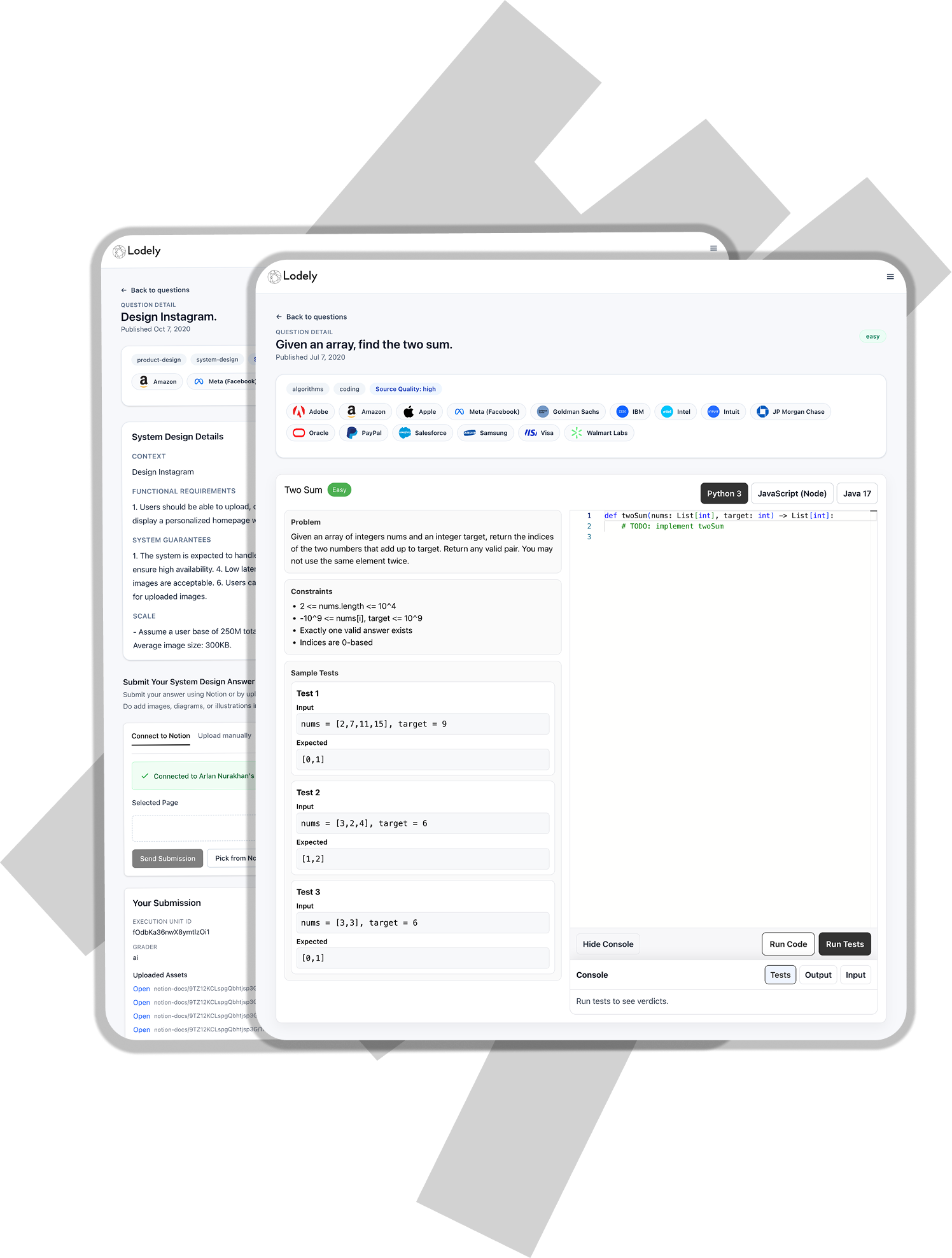
Use Lodely to practice Snowflake-specific coding and design questions with editorials. Each practice session covers a complete coding and design loop.

Snowflake Interview Breakdown
Thread Count
function maxSubseqLength(skills, k)- Given an array of integers skills and an integer k, find the maximum length of a subsequence of skills such that there are no more than k pairs of adjacent elements in the subsequence that are unequal.
- A subsequence is obtained by deleting zero or more elements from the array without changing the order of the remaining elements.
1 <= skills.length <= 10000 <= k <= skills.length1 <= skills[i] <= 10^5
skills = [1, 2, 1, 1, 3], k = 1
4
skills = [3, 3, 3, 3], k = 0
4
Type: Dynamic programming on subsequences. The Trick: Track both subsequence length and the number of unequal adjacent pairs instead of treating the input as a contiguous window. What It Tests: State design, transition correctness, and time-space analysis.
Design a System Like YouTube
Type: Large-scale media system. The Trick: Video bytes and high-QPS metadata should be delivered through different storage and delivery paths. What It Tests: Upload processing, content delivery, availability, search, and data-model boundaries.
String Formation
Type: Dynamic programming with column-frequency preprocessing. The Trick: Each target character must come from a strictly later column even though it can be selected from any word. What It Tests: Combination counting, modular arithmetic, and update ordering.
The final two overview entries complete the five-item list. System Design Master List groups infrastructure prompts involving queues, schedulers, quotas, storage, and transactions. Coding Master List collects board-state, tree, cache, transaction, and access-control exercises.
What Comes After The Interview
After the panel, the Snowflake team debriefs before the recruiter shares the decision. Based on September 2026 U.S. data, median total compensation is approximately $232,000 for IC1, $351,000 for IC2, and $570,000 for IC3. Much of the increase comes from equity.
Candidate Experiences
One recent backend candidate went through two 60-minute coding screens, then coding, system-design, and behavioral sessions. They finished the screening rounds in under 40 minutes each and the final coding session in under 50 minutes. The system-design prompt involved building a cloud service with autoscaling, durable queues, retries, and observability. The behavioral round covered ownership and decisions. They received an offer at the end of the loop.
Conclusion
Snowflake values candidates who demonstrate mastery in coding, infrastructure, and ownership storytelling. Use Lodely to practice Snowflake interview questions and the explanations you'll give in each 60-minute round.
✉️ Get free faang interview cheat sheet and interview tips weekly
✉️ Get free faang interview cheat sheet and interview tips weekly