


DoorDash Interview Questions: 9 from Real Interviews

DoorDash's current engineering process includes a recruiter conversation and may include a 60-minute technical interview before a virtual onsite. Engineering interviews now focus on a 60-minute AI-assisted working session in which you use your own machine and receive starter code that you can modify and debug while explaining your decisions. DoorDash's engineering team details what the session looks like here.
What to Expect: DoorDash Interview Process
The process starts with a 30-minute recruiter screen about your background, level, and fit. DoorDash's engineering page says the next stage is a technical screen followed by a virtual onsite that can include coding, system-design, or behavioral interviews, depending on your level. The working-session format changes how you should prepare: become comfortable navigating unfamiliar code, checking AI outputs, and narrating trade-offs as you work toward the correct answer. The public process overview is the best source for your role-specific baseline.
How to Prepare and Pass DoorDash Interviews
If your fundamentals are solid, plan four to six weeks. If you need to rebuild them, plan eight to twelve weeks. Practice the whole loop: read the task, state your assumptions, make a small change, check it, and explain what you learned. DoorDash checks whether you can orient yourself, validate outputs, debug, manage scope, and communicate tradeoffs.
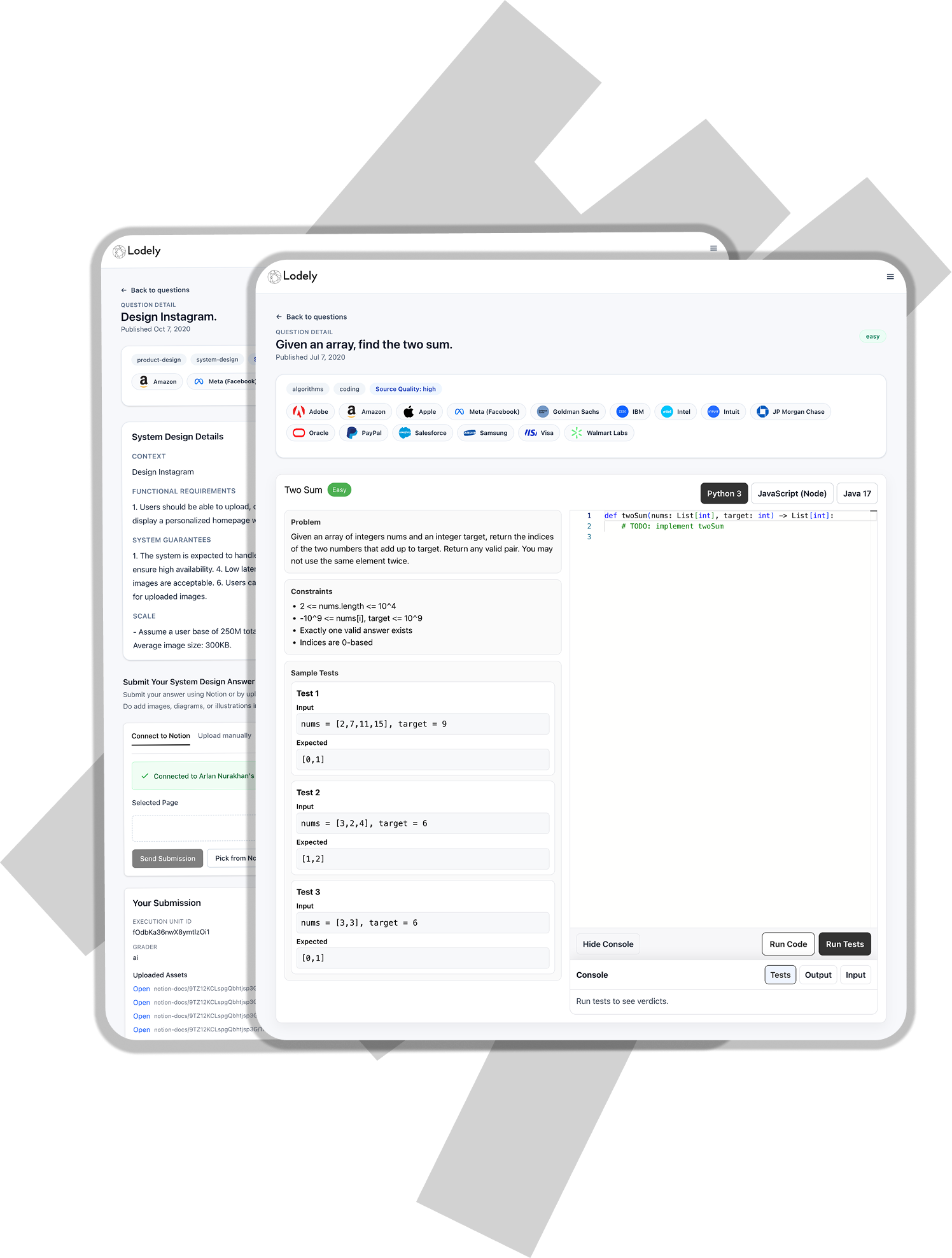
Create a short routine with Lodely. Complete one algorithmic problem, one design prompt, and one story with a measurable outcome. This keeps the routine focused on engineering judgment instead of interview format.

DoorDash Interview Breakdown
Credit Availability
function maxCredit(credits)- Given a list of time-limited credits, each with a time interval (HH:MM-HH:MM) and a dollar amount, find the maximum total credit available at any single point in time.
- Overlapping credits stack.
- Return the maximum total credit.
1 <= credits.length <= 10^4Times are in HH:MM format (00:00 to 23:59)1 <= amount <= 10^6
credits = [["10:00-11:00","5"],["13:00-15:00","10"]]
10
Type: Interval and sweep-line reasoning. The trick: Determine the event-processing order when time windows overlap. What it tests: The ability to convert a small requirement into a robust implementation while accounting for edge cases.
Alive Nodes
function maxAlivePathSum(values)- Given a binary tree represented as a level-order array (use -1 for null nodes), find the maximum path sum between any two leaf nodes.
- A leaf node is also called an "alive node."
- The path goes from one leaf, up through their lowest common ancestor, and down to another leaf, including all nodes on the path.
- The tree is given as an array where values[0] is the root, values[2*i+1] is the left child of values[i], values[2*i+2] is the right child of values[i], and -1 represents a null node.
1 <= values.length <= 10^4-1000 <= values[i] <= 1000 (or -1 for null)
values = [5, 2, 0, 25, -1, 14, 15]
47
values = [1, 2, 3]
6
Type: Tree dynamic programming. The trick: Find the best paths that can be merged through a common ancestor. What it tests: Recursive state, proof of correctness, and clean complexity analysis.
Payment Service Outage Handling in Checkout
Type: System design.
The trick: Define the checkout state, recovery behavior, and customer guarantees before choosing the infrastructure.
What it tests: How you handle trade-offs when the dependent payment system goes down.
The remaining questions cover order-related reviews and rewards, a disagreement between two teams, an engineering mistake, background, a conflict, and conversion vs. time to deliver. Answers should be specific. Name the constraint, the decision, the outcome, and what changed afterward.
What Comes After The Interview
Compensation is usually divided among base pay, stock, and bonuses. Interviewers assess how you work through ambiguity while considering merchants, Dashers, consumers, and partner teams. Ask the recruiter which parts of the loop you will complete and how the team uses the working-session format.
Candidate Experiences
Treat the process as an interactive conversation instead of a test. Strong candidates explain each check, narrow the hypothesis being tested, and connect behavioral stories to observable outcomes. Treat feedback and changes in direction as new information, then explain what you would do next.
Conclusion
DoorDash looks for clear engineering judgment: a working solution, proof of your understanding, and a simple explanation of your choices. Use Lodely to practice questions from your target company every day, so you can spend the interview demonstrating how you work.
✉️ Get free faang interview cheat sheet and interview tips weekly
✉️ Get free faang interview cheat sheet and interview tips weekly
