


Dropbox Interview Questions in 2026: 10 Examples

Dropbox software-engineering interviews often combine an assessment or technical screen with coding, system design, project discussion, and behavioral questions. Junior loops lean toward implementation, while experienced candidates should expect deeper architecture and ownership questions.
You'll need clean code and a clear explanation of how a design behaves during retries, concurrent edits, partial failures, and scaling. These behaviors matter especially in file storage and synchronization.
What to Expect: Dropbox Interview Process
The process currently takes roughly four to six rounds over two to four weeks: an assessment, a recruiter conversation, technical interviews, system design, a behavioral discussion, and a hiring-manager wrap-up. Follow the schedule your recruiter provides.
The Dropbox web development interview prep guide says the coding interview lasts 50 minutes and includes 10 minutes to discuss the question. It also says interviewers value production-quality work, rigorous thinking under pressure, teamwork, and examples of projects you're proud of. Backend and infrastructure interviews use different problems but assess the same signals.
How to Prepare and Pass Dropbox Interviews
Plan four to six weeks if you code and design regularly. Take eight to twelve weeks if you need to rebuild concurrency, distributed-systems, or timed-implementation skills.
- Practice production habits. Clarify inputs, name state, test boundaries, and explain complexity without prompting.
- Study storage and sync tradeoffs. Review metadata, chunking, versioning, deduplication, conflict resolution, caching, consistency, and recovery.
- Build one deep project story. Explain the goal, architecture, your decisions, a failure, and a measured result.
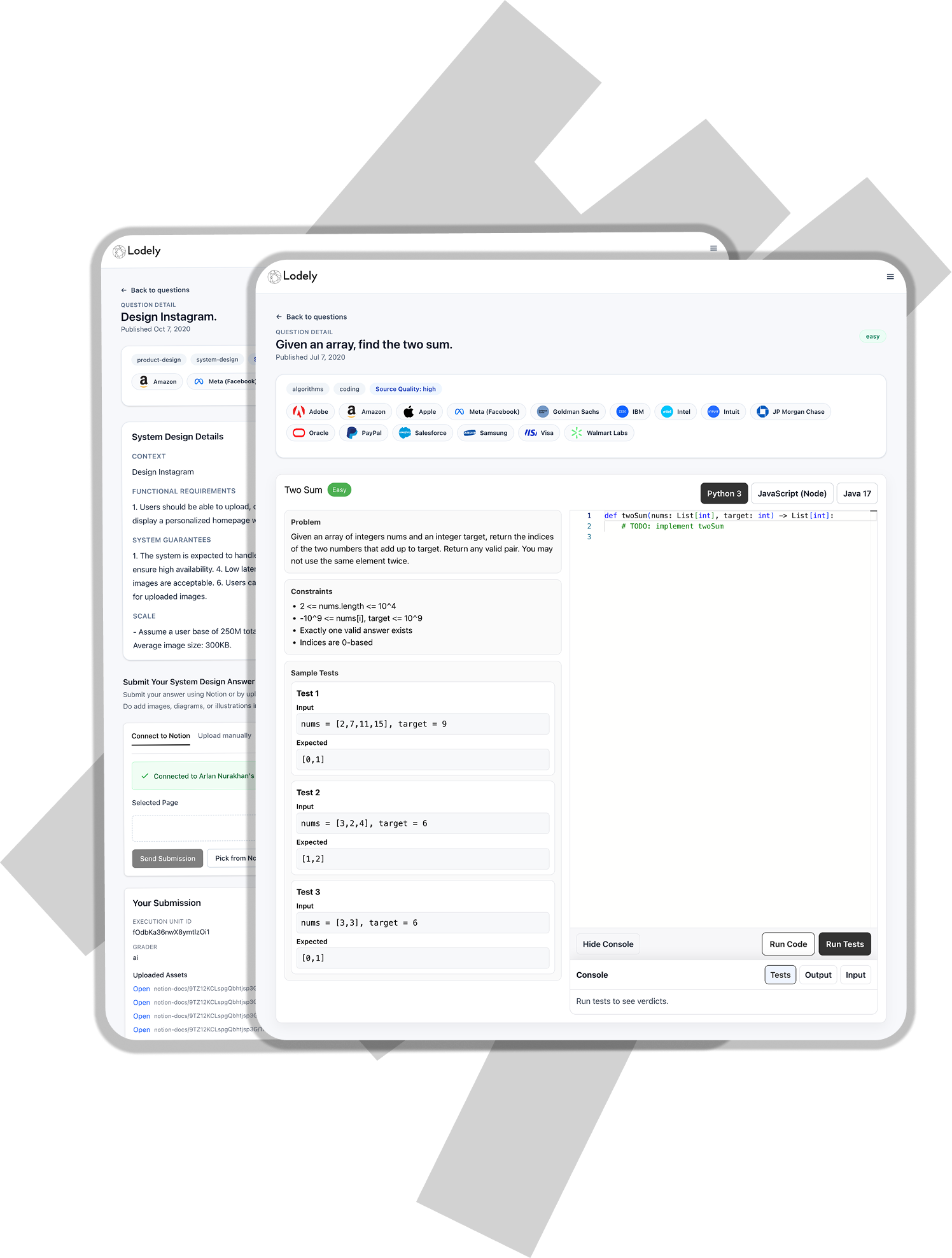
Lodely combines Dropbox-specific coding, design, and behavioral practice in one plan, matching the breadth of the loop.

Dropbox Interview Breakdown
Find Duplicate Files in a File System
function findDuplicate(paths)- Given a list of directory info, including the directory path, and all the files with contents in this directory, return all the duplicate files in the file system in terms of their paths.
- You may return the answer in any order.
- A group of duplicate files consists of at least two files that have exactly the same content.
- Each directory string has the format: "root/d1/d2/.../dm f1.txt(f1_content) f2.txt(f2_content) ... fn.txt(fn_content)".
- It means there are n files in the directory root/d1/d2/.../dm with contents f1_content, f2_content, ..., fn_content respectively.
- The output is a list of groups of duplicate file paths.
1 <= paths.length <= 2 * 10^41 <= paths[i].length <= 30001 <= sum of paths[i].length <= 5 * 10^5File content is composed of lowercase English letters and digits
paths = ["root/a 1.txt(abcd) 2.txt(efgh)","root/c 3.txt(abcd)","root/c/d 4.txt(efgh)","root 4.txt(efgh)"]
[["root/a/2.txt","root/c/d/4.txt","root/4.txt"],["root/a/1.txt","root/c/3.txt"]]
paths = ["root/a 1.txt(abcd) 2.txt(efgh)","root/c 3.txt(abcd)","root/c/d 4.txt(efgh)"]
[["root/a/2.txt","root/c/d/4.txt"],["root/a/1.txt","root/c/3.txt"]]
Type: File traversal, hashing, and data grouping.
The Trick: Split cheap candidate detection from expensive content verification. Describe collision resolution, memory use, and what changes when files are too large to fit in memory.
What It Tests: Algorithm choice, I/O awareness, correctness, and trade-offs.
Admin Console and Analytics
Type: Product and system design.
The Trick: Define the users, permissions, events, and freshness target. Auditability and tenant isolation are as important as dashboard latency.
What It Tests: Requirements, authorization, analytics pipelines, data modeling, and operational safety.
What Is the Project You Are Most Proud Of?
Type: Technical behavioral deep dive.
The Trick: Choose work where your decisions are easy to distinguish from the team's. Explain why one option was rejected, describe a setback, and show how your work made an impact.
What It Tests: Ownership, technical knowledge, communication, and self-awareness.
Seven more questions complete the set. Conflict With a Coworker, A Technical Challenge You Overcame, and Dealing With a Difficult Person test collaboration through concrete actions and outcomes. Deleted File Recovery covers retention, metadata, and safe restoration. Minimum Window Substring tests window state and frequency counts. Smart Sync Technology adds hydration, offline behavior, and cache policy. Search and Content Indexing covers ingestion, permissions, ranking, freshness, and scale.
What Comes After The Interview
Follow up once if the decision date passes. If you get an offer, confirm the level before comparing compensation. September 2026 U.S. data shows median annual totals near $179,000 at IC1, $256,000 at IC2, $375,000 at IC3, and $469,000 at IC4. Stock becomes a larger component at higher levels and follows a four-year, 25%-per-year schedule in the reported data.
Candidate Experiences
One recent software engineer described a four-stage take-home assessment that increased in difficulty, followed by two technical interviews. One used a straightforward coding exercise and emphasized fundamentals and explanation; the other asked for open-ended system design. A hiring-manager wrap-up followed, and the candidate received clear updates and an offer of feedback after rejection. Prepare to move from precise implementation to broad design without losing structure.
Conclusion
Dropbox engineering aims to build products that behave consistently through careful implementation. Practice the ten questions on Lodely and explain every important state change, failure mode, and trade-off aloud.
✉️ Get free faang interview cheat sheet and interview tips weekly
✉️ Get free faang interview cheat sheet and interview tips weekly