


Bloomberg Interview Questions: 8 Questions to Prepare for in 2026

Bloomberg's interviews for software engineering positions involve coding, code reviews, debugging, system design, project depth, and motivation for financial data products. Early-career and experienced loops differ, but they both require you to explain your choices while you are working.
What to Expect: Bloomberg Interview Process
Bloomberg's engineering and data recruitment overview shows a path from application to video interview, further interviews, and an offer. Recent engineering accounts add a recruiter discussion, one or more technical interviews, a longer virtual or in-person loop, and final discussions with HR or an engineering manager.
Technical rounds last an hour. Coding questions may include follow-ups about complexity and alternative approaches. Experienced candidates may also see code review, log-based debugging, or system design. The manager conversation usually covers a project, technical decisions, teamwork, and motivation for joining Bloomberg.
How to Prepare and Pass Bloomberg Interviews
Plan four to six weeks if you can solve medium-level coding problems reliably. If you are not confident with graphs, object-oriented design, or system design, plan additional time.
- Explain before you implement. Rephrase the prompt, select a data structure, and test it with a small example. Bloomberg interviewers often ask for time and space analysis.
- Review real code. Practice identifying correctness bugs, ownership issues, hidden state, and weak test coverage in a pull request. Trace logs back to the line that generated them.
- Connect design to market data. Review ordering, deduplication, subscriptions, search, freshness, and fault recovery for systems that carry time-sensitive information.
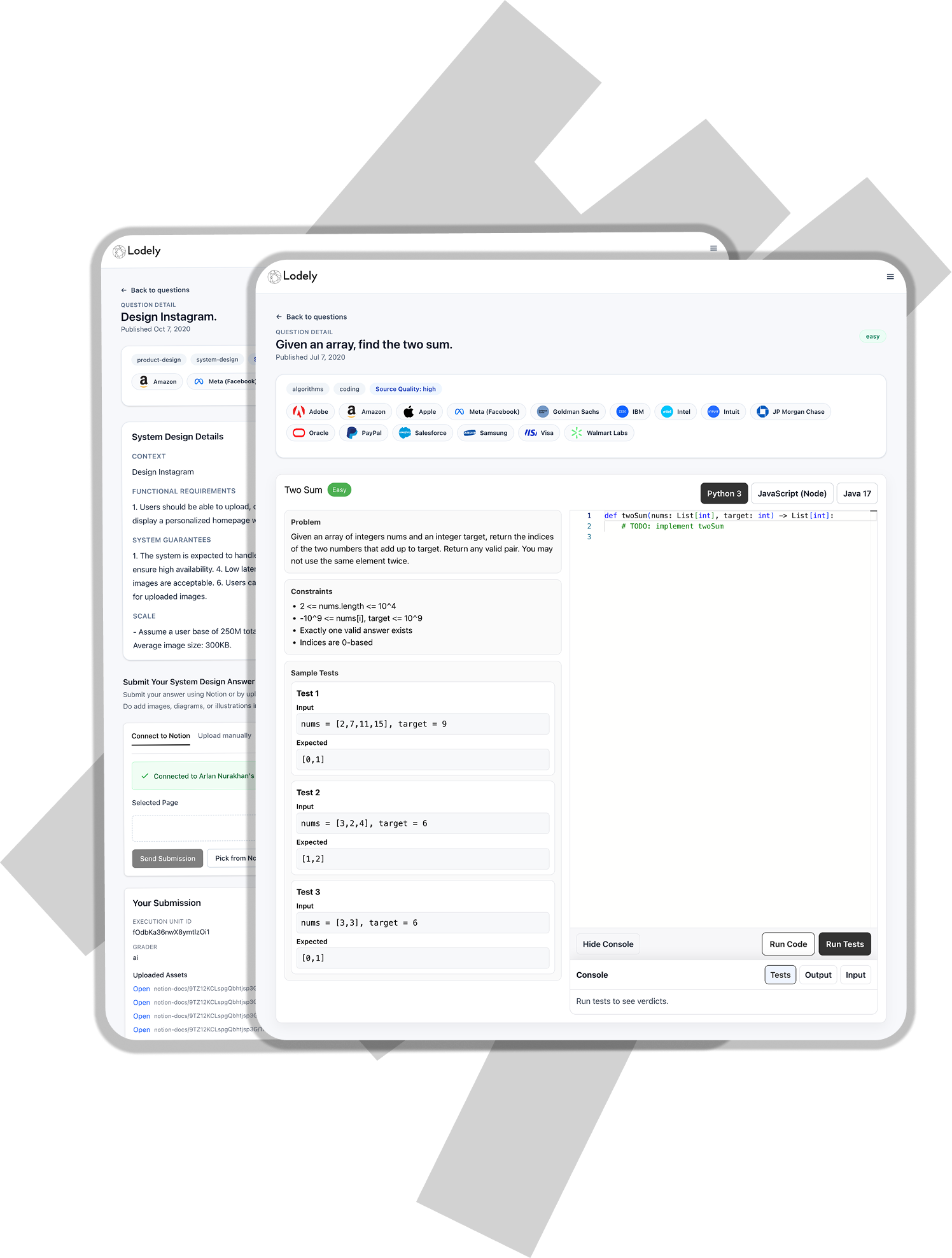
Use Lodely to include Bloomberg coding, system-design, and behavioral questions in your preparation.

Bloomberg Interview Breakdown
Aggregate Trades Across Equivalent Symbols
function aggregateTrades(tradeSymbols, tradeValues, equivA, equivB)- Given arrays of trade symbols and their values, along with equivalence pairs indicating that two symbols represent the same company, aggregate the total trade value per company using Union-Find.
- The canonical (representative) symbol for each group is the lexicographically smallest symbol.
- Return a sorted list of strings in the format 'symbol:total'.
1 <= tradeSymbols.length <= 10^5tradeValues[i] >= 00 <= equivA.length <= 10^5
tradeSymbols = ["GOOG","GOOGL","MSFT"], tradeValues = [100,50,200], equivA = ["GOOG"], equivB = ["GOOGL"]
["GOOG:150","MSFT:200"]
tradeSymbols = ["A","B","C","D"], tradeValues = [10,20,30,40], equivA = ["A","C"], equivB = ["B","D"]
["A:30","C:70"]
Type: Union-find and aggregation.
The Trick: Equivalence relationships are transitive, so assign each group one unique canonical symbol.
What It Tests: Graph representation, node grouping, and complexity control.
Design a Sequencer Class
function sequencerOps(operations, arguments)- Design a Sequencer that outputs content in order of IDs. add(id, content) caches the item and returns null. flush() returns a list of content strings for all consecutive IDs starting from the next expected ID.
- The sequencer expects IDs starting from 1 in order.
- If ID 2 is missing, flush returns content only up through ID 1, caching the rest.
1 <= id <= 10^5IDs are uniqueContent strings are non-empty
ops = ['add','add','flush','add','flush'], args = [[1,'aaa'],[3,'ccc'],[],[2,'bbb'],[]]
[null, null, ['aaa'], null, ['bbb','ccc']]
Type: Stateful object design.
The Trick: Buffer out-of-order elements until the next expected element arrives, then flush only the consecutive sequence.
What It Tests: Invariants, interface design, and amortized analysis.
Design a news feed service with search, filtering, and subscriptions
Type: Distributed system design.
The Trick: Separate ingestion, search, subscriptions, and live delivery, then choose where push and pull paths should meet.
What It Tests: Data modeling, indexing, fan-out control, freshness, and latency trade-offs.
The remaining five examples add breadth. Deck of Cards Shuffling tests randomized design and validation. Design a Stock Price and Financial Reporting System tests freshness and data consistency. Why are you interested in Bloomberg? requires a specific connection to the product and role. Tell me about a technical decision you made and its impact requires a measurable project story. The video-and-HR experience record covers the switch between technical and motivation-focused stages.
What Comes After The Interview
Ask when the hiring team plans to debrief and whether a manager round remains. If you receive an offer, confirm the level before comparing components. Reported U.S. total compensation is around $198,000 for Software Engineer and $314,000 for Senior Software Engineer, with bonus carrying more weight than equity in the reported packages.
Candidate Experiences
One recent senior candidate in London described a two-week process. After a 30-minute recruiter call and a one-hour coding interview, they completed a two-hour virtual block split between code review and another coding session. The review used hundreds of lines of code and a log file to locate a bug; the later problem required building routes through a graph. The candidate recognized the correct traversal pattern but felt nerves hurt the implementation.
Conclusion
Bloomberg looks for clear algorithms, practical review skills, and effective communication during follow-up questions. Before the interview loop, use Lodely to work through the eight selected questions while recording and timing the session.
✉️ Get free faang interview cheat sheet and interview tips weekly
✉️ Get free faang interview cheat sheet and interview tips weekly
