


Robinhood Interview Questions: 6 from Real Interviews

Robinhood engineering interviews focus on coding, system design, practical judgment, and products where correctness affects real money. The loop differs by role. A backend candidate may spend more time on distributed systems, while a mobile candidate may complete a hands-on app exercise alongside general coding and design.
In 2026, Robinhood made AI fluency an explicit expectation and prohibited real-time AI assistance during live interviews unless the interviewer permits it. Be ready to explain where AI fits into your workflow and how you verify its output.
What to Expect: Robinhood Interview Process
According to Robinhood's official interview guide, engineering interviews can include system-design discussions, coding exercises, and real-world situations. Recent software engineering accounts indicate that the process usually includes a screening followed by a virtual "loop" with coding, design, role-specific implementation, and behavioral questions.
Use the recruiter call to pin down the format. Ask whether you'll code from scratch, work in an existing project, or use a shared editor. Confirm the number of rounds and whether system design is product-level, backend-focused, or platform-specific.
How to Prepare and Pass Robinhood Interviews
Set aside four to six weeks when your fundamentals are current, or eight to twelve weeks when you're rebuilding them. Divide that time among algorithms, design, and behavioral stories.
- Practice financial correctness. Work through rounding, duplicate events, idempotency, ordering, and late data. Explain your assumptions before you write code.
- Design for failure. Review queues, caches, data partitioning, retries, reconciliation, observability, and safe rollbacks. Link each decision to latency and consistency requirements.
- Tell stories. Prepare one story involving a mistake, a difficult tradeoff, and a production incident. Explain what you did, its impact, and what changed afterward.
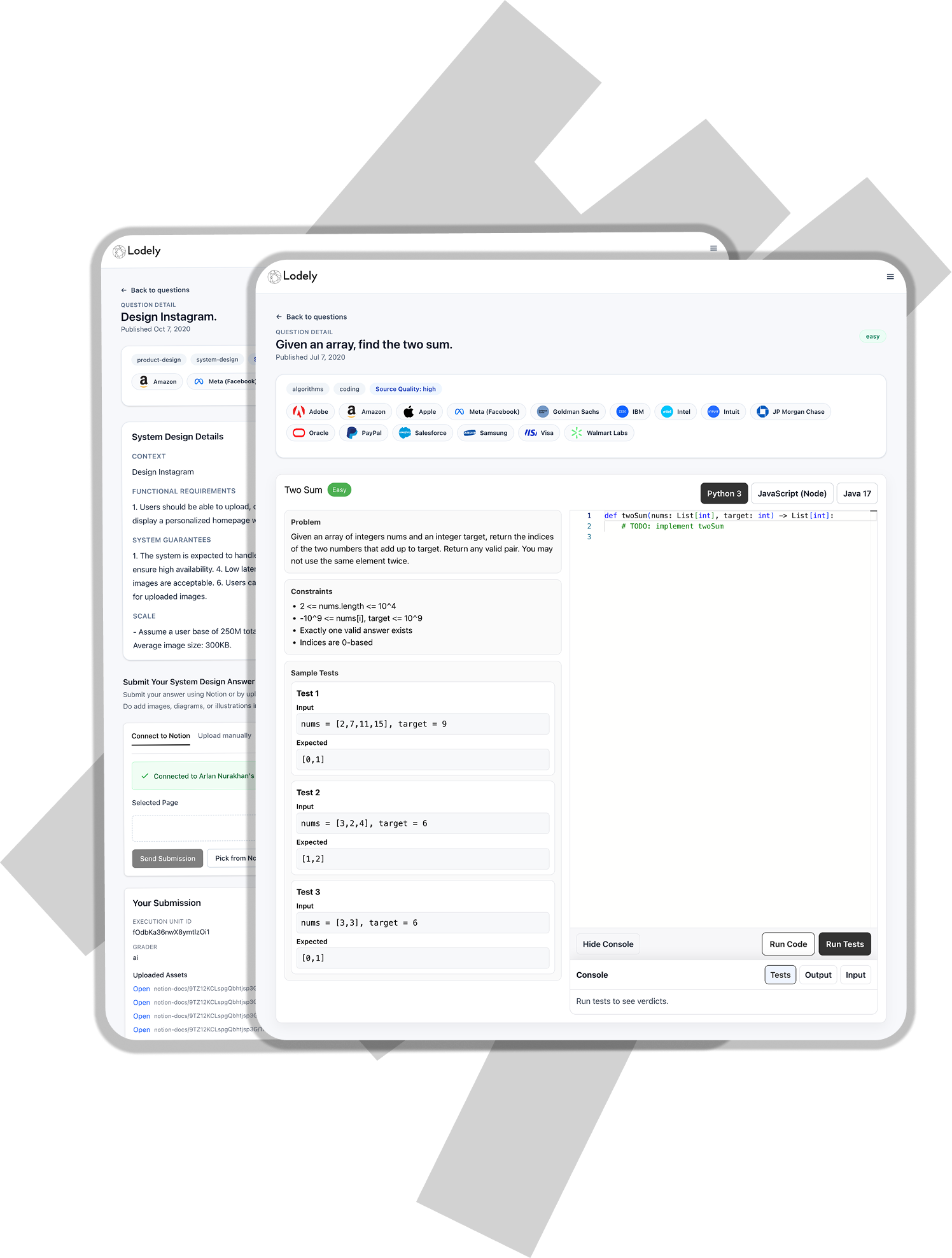
Use Lodely to practice company-specific coding, system design, and behavioral questions in one plan. This helps you balance preparation across rounds.

Robinhood Interview Breakdown
Tell Me About a Time You Made a Mistake
Type: Behavioral ownership.
The Trick: Choose a real error with consequences. Focus on detection, correction, and prevention, while keeping the background brief.
What It Tests: Whether you take responsibility, communicate early, and improve the system after making a mistake.
Tax Lot Tracking
Type: Coding and system design for stateful financial records.
The Trick: Tax lots can be partially sold, corrected, or replayed. Define stable identifiers and an ordering model before deciding on storage.
What It Tests: Data modeling, precision, auditability, and edge-case handling for customer balances.
Stock Price Aggregator
Type: Streaming aggregation and service design.
The Trick: Define event time, duplicate handling, late arrivals, and freshness guarantees before designing the pipeline.
What It Tests: Low-latency design with correct windows, state, and failure recovery.
The remaining questions cover additional skills. Implement LRU Cache checks constant-time operations and careful pointer updates. Dividend Calendar tests date handling and corporate-action edge cases. Stock Split Handler asks you to preserve portfolio correctness when quantities and prices change together.
Robinhood Software Engineer Compensation
Reported U.S. compensation varies considerably by level. According to September 2026 data, annual compensation is $201,000 at L1, $293,000 at L2, $433,000 at L3, and $480,000 at L4. Stock makes up a much larger share at higher levels, so compare vesting and refresh grants alongside base salary.
What Comes After The Interview
Your recruiter remains your point of contact, and the timeline depends on them. If you receive an offer, confirm the level, team, base pay, target bonus, equity schedule, sign-on terms, and any licensing or background-check requirements. If the promised update date passes, send one brief follow-up email.
Candidate Experiences
One recent mobile engineer with six years of experience described a screen that required building an Android app consuming an API, followed by four back-to-back virtual interviews. The loop covered general system design, a string-focused coding problem, Android implementation with state management, and behavioral questions. The candidate finished parts of the technical work early but struggled in the platform-specific build and was rejected without feedback. For a specialist role, rehearse the actual development environment alongside general algorithms.
Conclusion
Robinhood rewards engineers who can code cleanly, reason about money-sensitive systems, and explain tradeoffs. Practice these six questions on Lodely. In each answer, explain correctness, failure handling, and ownership.
✉️ Get free faang interview cheat sheet and interview tips weekly
✉️ Get free faang interview cheat sheet and interview tips weekly