


PayPal Interview Questions: 5 Questions to Prepare for in 2026

PayPal candidates typically complete a recruiter screen or assessment before coding, system-design, and behavioral interviews. The exact sequence depends on the role and level. You will need clean code, sound production tradeoffs, and specific examples of how you handled feedback and ownership.
These five questions cover algorithms, cache design, payment architecture, and a behavioral prompt. Prepare them as spoken exercises so the interviewer can follow your decisions.
What to Expect: PayPal Interview Process
PayPal's official interview guidance outlines the process for candidates. Reported engineering processes vary by team, but a typical sequence may include a recruiter call or online assessment, followed by a technical screen, coding interview, design interview, and conversation with a manager or leader.
Technical interviews may combine data structures and code design. Senior and backend roles may also include high- or low-level system design, scalability, API design, and failure scenarios. Ask the recruiter to confirm the number, length, and focus of your rounds, then base your study plan on that information.
How to Prepare and Pass PayPal Interviews
Set a realistic schedule. Plan four to six weeks if your foundations are current, or eight to ten weeks if you are relearning algorithms and system design. Divide your time among timed coding, design walkthroughs, and behavioral stories.
Practice reasoning about payment systems. Define idempotency, authorization boundaries, retries, audit history, and failure states before selecting components in your design answers. Explain how you would handle a dependency timeout after a payment has succeeded.
Make your work testable. Explain complexity, handle empty inputs and duplicates, and describe the tests you would write. For design questions, cover observability and recovery. Use Lodely to practice PayPal coding, system-design, and behavioral questions in real time from one place.

PayPal Interview Breakdown
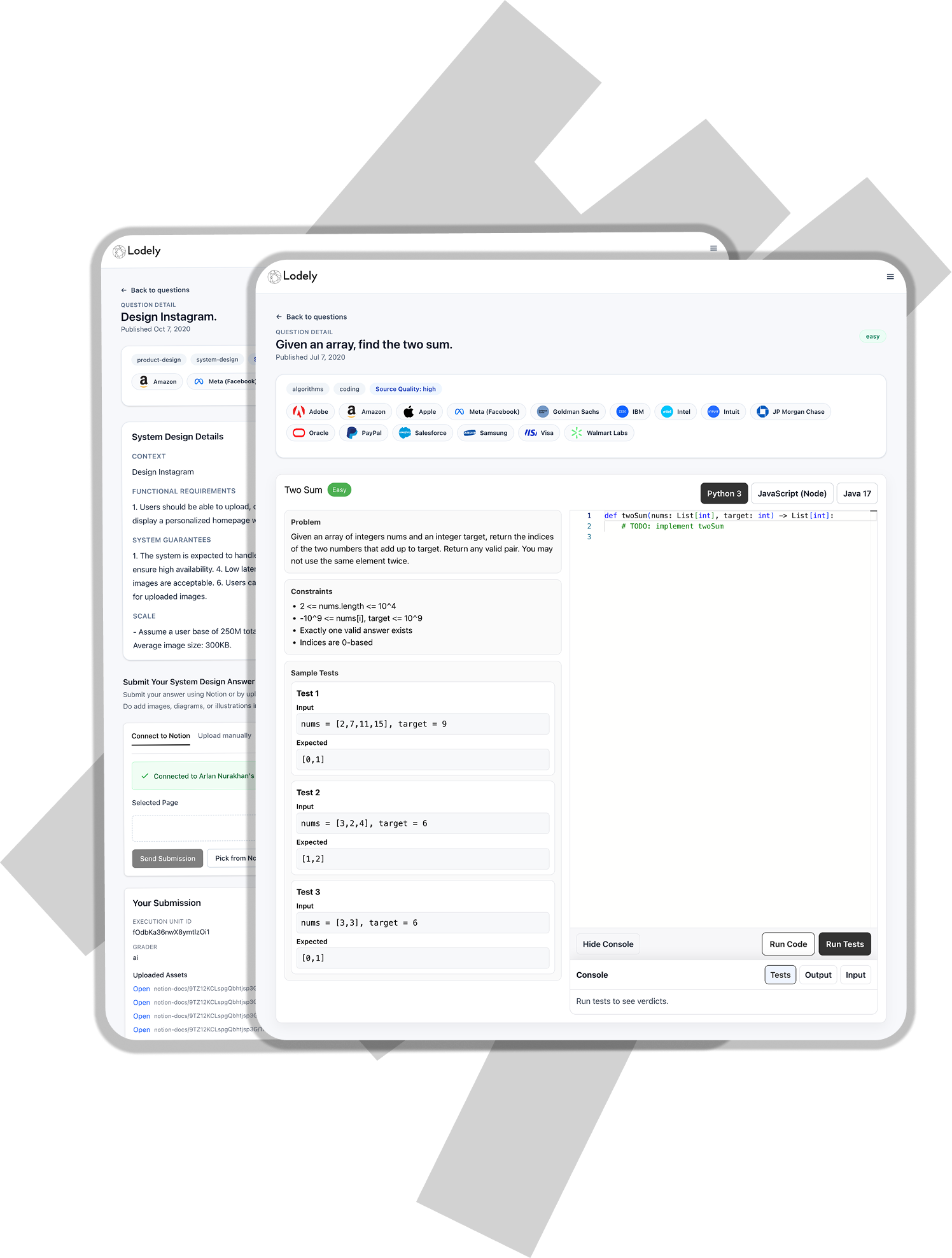
Given an Array, Find the Two Sum
function twoSum(nums, target)- Given an array of integers nums and an integer target, return the indices of the two numbers that add up to target.
- Return any valid pair.
- You may not use the same element twice.
2 <= nums.length <= 10^4-10^9 <= nums[i], target <= 10^9Exactly one valid answer existsIndices are 0-based
nums = [2,7,11,15], target = 9
[0,1]
Type: Hash map lookup.
The Trick: Preserve two distinct indices and decide when to add each value to the hash map. Test duplicate values, negative numbers, and a basic example.
What It Tests: Data structure selection, linear-time reasoning, edge cases, and a clear proof of correctness.
Implement LRU Cache
function lruCacheOperations(operations, arguments)- Design a data structure that follows the constraints of a Least Recently Used (LRU) cache.
- Implement the LRUCache class: LRUCache(int capacity) initializes the cache with positive size capacity. int get(int key) returns the value of the key if it exists, otherwise returns -1. void put(int key, int value) updates the value if the key exists, otherwise adds the key-value pair.
- If the number of keys exceeds the capacity, evict the least recently used key.
- The get and put operations must each run in O(1) average time complexity.
1 <= capacity <= 30000 <= key <= 10^40 <= value <= 10^5At most 2 * 10^5 calls will be made to get and put
['LRUCache', 'put', 'put', 'get', 'put', 'get'], [[2], [1,1], [2,2], [1], [3,3], [2]]
[null, null, null, 1, null, -1]
['LRUCache', 'put', 'get', 'put', 'get', 'get'], [[1], [1,10], [1], [2,20], [1], [2]]
[null, null, 10, null, -1, 20]
Type: Data structure design.
The Trick: Keep lookup and recency operations in O(1) time. Every read or write can change the ordering, so keep the map and linked structure synchronized.
What It Tests: Interface design, invariants, pointer manipulation, capacity, and precise complexity analysis.
Payment Gateway Authorization Service
Type: System design.
The Trick: Separate a request's business state from transport retries. Clarify idempotency keys, provider timeouts, authorization outcomes, reconciliation, and durable audit events.
What It Tests: API boundaries, data modeling, reliability, security, observability, and tradeoffs in the face of partial failure.
Two more questions complete the set. "Tell Me About a Time When You Received Negative Feedback and How You Handled It" tests whether you can explain the feedback, your response, and the change you made without becoming defensive. "Maximize Profit by Buying or Selling One Share per Day" asks you to reason through a series of price changes, enforce the one-transaction-per-day rule, and justify the time and memory costs.
What Comes After The Interview
Ask when the team will finish its debrief and whether another conversation is needed. If you receive an offer, confirm the level, base salary, annual bonus, equity value, vesting, refresh grants, and sign-on terms. Check each item against the compensation grid below. The figures reflect current reported U.S. packages and may differ by location and team.
Candidate Experiences
One recent backend candidate described an assessment, a 45-minute coding interview, a scenario-based system-design discussion, and a leadership conversation. The design interviewer added follow-up constraints and expected the candidate to think aloud instead of jumping directly to a diagram. The candidate reported receiving an offer. Rehearse your reasoning as carefully as your final answer.
Conclusion
PayPal looks for clean code, sound failure handling, and strong ownership stories. Use Lodely to practice the five selected PayPal questions and identify weak areas before the interview.
✉️ Get free faang interview cheat sheet and interview tips weekly
✉️ Get free faang interview cheat sheet and interview tips weekly