


Perplexity AI Interview Questions: 10 Questions to Prepare for in 2026

Perplexity uses several role-specific technical-interview formats rather than one standard loop. Current formats include a practical assessment, hands-on coding, Spike, agentic coding, system design, and a discussion of core expertise. Most technical loops also include a manager or cross-functional conversation.
The 10 questions below reflect that range.
What to Expect: Perplexity AI Interview Process
According to Perplexity's official technical interview portal, Perplexity assigns each role a curated subset of formats. Many technical positions start with a self-scheduled practical assessment. These exercises are designed to take 45 to 90 minutes but usually have a two- or four-hour submission window.
Hands-on live-coding sessions can last 30 to 60 minutes and often use a shared online code editor. The exercises will have multiple parts and will be written in-house. Focus on reading the question carefully, forming useful abstractions, debugging systematically, explaining tradeoffs, and executing precisely. System-design, spike, agentic, or specialist interviews may follow, depending on the role.
How to Prepare and Pass Perplexity AI Interviews
Practice hands-on implementation. Read the full prompt, identify how its parts connect, and preserve existing behavior as you add features. Write tests before making a quick fix that could cause a regression.
Review crawling, deduplication, retrieval, ranking, freshness, caching, source quality, and evaluation. Connect model behavior to user-visible latency and answer quality.
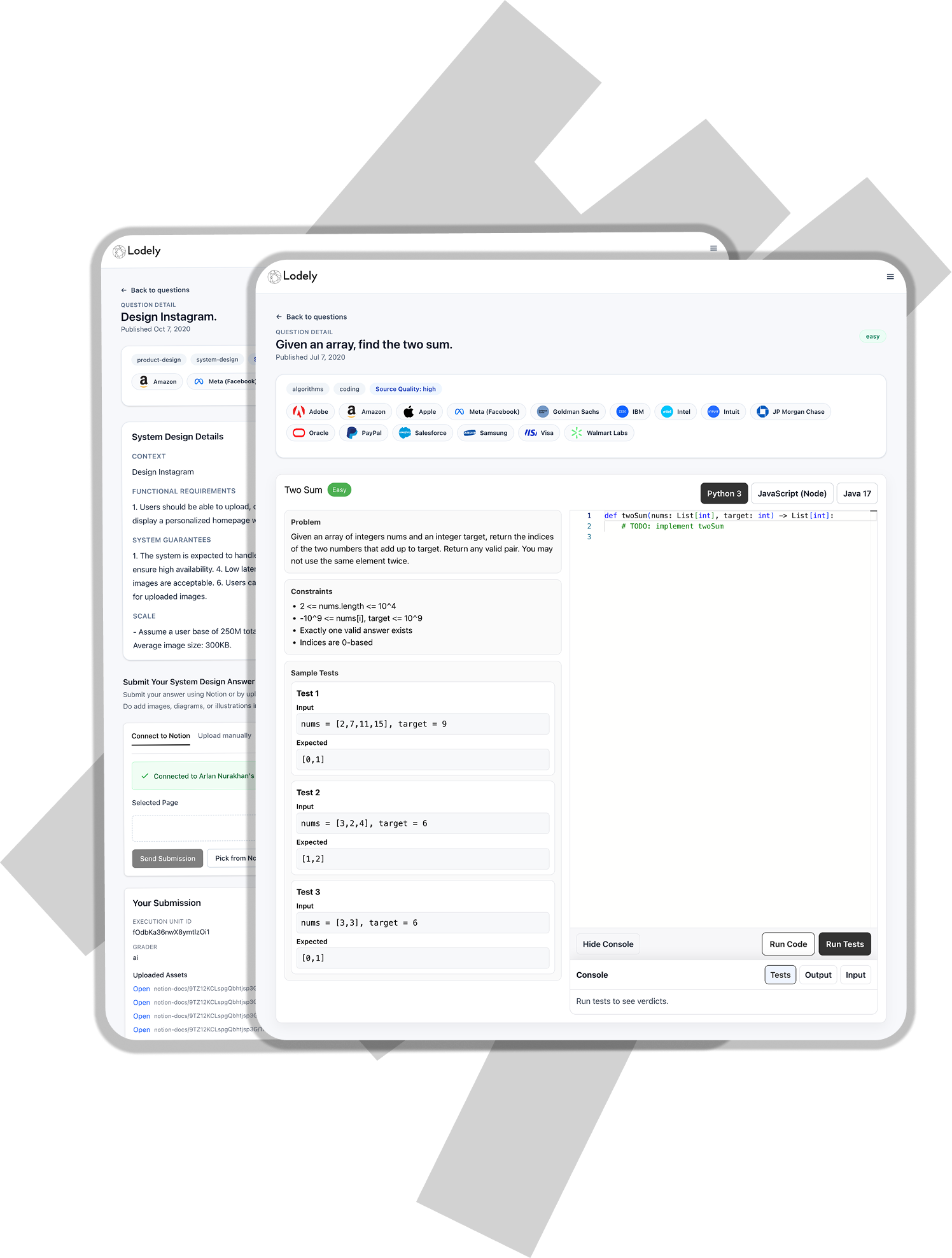
Plan four to six weeks, and add time if you need more practice debugging systems or working with machine-learning systems. Lodely lets you practice questions associated with Perplexity while keeping your coding, system-design, and behavioral preparation together.

Perplexity AI Interview Breakdown
Tell Me About Yourself
Type: Behavioral introduction
The Trick: Write a short technical story that connects two relevant experiences to the job and ends with what you want to do next. Do not read your resume.
What It Measures: Communication, motivation, the relevance of the information you provide, and how well your background matches the role.
Deduplication
Type: Coding and data-quality design.
To choose an algorithm, first define what counts as a "duplicate." Choosing exact identity, normalized content, or semantic similarity produces different tradeoffs in correctness and cost.
What it tests: Abstraction, edge cases, performance, and the ability to turn a vague product requirement into measurable behavior.
Design a Real-Time Knowledge Graph Platform
System design
The trick: Define state freshness, consistency, and related requirements before choosing databases, streaming technologies, or both. Cover ingestion, entity resolution, relationship updates, storage, and query serving.
What It Tests: Data modeling, distributed systems, update ordering, scalability, observability, and query design from a product perspective.
The remaining seven prompts cover the rest of the series. Dependency Validation tests graph modeling and cycles. Search Analytics Dashboard tests event design, aggregation, APIs, and metrics. Real-Time Web Scraping tests scheduling, politeness, parsing, change detection, and recovery. Multi-Source Search Aggregation tests normalization, ranking, timeouts, and partial results. Query Understanding tests intent, rewriting, and evaluation. Personalization Engine tests feedback signals, freshness, privacy, and cold starts. TODO List tests incremental requirements, dependencies, and maintainable code.
What Comes After The Interview
Perplexity generally responds to applicants who are a fit within two weeks. Candidates should receive an offer or next-step update within seven days of the final interview. If you receive an offer, compare base salary, equity value, vesting, and level scope. Because packages are equity-heavy, the assumptions used to value the grant matter.
Candidate Experiences
One recent L4 software engineer described a phone screen combining repairs to existing code with a matrix-path problem. During onsite coding, the candidate used application logs to diagnose failures and correct the implementation. The system-design discussion covered services, data flow, storage, and user features for a personal-finance aggregation product. Practice moving from diagnosis to implementation while keeping the product requirement in view.
Conclusion
Perplexity values careful execution, strong abstractions, and practical judgment across search and AI systems. Work through the ten selected Perplexity AI questions on Lodely to identify gaps in your preparation before the assessment.
✉️ Get free faang interview cheat sheet and interview tips weekly
✉️ Get free faang interview cheat sheet and interview tips weekly

