


5 Jane Street Interview Questions to Expect in 2026

Jane Street's software-engineering process begins with collaborative coding and can continue through a full day of in-office problem solving. You will write real code, explain your choices, consider edge cases, and pivot as the interviewer extends the problem. Knowledge of finance and OCaml is not required.
What to Expect: Jane Street Interview Process
According to Jane Street's official software engineering interview guide, the process begins with a technical Zoom interview and continues with final interviews in the office. The final round usually consists of a series of coding problems, although the format can vary. A person reviews each application, and Jane Street says it responds in about a week.
The interview is collaborative. Clarify the prompt, choose a language you know well, and write readable code that you can change during follow-ups. Interviewers may also note how you respond to feedback. Some loops may include trading-systems questions, so ask your recruiter whether yours includes design.
How to Prepare and Pass Jane Street Interviews
If your foundations are current, give yourself four to six weeks. If you need to rebuild them, plan eight to twelve weeks. Spend the first half on arrays, strings, stacks, queues, maps, parsing, state machines, and mutable data structures. Spend the second half on timed sessions in which you discuss and test your work aloud.
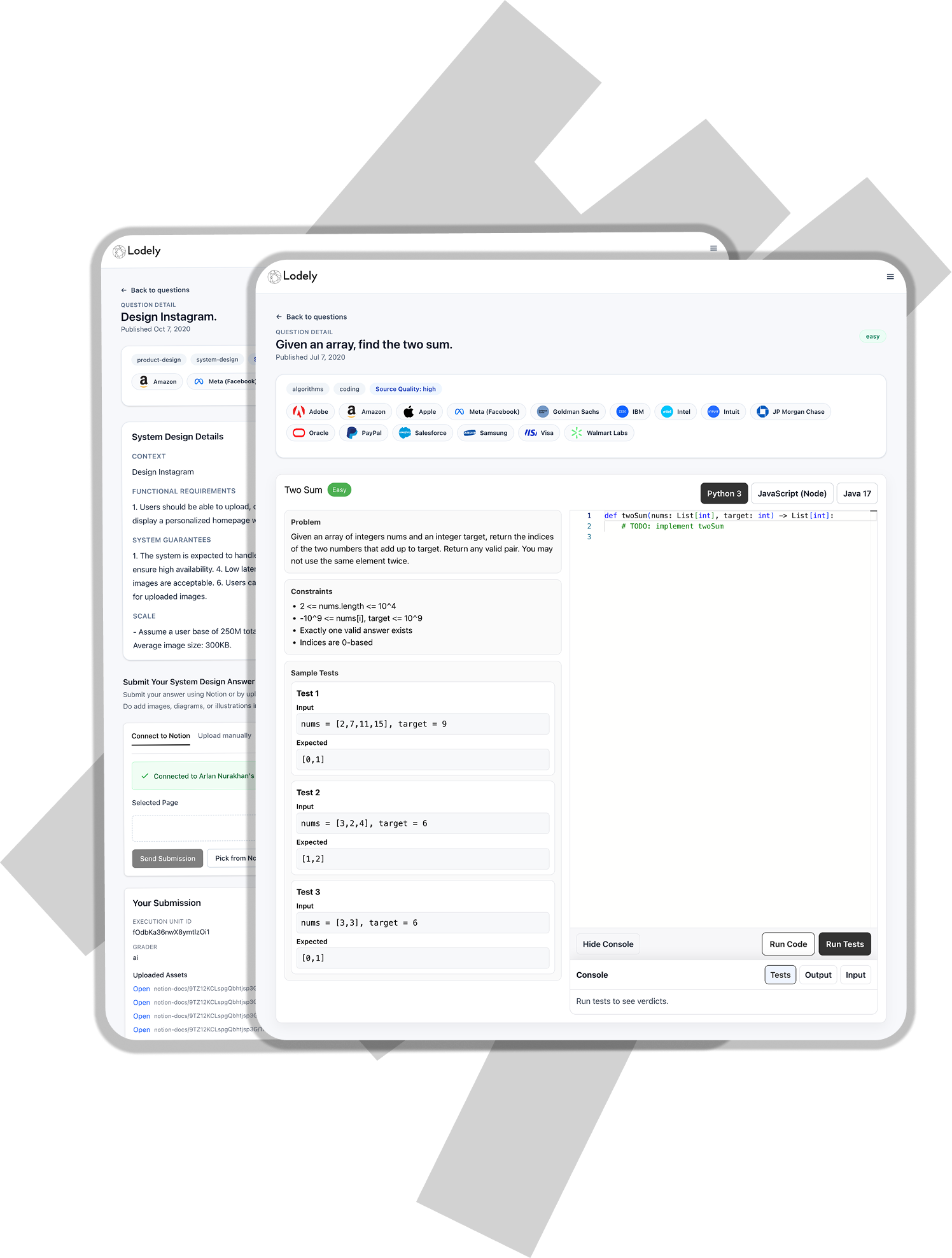
Practice modifying a working solution without losing correctness. Jane Street often adds constraints after the first implementation. Use Lodely for company-focused coding prompts, system-design questions, and behavioral practice, then read a detailed editorial after each attempt.

Jane Street Interview Breakdown
Cold Folding
Type: Stateful sequence simulation. The Trick: Define the direction and state of each fold before coding; ambiguous index numbering can cause silent bugs. What It Tests: Modeling, iteration, and edge-case testing.
Ring Buffer
Type: Circular data-structure implementation. The Trick: Keep the head, tail, size, full, and empty rules consistent when the buffer wraps. What It Tests: Mutable state, API design, and readable invariants.
Stack-Based Interpreter
Type: Parsing and stack evaluation. The Trick: Separate token parsing from execution so an operation error does not corrupt program state. What It Tests: Decomposition, error handling, and extensible code.
Two final questions broaden the practice set. Exchange System asks you to model operations and state transitions in a simplified market. Arithmetic Evaluator covers parsing, operator precedence, and invalid-input detection. Explain your solutions to all five questions aloud because communication is part of the evaluation.
What Comes After The Interview
Ask when the interview team will debrief and whether another conversation will be needed. If you receive an offer, compare base pay, bonuses, equity, and sign-on packages separately. In reported data for U.S. applicants as of September 18, 2026, the median software-engineer package is $450,000, though level-specific medians can vary across crowdsourced submissions.
Candidate Experiences
One recent London software-engineering candidate described an online assessment, a technical screen, and an onsite. The second round used a trade-sorting coding task, while the onsite began with two order-book design discussions covering message flow and data validation across several databases. The candidate was rejected before a planned coding round but found the interviewers helpful during technical discussion. Prepare for both implementation and systems reasoning because some loops include more than coding.
Conclusion
Jane Street values clear code, team collaboration, and the ability to adapt a solution quickly. Practice the five selected questions on Lodely as full interviews: clarify, implement, test, and explain.
✉️ Get free faang interview cheat sheet and interview tips weekly
✉️ Get free faang interview cheat sheet and interview tips weekly
