


Two Sigma Interview Questions: 6 from Real Interviews

Two Sigma's software-engineering process includes remote technical interviews that may cover a timed coding challenge, live coding, a detailed résumé discussion, and behavioral evaluation, followed later by team matching. You need strong algorithm skills and the ability to justify your engineering decisions.
What to Expect: Two Sigma Interview Process
Two Sigma's official interview page says interviews take place by video conference and a recruiting coordinator manages the schedule. A candidate in the 2025 general hiring process reported that, after passing an online screening, they received a two-hour video block: one hour for coding and one for detailed résumé analysis and behavioral questions.
The report describes a change from previous all-day loops. Follow the schedule your recruiter provides. Ask whether later rounds include system design, coding, or team matching, and confirm the language and environment before the first technical round.
How to Prepare and Pass Two Sigma Interviews
Plan five to seven weeks if your coding foundation is solid, or eight to twelve weeks if you need to rebuild it. Study graphs, arrays, strings, heaps, maps, interval thinking, parsing, and stateful structures. Practice turning algorithms into complete, testable implementations.
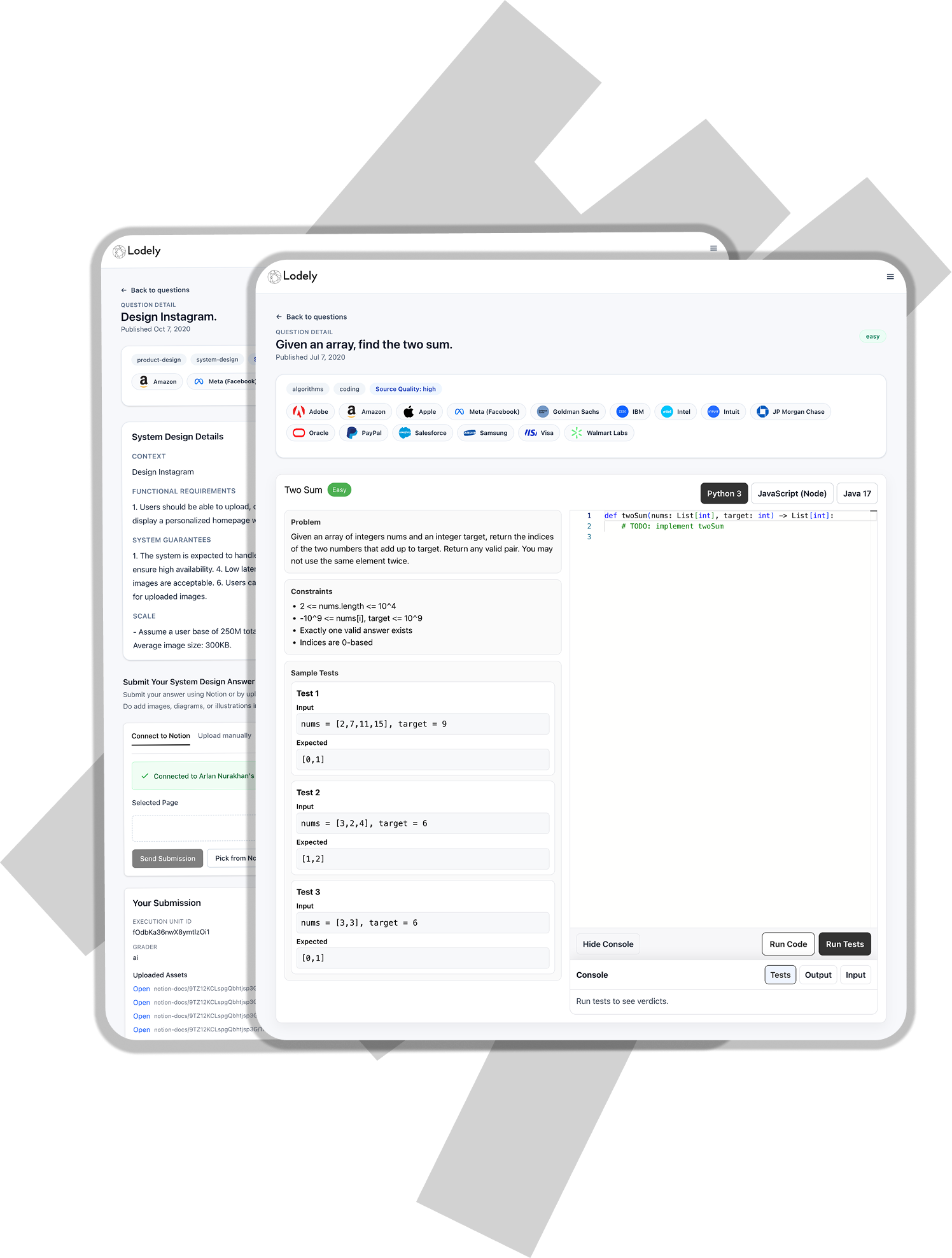
Prepare to discuss two projects in depth. Cover the architecture, data volume, your specific contribution, rejected alternatives, failure modes, and what you measured after launch. Use Lodely to connect Two Sigma coding prompts with the system-design and behavioral question, then use the editorials to find weaknesses in your reasoning instead of memorizing answers.

Two Sigma Interview Breakdown
Orderbook
Type: Stateful data-structure implementation. The Trick: Specify order and update rules before choosing container types. What It Tests: State-transition correctness, performance, and domain modeling.
Friend Chain
Type: Graph traversal. The Trick: Track visited nodes and clarify whether you need to find existence, length, or the path itself. What It Tests: Graphs, complexity, and requirements.
Group Transaction
Type: Balance aggregation. The Trick: Maintain a well-defined invariant for each participant when handling transfers. What It Tests: Mapping, arithmetic correctness, and edge cases.
The final three are harder challenges. Malloc requires reasoning about allocation, reuse, and fragmentation. Sub-array requires analyzing contiguous ranges under a constraint. Text Editor asks you to choose data structures for fast text editing and navigation.
What Comes After The Interview
Ask whether the next step involves further technical evaluation or team matching. If you receive an offer, compare the level, base, recurring bonus, sign-on, and any deferred components. As of September 18, 2026, the latest U.S. level data shows median compensation ranging from $247,000 at L1 to $730,000 at L6. The page also shows a $365,000 aggregate median.
Candidate Experiences
One recent QSE candidate in general hiring applied through a referral and passed the online assessment. The recruiter scheduled a two-hour video interview split evenly between coding and a detailed discussion of the résumé and behavioral questions. The candidate said this format differed from older reports of longer coding and behavioral blocks. Follow the schedule you receive, and explain your projects as rigorously as your code.
Conclusion
Two Sigma rewards complete implementations, disciplined thinking, and depth on your own engineering work. Use Lodely to work through the six selected questions and rehearse the reasoning behind your strongest projects.
✉️ Get free faang interview cheat sheet and interview tips weekly
✉️ Get free faang interview cheat sheet and interview tips weekly


