


Databricks Interview Questions in 2026: 7 Examples

Databricks gives candidates unusually detailed software-engineering interview guidance. For backend roles, the process includes a 30-minute recruiter screen and a one-hour technical screen, followed by a panel of four to six one-hour interviews. Internal team matching and hiring-committee reviews sit between candidate-facing stages.
The seven questions cover architecture, implementation, behavioral judgment, networking, APIs, and data pipelines. That range reflects the company's focus on production code and distributed-systems judgment.
What to Expect: Databricks Interview Process
The official 2025 engineering guide describes the common engineering interview modules: coding, algorithms, system programming, architecture, a deep dive, and a cross-functional or hiring-manager discussion. The team you meet depends on the role.
Coding interviews may assess whether you can write functional, clean, organized code; test it; handle edge cases; choose data structures; and explain Big-O notation. Architecture interviews may cover APIs, networking, concurrency, caching, replication, consistency, and failure handling. Behavioral interviews may cover your most important projects, collaboration, important decisions, and leadership at the level you're interviewing for.
How to Prepare and Pass Databricks Interviews
Train implementation and explanation together. Write code, state its invariants, add tests for failures, and compare alternatives. Show the interviewer both your reasoning and your answer.
Review systems from storage upward. Cover request flows, partitioning, replication, consistency, backpressure, caching, and recovery. Be ready to connect an API to the behavior of the storage and compute systems beneath it.
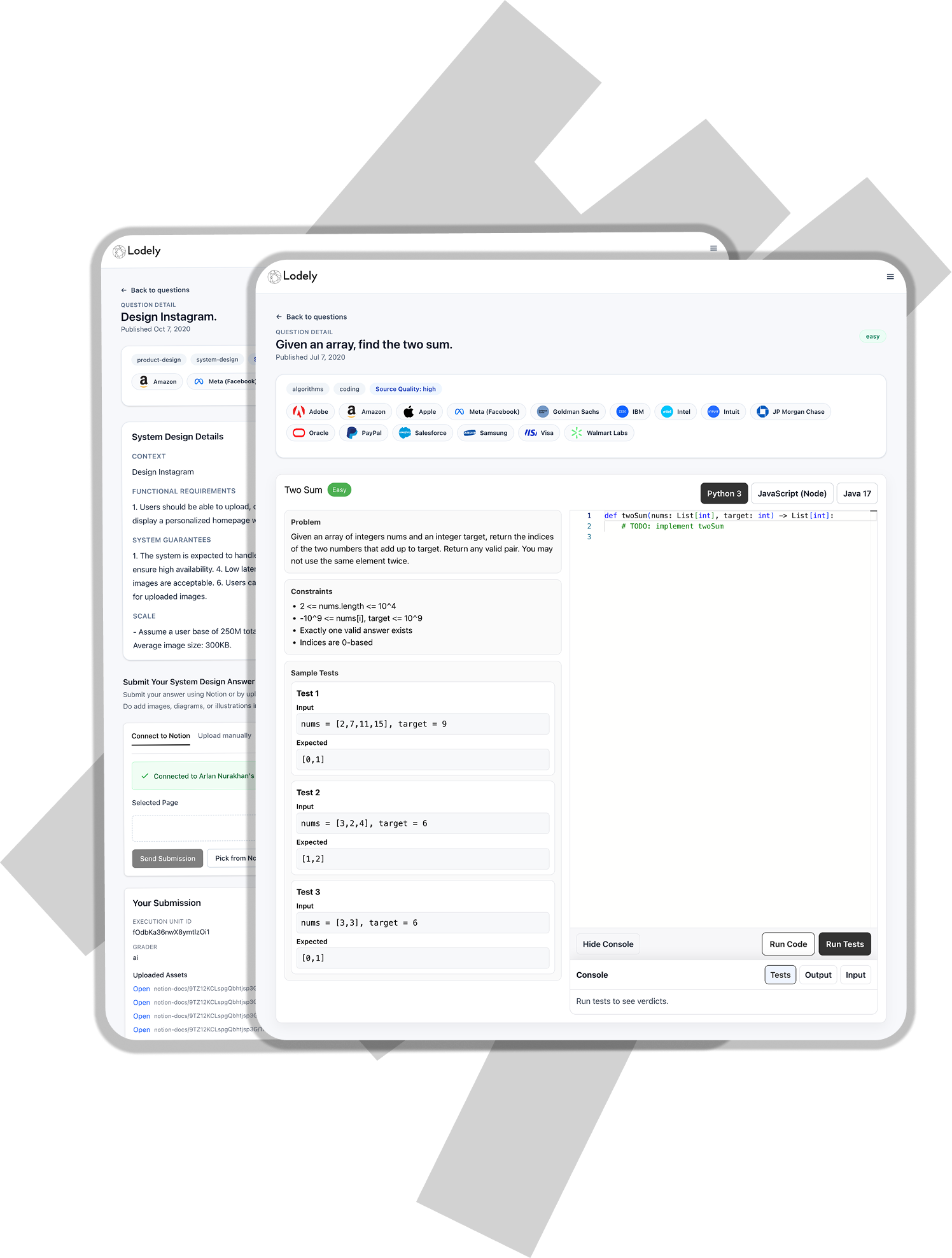
Plan four to six focused weeks. Use eight to twelve weeks if you need more work on concurrency or distributed systems. Practice Databricks questions on Lodely with timed coding, system-design walkthroughs, and behavioral rehearsal.

Databricks Interview Breakdown
Design a Web Crawler
Type: Distributed-system design. The Trick: Define the scope before scaling. Address URL normalization, duplicate suppression, politeness, scheduling, failures, and content freshness before adding workers. What It Tests: Requirements discovery, partitioning, queues, storage, reliability, and operational tradeoffs.
Modified TicTacToe
Type: Object-oriented implementation. The Trick: Model changing rules without special cases. Make state transitions explicit and keep winning-condition tests easy to write. What It Tests: Abstraction, correctness, extensibility, and communication.
Tell Me About the Accomplishment You Are Most Proud Of
Type: Behavioral deep dive. The Trick: Separate your contribution from the team's work. Explain the constraints, your decision, the measurable result, and what you would change now. What It Tests: Ownership, depth, impact, reflection, and leadership appropriate to the role.
The set includes four more questions. Interval Range covers boundary cases and efficient management of overlapping ranges. CIDR covers bit operations and network ranges. Customer Revenue Management API covers data modeling, interface design, and update behavior. Design a document processing pipeline combines document ingestion, durable state, retries, parallel execution, observability, and backpressure.
What Comes After The Interview
Team matching, a hiring-committee review, reference checks, and an offer can all follow the interview. Ask which internal review comes next and when to expect an update. If you receive an offer, compare base salary, bonus, equity, vesting, and level scope. Equity makes up more of the package at senior levels.
Candidate Experiences
One recent U.S. software-engineering candidate completed a phone interview, a recruiter interview, and four final rounds: two coding interviews, one system-design interview, and one behavioral interview. The process moved quickly, and the company rejected the candidate a couple of days later. Prepare for each format individually. Strong performance in one format does not compensate for an unpracticed round.
Conclusion
Databricks values production-quality code, thoughtful architecture choices, and technically detailed project stories. Practice these seven Databricks questions on Lodely so every part of the panel gets deliberate preparation.
✉️ Get free faang interview cheat sheet and interview tips weekly
✉️ Get free faang interview cheat sheet and interview tips weekly


