


Citadel Interview Questions in 2026: 10 Examples

Citadel interviews test algorithms, problem solving, communication, and technical judgment under time pressure. The company builds systems for research, trading, risk, funding, and settlement, so interviewers also care about commercial and operational outcomes.
Campus and experienced hiring follow different paths. Campus recruiting has a published process, while experienced candidates are matched to roles and teams by seniority and background.
What to Expect: Citadel Interview Process
Citadel's published campus engineering process starts with a 45-minute video interview covering coding, data structures, algorithms, problem solving, and behavioral questions. The second round normally has three 45-minute interviews. Interested teams can then invite you to senior-engineer or leadership conversations before final review.
For senior roles, ask the recruiter to define the path. Citadel's current software-engineer posting requires computer science fundamentals, proficiency in Java, C++, or Python, software-design experience, problem-solving and communication skills, and the ability to work without complete specifications.
How to Prepare and Pass Citadel Interviews
If your basic skills are current, plan six to eight weeks, but if timed coding is new to you, you may need more time.
- Optimize after proving correctness. Describe the simple approach, identify the bottleneck, and then improve it. Test an adversarial input before declaring the solution done.
- Know your projects deeply. Prepare architecture, performance limits, rejected alternatives, failures, and your exact contribution. Citadel interviews can focus heavily on past work.
- Link systems to outcomes. For trading cases, explain how latency, throughput, determinism, precision, auditability, and recovery affect the business and operations.
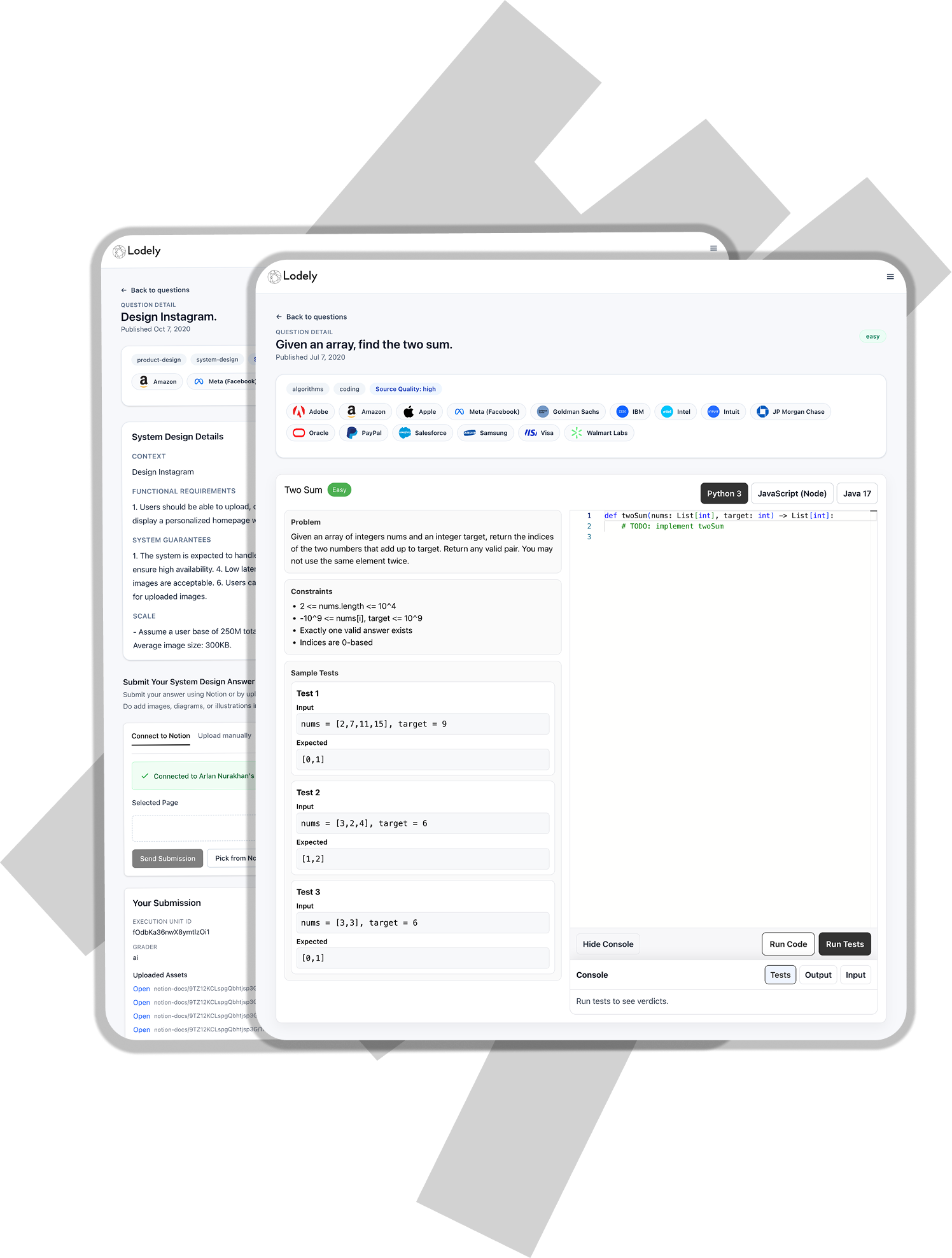
Use Lodely to practice Citadel coding, design, and behavioral questions across the full process.

Citadel Interview Breakdown
Maximize Profit by Buying or Selling One Share Per Day
function maxProfitII(prices)- You are given an integer array prices where prices[i] is the price of a given stock on the ith day.
- On each day, you may decide to buy and/or sell the stock.
- You can only hold at most one share of the stock at any time.
- However, you can buy it then immediately sell it on the same day.
- Find and return the maximum profit you can achieve.
1 <= prices.length <= 3 * 10^40 <= prices[i] <= 10^4
prices = [7,1,5,3,6,4]
7
prices = [1,2,3,4,5]
4
Type: Greedy algorithm and dynamic reasoning. The Trick: Clarify the position constraint and whether inventory can carry across days before deciding which price movements create profit. What It Tests: Converting a financial rule into an invariant, proving the approach, and analyzing complexity.
Aggregate Trades Across Equivalent Symbols
function aggregateTrades(tradeSymbols, tradeValues, equivA, equivB)- Given arrays of trade symbols and their values, along with equivalence pairs indicating that two symbols represent the same company, aggregate the total trade value per company using Union-Find.
- The canonical (representative) symbol for each group is the lexicographically smallest symbol.
- Return a sorted list of strings in the format 'symbol:total'.
1 <= tradeSymbols.length <= 10^5tradeValues[i] >= 00 <= equivA.length <= 10^5
tradeSymbols = ["GOOG","GOOGL","MSFT"], tradeValues = [100,50,200], equivA = ["GOOG"], equivB = ["GOOGL"]
["GOOG:150","MSFT:200"]
tradeSymbols = ["A","B","C","D"], tradeValues = [10,20,30,40], equivA = ["A","C"], equivB = ["B","D"]
["A:30","C:70"]
Type: Graph or disjoint-set normalization and aggregation. The Trick: Equivalent-symbol relationships are transitive, so normalize every connected group before performing the trade calculations. What It Tests: Data modeling, grouping, numerical care, and scalability across trades and equivalence links.
Stock Trading Order Manager
Type: Stateful system design. The Trick: Define order states, idempotent commands, sequencing, and recovery before choosing APIs and storage. What It Tests: Correctness under concurrency, an auditable lifecycle, failure handling, and practical service boundaries.
The final seven questions cover a wider range of topics. Design a Currency Exchange System covers quotes, accuracy, settlement, and stale rates. Two behavioral questions ask about a difficult tradeoff and a decision made with incomplete information; identify the risks and explain how you validated each choice. Low Latency Order Book covers deterministic updates and fast access to price levels. Trading Strategy Optimizer tests constraint modeling. Frequency Cache tests constant-time eviction bookkeeping. Trade Reconciliation System tests how you compare independent records, classify break types, and make safe repairs.
Citadel Software Engineer Compensation
Citadel's current U.S. software-engineer posting lists a base salary of $150,000 to $300,000 plus discretionary incentive compensation. September 2026 reports list average annual total compensation at about $463,000, including roughly $260,000 base and $195,000 bonus. Because bonus accounts for a large share of the package, confirm the target and realized incentive pay before comparing offers.
What Comes After The Interview
Campus candidates should receive next steps within two weeks of the second round. Team interest can lead to multiple leadership interviews, so ask whether you're still in general matching or under review by a specific group. At offer stage, compare scope, location, base, bonus terms, sign-on, and any deferral or repayment conditions.
Candidate Experiences
One recent software-engineering intern candidate described an online assessment, a 45-minute technical interview, and a virtual superday with three 45-minute technical rounds. Leadership calls with interested teams from two related businesses extended the process to about ten and a half weeks. The candidate completed one assessment problem and half of another, advanced, and later received an offer. Keep your project story consistent across repeated interviews.
Conclusion
Citadel rewards fast, correct problem solving backed by clear reasoning. Practice these ten questions on Lodely and make every solution explicit about invariants, performance, and failure recovery.
✉️ Get free faang interview cheat sheet and interview tips weekly
✉️ Get free faang interview cheat sheet and interview tips weekly