


Faire Online Assessment: Questions Breakdown and Prep Guide

Thinking about “Cracking Faire’s Assessment” but not sure what you’re walking into? You’re not alone. Marketplace engineers see a blend of classic DSA, real-world data challenges, and product-flavored scenarios — and the hardest part is training for the right patterns.
If you want to walk into the Faire Online Assessment (OA) confident and ready to execute, this guide is your playbook. No fluff. Real breakdowns. Strategic prep.
When to Expect the OA for Your Role
Faire doesn’t send a one-size-fits-all assessment. The timing and content depend on your role and level.
- New Grad & Intern Positions – Expect an OA quickly after recruiter contact. For internships, it’s often the only technical filter before the final loop.
- Software Engineer (Backend / Full-Stack / Mobile) – Standard practice. Expect a HackerRank or CodeSignal link with 2–3 timed problems focused on data structures and algorithms.
- Data / ML / Search & Relevance – Still an OA, sometimes with a SQL or data manipulation section, plus an algorithmic question tied to ranking, aggregation, or streaming.
- SRE / Infrastructure – OA may include log parsing, concurrency basics, and fault isolation reasoning in addition to coding.
- Senior Engineering Roles – Some candidates move directly to live interviews or a take-home, but many still see a short OA as an initial screen.
- Non-Engineering Roles – Rare. If it happens, it’s more of an analytical/logic assessment.
Action step: As soon as you get a recruiter email, ask: “What’s the expected format and platform for the OA for this role?” You’ll usually get the platform, duration, and number of questions.
Does Your Online Assessment Matter?
Short answer: yes — more than you think.
- It’s the main filter. Your OA performance determines whether you move to the live loop.
- It sets the tone. Interviewers may review your OA code and use it to shape follow-up questions.
- It mirrors the work. Faire’s marketplace reality involves inventory integrity, high-volume events, and correctness under race conditions.
- It signals engineering maturity. They look at clarity, naming, edge-case handling, and complexity — not just passing tests.
Pro Tip: Treat the OA like a first-round interview. Write clean code, annotate tricky parts, and handle edge cases deliberately.
Compiled List of Faire OA Question Types
You’ll see classic categories with marketplace-flavored twists. Practice these:
- Top K Frequent Words — type: Heap / Hash Map (think: top-selling products)
- Merge Intervals — type: Intervals (think: consolidating inventory batches or discount windows)
- Meeting Rooms II — type: Sweep Line / Heap (think: overlapping shipments or dock capacity)
- Sliding Window Maximum — type: Deque / Sliding Window (think: rolling sales/GMV metrics)
- Network Delay Time — type: Graph / Dijkstra (think: shipping routes or dependency latencies)
- Course Schedule — type: Graph / Cycle Detection (think: catalog dependency validation)
- LRU Cache — type: Design / Hash + DLL (think: product page or search results caching)
- Merge k Sorted Lists — type: Divide & Conquer / Heap (think: merging event streams)
- Design Hit Counter — type: Queues / Time-based Sliding Window (think: rate limiting or traffic spikes)
- Seat Reservation Manager — type: Heap / Design (think: reserving inventory SKUs and releasing)
- Kth Largest Element in an Array — type: Quickselect / Heap (think: top sellers and rank thresholds)
- Group Anagrams — type: Hashing / Strings (think: SKU normalization/grouping)
- Two Sum — type: Hash Map (think: bundle/price matching)
- Valid Parentheses — type: Stack (think: validating templated filters or query syntax)
How to Prepare and Pass the Faire Online Assessment
Think of your prep as a training cycle. You’re building reflexes, not memorizing answers.
1. Assess Your Starting Point (Week 1)
List your current strengths (arrays, hashing, strings) and gaps (graphs, intervals, sliding window, design). Use LeetCode Explore or HackerRank skills tests to benchmark. This directs your next 4–6 weeks.
2. Pick a Structured Learning Path (Weeks 2-6)
You have options:
- Self-study on LeetCode/HackerRank
- Best if you’re disciplined and cost-conscious. Build topic tracks and set timers.
- Mock assessments / bootcamps
- Paid platforms simulate CodeSignal/HackerRank with proctoring and analytics.
- Mentor or coach
- A mentor can review your code quality, communication, and pacing under time pressure.
3. Practice With Realistic Problems (Weeks 3-8)
Don’t grind random easies. Build a 40–60 question set anchored to:
- Hash maps, heaps, sliding window, intervals, graphs, and simple design
- Time-based windows and event streams
- Heap-backed top-K and merging tasks Refactor for clarity after each solve, and time yourself.
4. Learn Faire-Specific Patterns
Given Faire’s marketplace domain, expect patterns like:
- Inventory reservation and release, idempotent updates
- Time-windowed metrics (rolling 7/30-day sales), event deduplication
- Intervals for discounts, availability windows, or shipping cutoff times
- Ranking/search basics (top-K, tie-breaking, stable ordering)
- Caching and pagination (LRU, cursor tokens), rate limiting
- Graph reasoning for dependencies or routing
5. Simulate the OA Environment
Use CodeSignal/ HackerRank practice modes. Turn off notifications, and run:
- 90–120 minutes for 2–3 questions
- One medium-heavy algorithm plus one medium implement/design
- Strictly manage time: first pass for correctness, second for cleanup and tests
6. Get Feedback and Iterate
Review with a peer or mentor. Track repeat errors:
- Off-by-one, edge inputs (empty, single element, large N)
- Poor asymptotics (missed heap or deque optimization)
- Messy invariants (state tracking for reservations/windows)
Faire Interview Question Breakdown
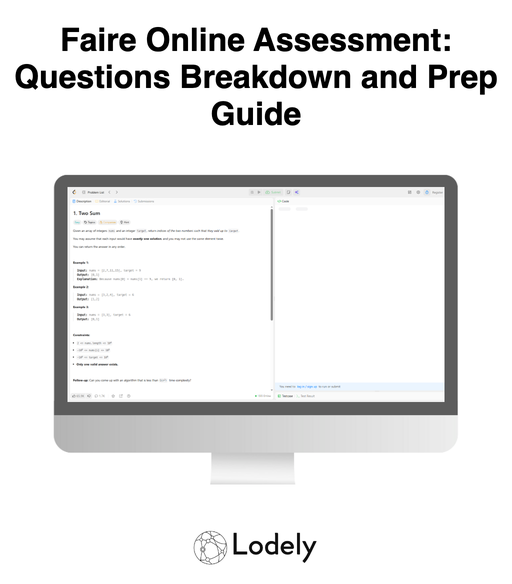
Here are featured sample problems inspired by the OA patterns above. Master these and you’ll cover most of the ground Faire cares about.
1. Top-K Frequent Products in Orders
- Type: Heap / Hash Map
- Prompt: Given a stream or list of product IDs representing orders, return the top K most frequently ordered products. If frequencies tie, sort lexicographically by product ID.
- Trick: Count with a hash map and maintain a min-heap of size K, or use bucket sort for linear-ish performance.
- What It Tests: Frequency counting at scale, heap fluency, deterministic tie-breaking, and output formatting.
2. Inventory Reservation with Expirations
- Type: Design / Heap / Hash Map
- Prompt: Design a class to reserve and release inventory SKUs with an expiration TTL (if not confirmed, reservations auto-expire). Support reserve(sku), confirm(sku), release(sku), and sweep(now) to clear expirations.
- Trick: Track active reservations with a hash map and a min-heap keyed by expiration time; ensure idempotency and handle duplicate calls gracefully.
- What It Tests: State management, time-based data structures, correctness under race-like sequences, and API design clarity.
3. Merge Overlapping Discount Windows
- Type: Intervals / Sorting
- Prompt: Given a list of [start, end] discount windows for a product, merge overlaps and return the minimal set of non-overlapping windows.
- Trick: Sort by start time, sweep and merge greedily; watch adjacent boundaries and inclusive/exclusive semantics.
- What It Tests: Intervals intuition, sorting, and careful boundary handling.
4. Shipping Routes Shortest Path with Blackouts
- Type: Graph / Dijkstra
- Prompt: Given a directed graph of shipping routes with weights (cost or time), compute shortest paths from a source. Some edges may be temporarily unavailable (blackouts).
- Trick: Use a priority queue; skip blacked-out edges on-the-fly. Don’t use BFS for weighted graphs.
- What It Tests: Graph modeling, priority queues, robustness to disconnected nodes and dynamic constraints.
5. Rolling 7-Day GMV by Timestamped Orders
- Type: Sliding Window / Deque
- Prompt: Given time-ordered (timestamp, amount) pairs, compute the rolling 7-day sum at each event.
- Trick: Use a deque of events; pop from the front while out of window. Keep a running sum to avoid recomputing.
- What It Tests: Time-window reasoning, amortized efficiency, and precision around inclusive boundaries.
What Comes After the Online Assessment

Passing the Faire OA isn’t the finish line — it’s your entry ticket. After you clear it, the focus shifts from “can you code” to “can you design, communicate, and deliver within marketplace constraints.”
1. Recruiter Debrief & Scheduling
Expect an email within a few days. You’ll get high-level feedback and the structure of next rounds. Ask about topic focus (algorithms vs. design vs. product sense) and any prep tips.
2. Live Technical Interviews
Paired with Faire engineers on Zoom or a collaborative IDE. Expect:
- Algorithms & Data Structures (interactive variants of OA themes)
- Debugging or refactoring an existing function
- Clear, step-by-step communication of trade-offs
Pro tip: Revisit your OA solutions — interviewers sometimes ask you to walk through them.
3. System Design / Architecture Round
For mid-level and senior roles, a 45–60 minute design session. You might design:
- A lightweight inventory reservation service
- A top-K ranking endpoint for trending products
- A time-windowed metrics pipeline with idempotent processing
They’re evaluating decomposition, consistency vs. availability trade-offs, scaling, failure modes, and communication.
4. Behavioral & Values Interviews
Expect questions around execution, ownership, and collaboration:
- “Tell me about a time you shipped under ambiguity.”
- “Describe a disagreement and how you resolved it.”
Use the STAR method and quantify impact.
5. Final Round / Onsite Loop
A series of back-to-back sessions:
- Another coding or bug-fixing round
- A deeper design session
- Cross-functional conversations (e.g., product or data partners)
Manage energy and context switching across multiple hours.
6. Offer & Negotiation
If all goes well, you’ll get a verbal update followed by a written offer. Compensation typically includes base, bonus, and equity. Research market ranges and be ready to negotiate thoughtfully.
Conclusion
You don’t need to guess. You need to train the right patterns. The Faire OA is challenging but predictable. If you:
- Identify weak areas early,
- Practice marketplace-style problems under a timer,
- Write clear, robust code with strong edge-case coverage,
you’ll turn the OA from a hurdle into momentum. Focus on fundamentals, simulate the real environment, and carry that signal into design and behavioral rounds.
For more practical insights and prep strategies, explore the Lodely Blog or start from Lodely’s homepage to find guides and career resources tailored to software engineers.
✉️ Get free faang interview cheat sheet and interview tips weekly
✉️ Get free faang interview cheat sheet and interview tips weekly


