Grammarly Interview Questions: 6 from Real Interviews

Grammarly's software interviews feature coding, design, project analysis, and behavioral assessment. The company's guide begins with a recruiter conversation and may include a hiring-manager interview before the technical loop. The exact technical format varies by role, so confirm the session mix with the recruiter.
Grammarly is a product and part of a changing company. Grammarly's official company history says the company acquired Coda and Superhuman Mail in 2025 and became Superhuman, with Grammarly as its primary product. Understand both the writing assistant and the broader AI productivity suite.
What to Expect: Grammarly Interview Process
Grammarly's official interview guide says the recruiter covers the role, your qualifications, and your interest. A hiring manager may then ask about past work, your work style, and your impact. Technical interviews depend on the role and may include programming languages, algorithms, data structures, and systems design.
Expect follow-up questions about how you turn ambiguity into a finished implementation, compare approaches, handle edge cases, and improve an initial design. For machine-learning roles, discuss model evaluation, data quality, experimentation, and product safety.
How to Prepare and Pass Grammarly Interviews
Plan four to six weeks if your fundamentals are strong. Plan eight to twelve weeks if you need to rebuild coding fluency and distributed-systems depth.
- Make string work dependable. Practice normalization, indexing, adjacency handling, and parsing. Handle boundaries carefully.
- Design for real product constraints. Review rate limits, caching, queues, persistence, observability, and graceful degradation.
- Prepare one deep project story. Explain the goal, architecture, your decisions, the impact of your work, and what you would change.
- Connect to the product. Discuss product quality, latency, privacy, and user trust in an AI-assisted writing experience.
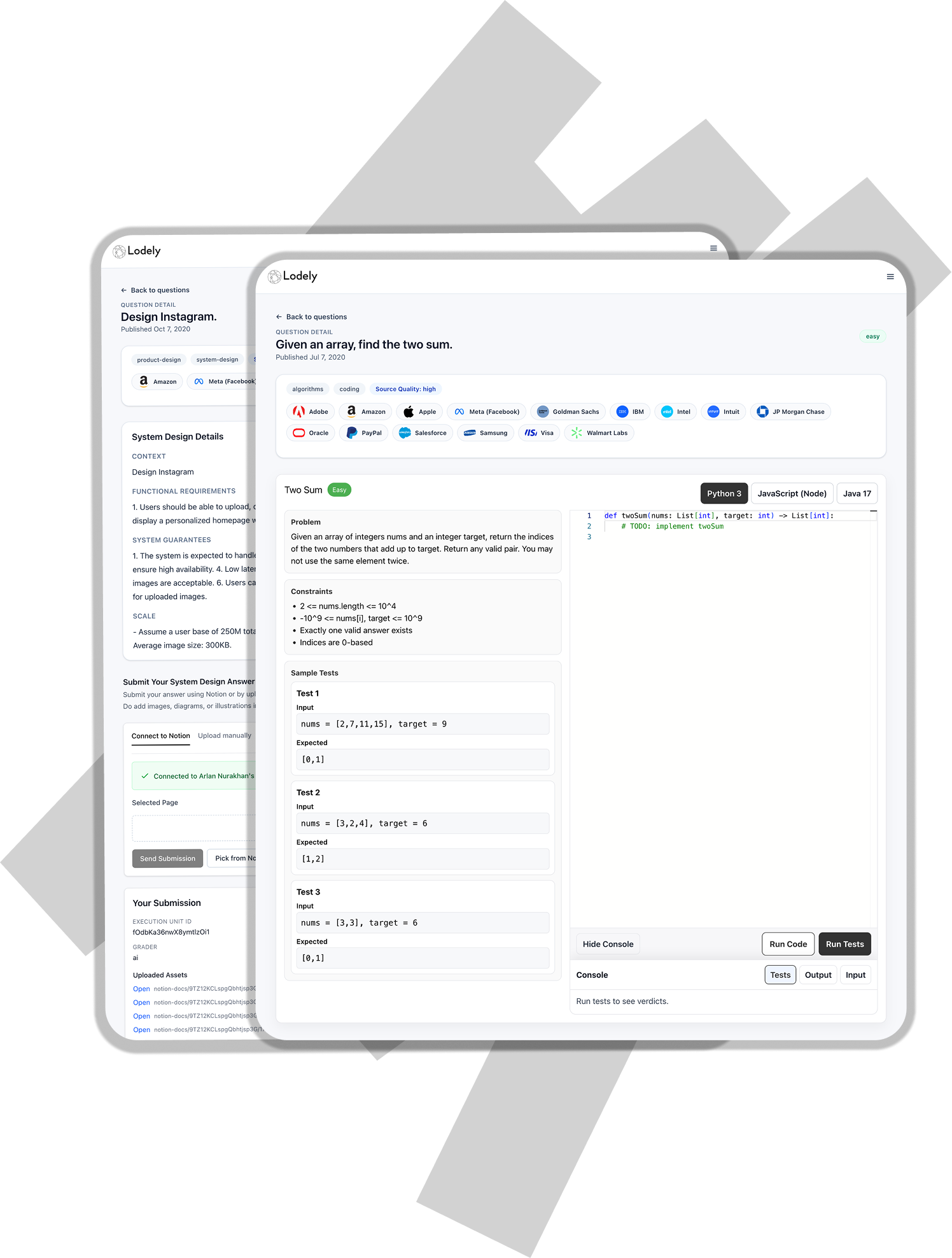
Lodely lets you practice Grammarly-specific coding, design, machine-learning, and behavioral prompts in one plan, which matches the breadth of the loop.

Grammarly Interview Breakdown
Remove Adjacency
Type: Sequence-processing or string-processing implementation. The Trick: Define what counts as adjacent and whether a removal can create a new pair. Then choose a state representation that handles repeated updates cleanly. What It Tests: Requirement clarification, linear scans, edge cases, and whether your output remains unchanged.
Rate Limiter
Type: Stateful coding and design. The Trick: Before coding, define the policy, time period, identity key, concurrency model, and storage boundary. Weak designs often fail at boundary cases. What It Tests: Data structures, time, thread safety, distributed-systems trade-offs, and test design.
Why Did You Leave Your Last Role?
Type: Behavioral and motivation. The Trick: Be factual, concise, and forward-looking. Explain what you've learned and why this job is a good next step without criticizing people at your current employer. What It Tests: Judgment, self-awareness, communication, and congruence.
The page includes three more prompts. Minimum Time Difference covers parsing, ordering, and comparing times. MLE Question List covers evaluation, deployment, and monitoring. Subscription and Subject Class covers object relationships, event delivery, lifecycle management, and clean interfaces.
What Comes After The Interview
Confirm the date on the offer and whether you need references or another call. If you receive an offer, compare the assigned level and every component. The 2026 U.S. median salaries are $160,000 at L1, $254,000 at L2, $276,000 at L3, and $409,000 at L4. Equity makes up a much larger share of the package at senior levels.
Candidate Experiences
One recent software candidate described two technical interviews with sharply different goals. The design round asked for a collaborative spreadsheet with an AI chat interface, including edits such as inserting rows and updating cells. A separate 45-minute coding round focused on merging data correctly under time pressure. Prepare to switch from broad product architecture to precise implementation without losing clarity.
Conclusion
Grammarly rewards correct implementation, sound system-level reasoning, and evidence that the product works. Practice the six selected Grammarly questions on Lodely so you can switch among the question types under realistic time pressure.
✉️ Get free faang interview cheat sheet and interview tips weekly
✉️ Get free faang interview cheat sheet and interview tips weekly