


Parafin Online Assessment: Questions Breakdown and Prep Guide

Trying to figure out how to prep for Parafin’s OA without guessing? You’re in the right place. Parafin builds embedded financing and payout products for platforms — which means the coding assessment leans on core data structures and algorithms, with a healthy dose of fintech-flavored edge cases like idempotency, precision with money, and windowed aggregates.
This guide distills what to expect, how to practice, and the exact problem patterns to train.
When to Expect the OA for Your Role
Parafin tailors the OA to your role and level, but the rhythm is fairly consistent:
- New Grad & Intern — Expect an OA invite shortly after recruiter contact. For many new grad/intern tracks, the OA is the primary technical filter before onsite.
- Software Engineer (Backend / Full-Stack / Platform) — Standard OA via HackerRank or CodeSignal. Expect 2–3 questions in ~90 minutes, DS&A-heavy with backend-flavored scenarios (APIs, logs, event streams).
- Data / Analytics / ML Engineering — Often similar platforms but with a twist toward data parsing, windowed computations, or ETL-style transformations.
- Risk / Underwriting / Infrastructure — May include domain-tinged tasks (e.g., de-duplication, rate limiting, ledger reconciliation, numeric precision).
- Senior & Staff — Sometimes the OA is replaced by live coding or design, but many candidates still see an OA for calibration.
Action step: Ask your recruiter which platform and how many questions you’ll get. They’ll usually share duration, language options, and whether partial credit/test cases are used for scoring.
Does Your Online Assessment Matter?
Yes — it’s the gateway.
- It’s the main screen. Strong resumes get you the invite; OA performance gets you the loop.
- Your code travels. Interviewers may review your OA solutions to shape follow-up questions.
- Fintech edge cases matter. Expect tests around idempotency, time windows, and BigDecimal-like handling of money.
- Clarity is a signal. Clean naming, small functions, defensive coding, and tests hint at how you ship production code.
Pro tip: Treat your OA as a first interview. Aim for correct, readable, and robust — in that order.
Compiled List of Parafin OA Question Types
These mirror the patterns Parafin engineers commonly care about. Practice them:
- Maximum Average Subarray I — type: Sliding Window / Array (rolling revenue windows)
- Find the Difference of Two Arrays — type: Hashing / Set Ops (ledger reconciliation)
- Logger Rate Limiter — type: HashMap / Time Windows (idempotency and de-duplication)
- Merge Intervals — type: Intervals / Sorting (payout freeze windows and scheduling)
- Add Strings — type: Big Integer / String Math (currency-safe arithmetic without floating point)
- Network Delay Time — type: Graph / Dijkstra (service dependency and latency)
- Top K Frequent Elements — type: Heap / Counting (top merchants by activity/revenue)
- Course Schedule — type: Graph / Cycle Detection (pipeline dependency checks)
- Find Median from Data Stream — type: Heaps (live metrics dashboards)
- Longest Substring with At Most K Distinct Characters — type: Sliding Window (bounded diversity in streams)
- Accounts Merge — type: Union-Find / Graph (entity resolution across partner data)
- Valid Parentheses — type: Stack (input validation / parsers)
- Design Hit Counter — type: Queue / Sliding Window (rate-limiting and throughput)
- K Closest Points to Origin — type: Heap / Selection (nearest entities / ranking under constraints)
How to Prepare and Pass the Parafin Online Assessment
Think training plan, not problem roulette. Build reflexes around a small set of patterns, and practice under time.
1. Assess Your Starting Point (Week 1)
- Take 2–3 timed problems across arrays, hashing, and graphs.
- Identify weak areas (graphs? intervals? heaps?).
- Note the “gotchas” you miss: off-by-one, empty inputs, overflow, duplicate handling.
2. Pick a Structured Learning Path (Weeks 2-6)
- Self-study on LeetCode/HackerRank
- Low-cost and flexible. Use Explore cards and curated lists for consistency.
- Mock assessments
- Simulate Parafin-style OAs with timed, proctored sessions and hidden tests.
- Mentor or coach
- A software engineer career coach can review code structure, pacing, and communication.
3. Practice With Realistic Problems (Weeks 3-8)
- Build a list of 40–60 problems that match Parafin’s patterns: sliding windows, heaps, hashing, intervals, graphs, and simple design (LRU/HitCounter).
- For each problem:
- Solve in 20–30 minutes.
- Refactor for readability.
- Add tests for edge cases (empty, single element, duplicates, overflow, negative/zero).
4. Learn Parafin-Specific Patterns
- Money-safe arithmetic
- Avoid floats; think integer cents or BigDecimal equivalents. Watch rounding modes.
- Idempotent, event-driven systems
- De-dup by key+version, ensure at-least-once vs. exactly-once semantics in code.
- Windowed aggregates
- Rolling 7/30-day metrics with sliding windows or two heaps.
- Data reconciliation
- Hash-based matching, handling missing/extra entries, stable sorting for tie-breakers.
- Intervals and schedules
- Merge/insert intervals for payout blocks, holidays, or freeze windows.
5. Simulate the OA Environment
- Use the same language and editor you’ll use on the platform.
- Run 2–3 full mocks: 2–3 problems in ~90 minutes, no breaks, no internet beyond the IDE.
- Practice reading the prompt carefully, outlining a plan, then coding with test scaffolding.
6. Get Feedback and Iterate
- Re-solve the same problems a week later for speed and cleanliness.
- Share solutions with peers or mentors; request feedback on naming, decomposition, and edge cases.
- Track repeat errors and add “checklists” (null/empty, bounds, duplicates, overflow).
Parafin Interview Question Breakdown
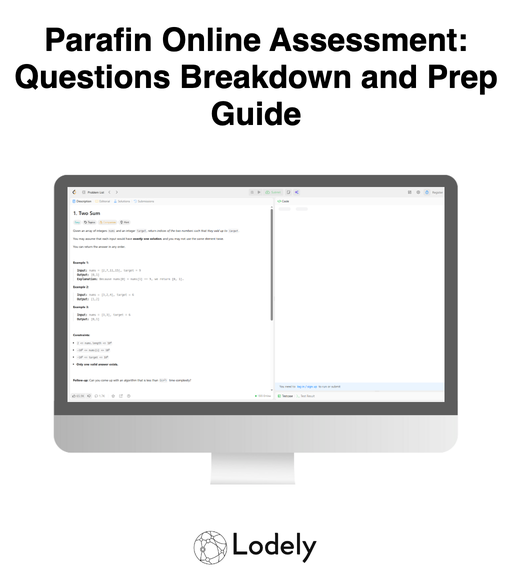
Below are sample problems reflecting common OA patterns with Parafin-appropriate twists.
1. Rolling Revenue Window (Max Average/Subarray)
- Type: Sliding Window / Array
- Prompt: Given a merchant’s daily revenue array and a window size k, compute the maximum average (or sum) over any contiguous k-day period.
- Trick: Maintain a running window sum in O(n). Handle negatives, k > n, and large values safely.
- What It Tests: Time efficiency, boundary cases, numerical stability, and sliding window fluency.
2. Ledger Reconciliation Between Two Sources
- Type: Hashing / Set Operations
- Prompt: Given two lists of transaction records (ids, amounts in cents), return missing, extra, and mismatched entries between the lists.
- Trick: Normalize money to integers (cents). Use maps keyed by id; handle duplicates and stable ordering for output.
- What It Tests: Hash maps, data normalization, and precise equality checks with money.
3. Idempotent Event Processor (De-dup in a Time Window)
- Type: HashMap / Queue / Sliding Window
- Prompt: Build a function that accepts events (key, timestamp, version) and emits an event only if it’s not a duplicate or an older version within a rolling window.
- Trick: Track last-seen version per key and prune old timestamps with a queue. Think memory bounds and cleanup.
- What It Tests: State management, correctness under streaming input, and reasoning about idempotency.
4. Merge Payout Freeze Windows
- Type: Intervals / Sorting
- Prompt: Given a list of payout freeze windows [start, end], merge overlapping intervals and insert a new freeze window.
- Trick: Sort by start, merge in one pass, handle touch boundaries (end == next start).
- What It Tests: Interval reasoning, off-by-one, and clean implementation.
5. Service Latency Propagation (Network Delay)
- Type: Graph / Dijkstra
- Prompt: Given a directed graph of services and call latencies, return time to propagate a signal from a source to all nodes (or detect unreachable).
- Trick: Use a priority queue; avoid BFS on weighted graphs. Keep visited set; handle disconnected subgraphs.
- What It Tests: Graph fundamentals, priority queues, and robust error handling.
What Comes After the Online Assessment

Passing the OA moves you from “can you code?” to “can you build, communicate, and own outcomes in a fast-moving fintech environment?”
1. Recruiter Debrief & Scheduling
You’ll hear whether you passed, plus a rough outline of the next stages. Ask about interview composition (coding vs. design vs. behavioral), interviewers’ focus areas, and suggested prep.
2. Live Technical Interviews
Expect interactive coding in a shared editor or IDE. You’ll cover:
- Algorithms and data structures (similar patterns to the OA, with deeper probing)
- Debugging a small, buggy function (explain assumptions out loud)
- Reasoning about complexity and trade-offs
Pro tip: Review your OA solutions. Interviewers may ask you to walk through decisions, edge-case handling, and improvements.
3. System Design & Data Architecture
For mid-level and senior roles, you’ll discuss designs like:
- An idempotent payouts pipeline with retries and de-duplication
- A windowed metrics service for merchant revenue
- A reconciliation service between partner and internal ledgers
They’re looking for clear decomposition, data modeling, failure handling, and attention to money-safe operations and consistency guarantees.
4. Behavioral & Values Alignment
Parafin values ownership, customer empathy (platforms and their merchants), and pragmatic execution. Expect:
- “Tell me about a time you shipped under ambiguity.”
- “Describe a failure mode you anticipated and how you mitigated it.” Use STAR. Highlight measurable outcomes and learning loops.
5. Final Loop
A compact set of back-to-back interviews may include:
- Another coding session
- A deeper design or data round
- Cross-functional chats (product, data, or risk) Keep notes between sessions; expect context shifts and follow-up scenarios.
6. Offer & Negotiation
Comp is typically base + equity and may include bonus. Come prepared with market data and your priorities (role scope, leveling, impact). Ask about growth paths and expectations for the first 90 days.
Conclusion
You don’t need to outguess the OA — you need to outprepare it. If you:
- Drill Parafin-style patterns (sliding windows, hashing, intervals, heaps, graphs),
- Practice money-safe and idempotent coding habits,
- Simulate timed sessions and refactor for clarity,
you’ll turn the assessment into a strong first impression. Focus on correctness, readability, and edge cases — the exact things Parafin engineers rely on when building embedded finance at scale.
For more practical insights and prep strategies, explore the Lodely Blog or start from Lodely’s homepage to find guides and career resources tailored to software engineers.
✉️ Get free faang interview cheat sheet and interview tips weekly
✉️ Get free faang interview cheat sheet and interview tips weekly


