


5 Plaid Interview Questions to Expect in 2026

Plaid's software-engineering interviews usually begin with an initial screen, followed by coding, system design, and a project or behavioral interview. Interviewers look for code that handles changing requirements and designs that remain reliable when financial institutions return inconsistent data or fail.
What to Expect: Plaid Interview Process
New-grad candidates also report an assessment before the live screen, while experienced roles reportedly do not. Confirm your process with the recruiter. Both paths emphasize practical skills, including transaction parsing, API client development, retry strategies, and maintaining correctness when dependencies are unreliable.
How to Prepare and Pass Plaid Interviews
Plan four to six weeks if you are already familiar with coding and distributed systems, or eight to ten weeks if you need to review idempotency, rate limiting, queues, and data normalization. Practice building features based on existing code, not from scratch.
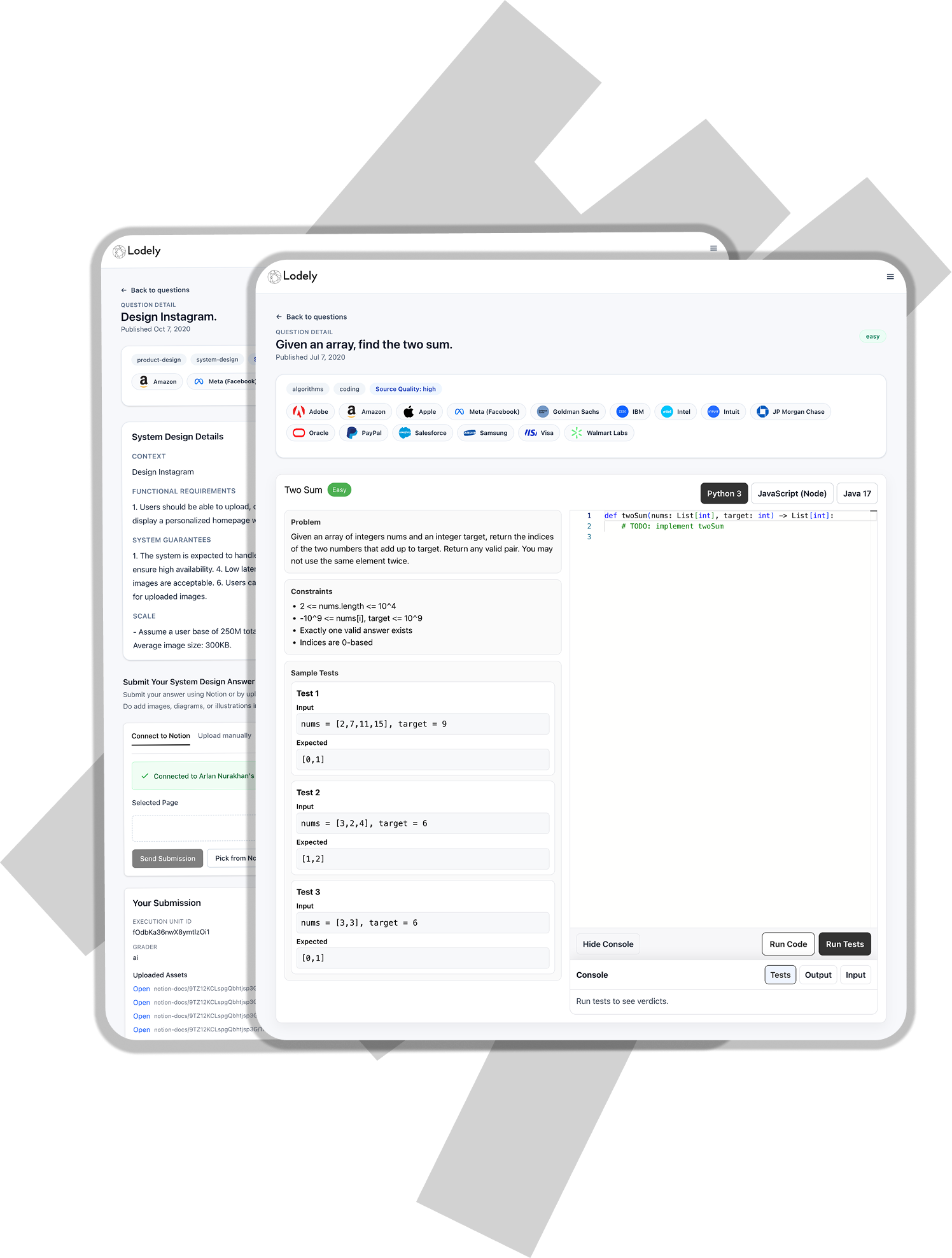
Prepare stories that show how your ownership affected customers and how you made technical decisions. Be ready to explain the rationale for a database/API boundary and how it changes at two, three, or 100 times the load. Use Lodely to practice the company's coding, system-design, and behavioral rounds and switch between formats as the loop requires.

Plaid Interview Breakdown
Tell Me About a Technical Challenge That You Have Overcome
Type: Technical-behavioral discussion. The Trick: Explain the technical decision with relevant details; a dramatic problem cannot replace the technical explanation. What it tests: Ownership, technical depth, communication, tradeoff analysis, and the ability to connect decisions to outcomes.
Payment Schedule
Type: Stateful coding. The trick: Resolve edge cases involving dates, ordering, and repeated events before coding. What it tests: Data modeling, iterative thinking, and readable business logic.
Rate Limiter
Type: Applied coding and systems. The trick is to define the time window and state-cleanup policy. It tests boundary checking, concurrency awareness, and design extensibility.
Two questions remain. In Group Transactions, sort related records without breaking their grouping or totals. In Healthy Data, encode validation rules and expose bad or incomplete data. Both require you to name the invariants before coding.
What Comes After The Interview
After the loop, interview feedback informs the level and offer decisions. Reported 2026 software-engineer total compensation is $242K at E3, $331K at E4, $467K at E5, and $685K at E6; the compensation reports include salary, bonus, and private-company RSUs. The reported vesting schedule runs over four years, so ask how valuation and liquidity affect the equity.
Candidate Experiences
One recent software-engineering candidate reported a phone screen with behavioral and coding questions, followed by an onsite with behavioral questions, a coding problem, and a system-design question. The candidate found the questions approachable but was surprised not to receive an offer. Treat communication and solution quality as separate scoring areas even when the questions seem easy.
Conclusion
Plaid values practical work, reliability-minded thinking, and clear explanations of your past work. Practice the full process on Lodely so you prepare your transaction logic, API decisions, and project stories to a consistent standard.
✉️ Get free faang interview cheat sheet and interview tips weekly
✉️ Get free faang interview cheat sheet and interview tips weekly