


Plaid Online Assessment: Questions Breakdown and Prep Guide

Thinking about “Cracking Plaid’s Assessment” but not sure what you’re getting into? You’re not alone. Engineers stare down HackerRank, CodeSignal, JSON-heavy puzzles, and API thinking — and the hardest part is knowing which challenge to train for.
If you want to walk into the Plaid Online Assessment (OA) confident and prepared, this guide is your playbook. No fluff. Real breakdowns. Strategic prep.
When to Expect the OA for Your Role
Plaid varies OA content based on the role and team, but the pattern is fairly consistent:
- New Grad & Intern Positions – Expect an OA link within a week or two of initial contact. Often 1–2 data structures/algorithms questions plus a practical coding task involving parsing or simple API-like logic.
- Software Engineer (Backend / Full-Stack / Platform) – Very common. Usually a HackerRank or CodeSignal assessment with DS&A and a task simulating backend scenarios: idempotency, pagination, or event ordering.
- Data Engineering / Analytics Engineering – OA typically includes SQL or data transformation, with questions around deduplication, window functions, and incremental sync logic.
- Mobile / Frontend – A DS&A portion plus a practical UI/data formatting question (e.g., transforming nested JSON, handling pagination, state consistency).
- SRE / Infrastructure – A mix of coding plus scenarios involving rate limiting, retry semantics, log parsing, and monitoring signals.
- Security / Risk – Coding plus lightweight cryptographic or signature verification tasks (e.g., HMAC validation for webhooks).
- Senior Roles – Sometimes a recruiter may fast-track to live rounds, but many candidates still receive an OA focused on DS&A plus real-world backend patterns.
Action step: When the recruiter reaches out, ask for the platform, number of questions, and time limit. Plaid recruiters are generally open about the format.
Does Your Online Assessment Matter?
Short answer: yes — and it’s a big signal at Plaid.
- It’s the main filter. Strong resumes get you the invite; OA performance determines whether you move on.
- It sets the tone. Your OA code can be referenced by interviewers in later rounds.
- It’s realistic. Expect problems that mirror Plaid’s domain: incremental syncs, idempotent processing, pagination, and handling partial failures.
- It signals work style. Clean code, meaningful naming, tests, and edge-case handling matter.
- It tests API thinking. Backoffs, rate limits, retries, and exactly-once semantics are themes Plaid cares about.
Pro Tip: Treat the OA like your first interview. Write readable code, document edge cases, and think in terms of production constraints (timeouts, duplicates, order).
Compiled List of Plaid OA Question Types
Candidates report seeing a mix of core algorithms and Plaid-flavored problems. Practice these:
- Logger Rate Limiter — type: Design / HashMap / Time-based
- Design Hit Counter — type: Queue / Sliding Window
- Merge Intervals — type: Sorting / Interval Math
- Top K Frequent Elements — type: Heap / HashMap
- K-way Merge of Sorted Streams — type: Heap / Streaming
- Deduplicate Sorted Array/Stream — type: Two Pointers
- Longest Subarray/Substring with Constraint — type: Sliding Window
- Event Ordering with Dependencies — type: Graph / Topological Sort
- Binary Search on Answer (paginate/find threshold) — type: Binary Search / Feasibility
- Dijkstra / Shortest Path on Latency Graphs — type: Graph / Priority Queue
- Validate Parentheses (parsing JSON-like strings) — type: Stack
- JSON-like Tree Traversal (nested structure iterator) — type: Iterator / Stack
- LRC/Checksum/HMAC-style validation (conceptual) — type: String/Bytes / Hashing
- Maximum Average Subarray / Rolling Aggregates — type: Sliding Window
- Exponential Backoff Scheduling (pattern) — type: Queues / Time-based Scheduling
For domain context and mental models, browse Plaid’s docs: https://plaid.com/docs/
How to Prepare and Pass the Plaid Online Assessment
Think of your prep as building reflexes for API-heavy, correctness-first engineering.
1. Assess Your Starting Point (Week 1)
List what you’re comfortable with (arrays, maps, two pointers) and what you avoid (graphs, heaps, concurrency patterns). Do a timed set of 3–4 problems across arrays, strings, and a streaming/heap problem to benchmark.
2. Pick a Structured Learning Path (Weeks 2-6)
You have options:
- Self-study on LeetCode/HackerRank
- Best for disciplined learners. Focus on intervals, heaps, sliding window, and hash maps.
- Mock assessments / bootcamps
- Timed, proctored sessions can simulate Plaid’s pressure and cadence.
- Career coach or mentor
- A mentor can review solutions for clarity, edge cases, and production-minded tradeoffs (idempotency, retries, pagination).
3. Practice With Realistic Problems (Weeks 3-8)
Build a set of 40–60 problems. Emphasize:
- Rate limiting and time-bucketed counters
- K-way merge, streaming aggregates, and dedup
- Interval math and sorting
- Graph basics (topo sort, Dijkstra)
- Parsing and validating nested structures
Time yourself, then refactor for readability and test coverage.
4. Learn Plaid-Specific Patterns
Plaid is the connective tissue between financial institutions and apps. Expect:
- Idempotency and exactly-once processing for webhooks/events
- Cursor-based pagination and incremental sync with deduplication
- Retry semantics with exponential backoff and jitter
- Rate limits and batching for upstream/downstream APIs
- JSON parsing, partial updates (patch/merge), and schema evolution
5. Simulate the OA Environment
Use HackerRank or CodeSignal practice modes. Turn off distractions. Run two-hour blocks with 2–3 questions. Include at least one “production-style” task (e.g., process a stream with duplicates and out-of-order events).
6. Get Feedback and Iterate
Do post-mortems. Track repeated misses: off-by-one in windows, forgetting to update cursors, not handling empty/invalid input, O(n log n) vs O(n). Tighten your error handling and naming.
Plaid Interview Question Breakdown
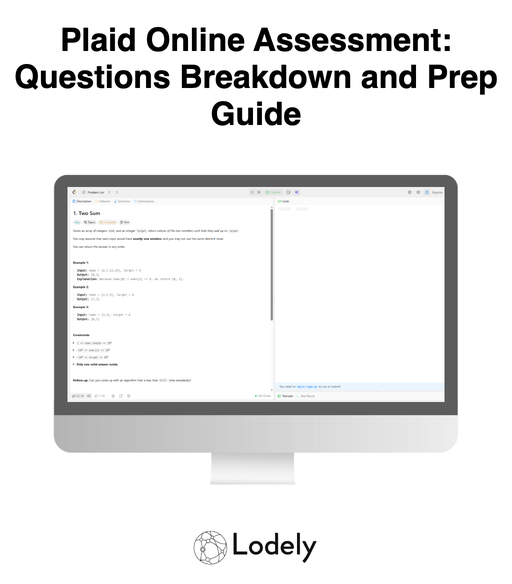
Here are featured sample problems inspired by Plaid’s OA style. Master these patterns and you’ll cover most of what matters.
1. Idempotent Webhook Processor
- Type: Hashing / Ordering / Exactly-once Processing
- Prompt: You receive a stream of webhook deliveries, each with an event_id and delivery_id. The same event can arrive multiple times and out of order. Implement a processor that applies each event exactly once and outputs the final ordered list of applied event_ids.
- Trick: Maintain a set of processed event_ids for idempotency. If ordering is required by event timestamp, buffer out-of-order deliveries in a min-heap keyed by timestamp and drain when possible.
- What It Tests: Real-world ingestion logic, deduplication, buffering, and clean state management.
2. Cursor-Based Pagination Merge
- Type: K-way Merge / Dedup / Streaming
- Prompt: Given multiple pages of transactions from a paginated API, each page contains transactions with possibly overlapping items and a next_cursor. Merge pages into a single list sorted by time, deduplicate by transaction_id, and return the final cursor.
- Trick: Use a hash set for seen IDs and a heap for merging sorted chunks; carefully handle the last page with null cursor.
- What It Tests: Practical API consumption, deduplication, memory/time trade-offs.
3. Rate Limiter with Backoff
- Type: Queues / Scheduling
- Prompt: Implement a scheduler that executes API calls under a max QPS limit. On 429 responses, reschedule with exponential backoff and jitter. Provide a function schedule(fn) that guarantees eventual execution without exceeding QPS.
- Trick: Token-bucket or leaky-bucket approach for steady rate; a priority queue keyed by next_allowed_time; randomized jitter to avoid thundering herd.
- What It Tests: Production constraints, fairness, and failure handling.
4. Incremental Sync Window Aggregates
- Type: Sliding Window / Map
- Prompt: Given a time-ordered stream of transaction updates (insert, update, delete), compute rolling totals per category over the last N minutes and support query(category, now) -> sum.
- Trick: Use deques per category for windowing; maintain running sums adjusted by updates and deletes; prune expired entries lazily.
- What It Tests: Sliding windows, state mutation, and edge-case rigor.
5. Validate HMAC-Signed Payload
- Type: Crypto Primitives / Byte Handling
- Prompt: Implement verify(signature, payload, secret) using HMAC-SHA256. Signature is hex; payload is a string. Return true if valid and protect against timing attacks.
- Trick: Constant-time comparison for the signature; compute HMAC over exact payload bytes; careful hex parsing.
- What It Tests: Security hygiene and attention to correctness details.
What Comes After the Online Assessment

Passing Plaid’s OA gets you in the door. Next, the process shifts from “can you code” to “can you design, reason about APIs, and uphold reliability and privacy.”
1. Recruiter Debrief & Scheduling
Expect an email within a few days. You’ll get high-level feedback and the layout of upcoming rounds (coding, design, behavioral). Ask about teams hiring, interview focus areas, and logistics.
2. Live Technical Interviews
You’ll pair with Plaid engineers in a collaborative editor.
- Algorithm & Data Structures: Similar to OA, but interactive.
- Debugging: Step through a broken function or flaky test and reason out fixes.
- Communicating trade-offs: Explain your choices as you code.
Pro tip: Revisit your OA solutions; interviewers may ask you to walk through them.
3. System Design / Architecture Round
For mid-level and senior roles, expect a design session. Common prompts include:
- Designing a webhook ingestion pipeline with idempotency, retries, and DLQs
- Building a transactions sync service with cursor-based pagination and dedup
- Designing a rate-limited API client with exponential backoff and observability
They’re assessing scalability, fault tolerance, consistency, and clear trade-off communication.
4. Practical API/Data Exercise
Some teams include a hands-on exercise:
- Parse and normalize nested JSON, handle schema evolution
- Implement pagination and partial failures
- Add metrics, alerts, and idempotency keys
Focus on readability, tests, and thoughtful error handling.
5. Behavioral & Values Alignment
Expect questions about customer empathy, privacy, and ownership:
- “Tell me about a time you handled a production incident.”
- “Describe how you ensured data correctness under ambiguous input.”
Use the STAR method and highlight collaboration, iteration, and impact.
6. Final Loop & Offer
The onsite loop may combine coding, design, and cross-functional conversations. If successful, you’ll receive a verbal, then written offer. Compensation often includes base, bonus, and equity. Do market research and be ready to negotiate.
Conclusion
You don’t need to guess — you need to prepare. The Plaid OA rewards engineers who:
- Diagnose weak spots and drill the right patterns
- Practice timed sessions with API-minded constraints
- Write clean, testable code with edge-case coverage
Treat the OA as your first interview. If you combine DS&A fundamentals with production instincts — idempotency, pagination, backoff, and rate limits — you’ll walk into the next stages with confidence.
For more practical insights and prep strategies, explore the Lodely Blog or start from Lodely’s homepage to find guides and career resources tailored to software engineers.
✉️ Get free faang interview cheat sheet and interview tips weekly
✉️ Get free faang interview cheat sheet and interview tips weekly


