


Qualcomm Interview Questions: 8 from Real Interviews

Qualcomm engineering interviews vary considerably by team. Software engineers often have a recruiter or hiring-manager screen in addition to multiple technical sessions. These sessions may cover C and C++ fundamentals, memory, operating systems, concurrency, embedded systems, algorithms, and project depth. GPU, modem, AI, and driver teams may ask domain-related questions based on their work.
What to Expect: Qualcomm Interview Process
Qualcomm's careers page publishes current interview policies and candidate guidance, while individual job descriptions define role-specific expectations. Recent engineering accounts describe technical rounds lasting 45 to 75 minutes and loops that combine coding, low-level knowledge, architecture, and a manager conversation. Before planning, ask the recruiter which team you'll meet, how many interviews to expect, and which language you may use.
Expect follow-up questions. After a C++ answer, interviewers will likely ask about layout, lifetime, undefined behavior, or performance. After a GPU answer, they will likely ask about memory traffic, occupancy, synchronization, or power. Interviewers want to see how you adapt when a new constraint changes the problem.
How to Prepare and Pass Qualcomm Interviews
For a systems-heavy role, plan six to eight weeks. Spend two weeks on C/C++, including pointers, memory management, bit operations, object layout, and concurrency. Spend two weeks on algorithms and debugging, then focus on the relevant domain, such as graphics pipelines, embedded Linux, modem software, compilers, machine learning, or hardware-aware performance.
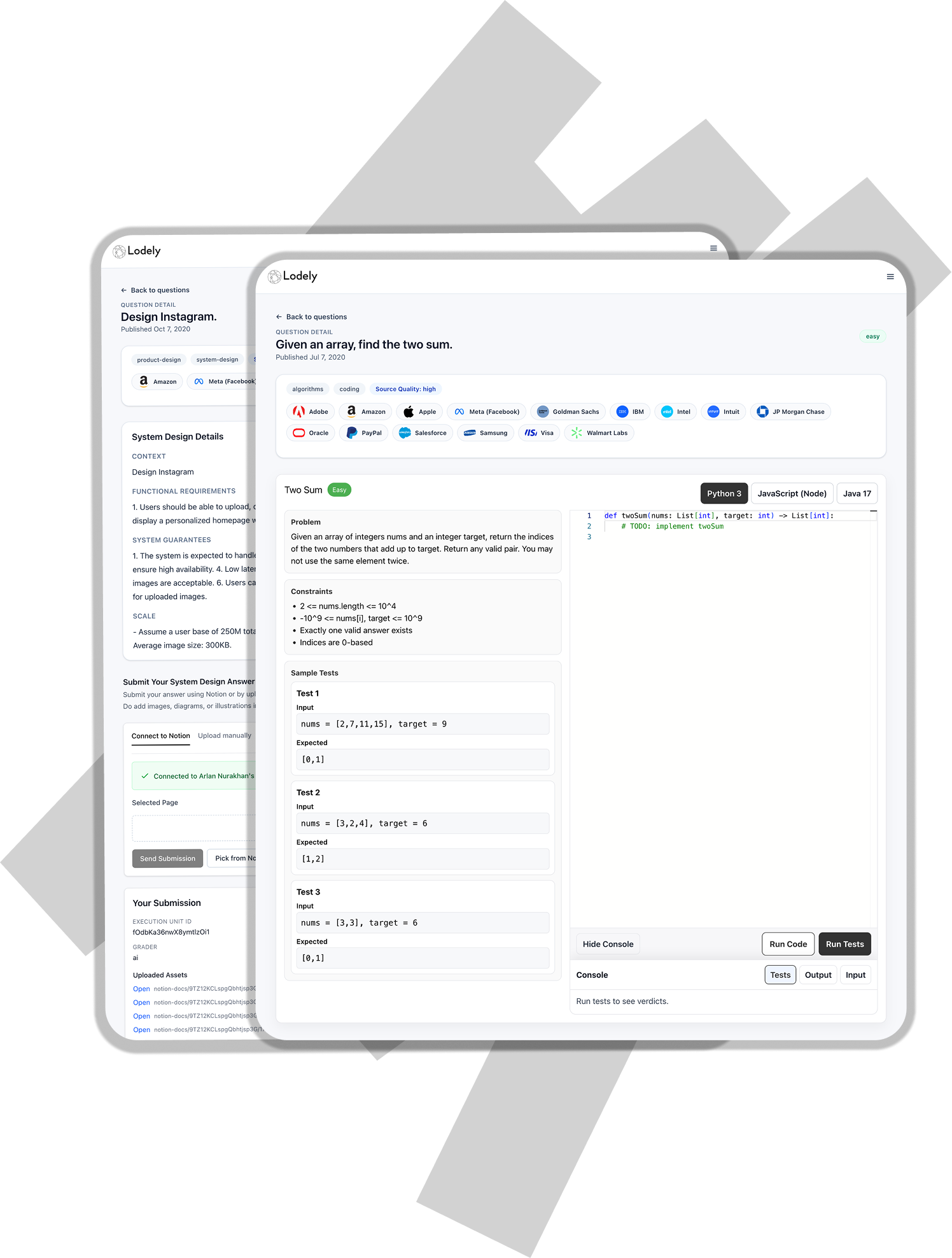
Practice explaining every decision and checking edge cases before the interviewer prompts you. Lodely provides Qualcomm-specific coding and system questions with full editorials to help you move from implementation to tradeoff analysis.

Qualcomm Interview Breakdown
A* Maze Shortest Path
function shortestPathMaze(grid, sr, sc, tr, tc)- Given an R×C grid where 0 is free and 1 is a wall, find the shortest path length from (sr, sc) to (tr, tc) using 4-directional movement.
- Return -1 if no path exists.
1 <= R, C <= 100grid[i][j] is 0 or 1Start and target cells are always 0
grid = [[0,0,0],[0,1,0],[0,0,0]], sr = 0, sc = 0, tr = 2, tc = 2
4
grid = [[0,1],[0,0]], sr = 0, sc = 0, tr = 1, tc = 1
2
Graph search. The Trick is not to preserve shortest path guarantees, or to treat an unreachable target as an unvisited node. What's Tested: Search fundamentals, state tracking, complexity, and edge cases. First define the grid, legal moves, the estimate of distance, and the termination condition, and then write the code.
Macro vs Function - Differences and Pitfalls
C/C++ Technical knowledge The trick is to say macros are just faster functions. What it tests for is knowledge of the preprocessor, type safety, scope, evaluation, and debugging. How to deal with multiple evaluations, operator precedence, namespace pollution and the few times a macro is actually worth it.
C++ Enum/Struct: Predict Output
Type: C++ code reasoning. The Trick: The risk is reading members in source order without considering scoped enums, implicit conversion, padding, or alignment. What It Tests: Language precision and memory-layout knowledge. Walk through types and offsets before predicting output or sizeof.
The remaining examples involve the same systems standard. GPU Uniform Operations and GPU Kernel Optimization require reasoning about memory traffic, divergence, occupancy, energy, and performance. Design a Cache Controller requires reasoning about cache coherence, invalidation, and write buffering. Count Islands tests traversal discipline. Continuous Subarray Sum tests prefix state and modulo arithmetic.
What Comes After The Interview
After the panel, the hiring manager and recruiter reach agreement on the role, level, and feedback. Qualcomm offer packages include base salary, equity, and bonus. Equity and annual bonus become more important at Senior Engineer and above.
Candidate Experiences
The latest machine-learning software candidate described a recruiter screen, a hiring-manager screen, and three technical screens. The technical screens included C++ questions based on the candidate's résumé, a machine-learning coding problem, and a system-design problem about training loops and transformer architecture. The candidate did not receive an offer. The account shows how quickly the process moves from language fundamentals to domain-specific design. Prepare both areas for the team you're interviewing with.
Conclusion
Qualcomm rewards low-level precision, domain knowledge, and clear tradeoff analysis. Practice these eight questions on Lodely and explain your response to each follow-up.
✉️ Get free faang interview cheat sheet and interview tips weekly
✉️ Get free faang interview cheat sheet and interview tips weekly