


Scale AI Interview Questions: 6 Questions to Prepare for in 2026

Scale AI's software-engineering process includes a timed test, live coding, a virtual technical loop, and a values discussion. The process places the most weight on your ability to turn an evolving spec into correct, testable code and explain each decision.
What to Expect: Scale AI Interview Process
A recent new-grad report describes a 50-minute assessment, 60-minute technical screen, and a virtual loop of system design, a backend practical, debugging, and a 45-minute Credo interview. Experienced candidates may start with a recruiter or hiring-manager conversation. Ask the hiring team to confirm the exact order because the team and entry point determine it.
The 2026 report places more emphasis on practical tasks. You may be asked to write standard application code, while later rounds may ask you to debug a service that calls a model or design a data-evaluation pipeline. Clean code, tests, and visible progress matter if the interviewer adds more requirements.
How to Prepare and Pass Scale AI Interviews
If your fundamentals are current, plan four to six weeks. If you need to rebuild your system-design expertise from scratch, plan eight to ten weeks. Build a small service or simulation that you can complete in one sitting. State your assumptions, separate the state, and test edge cases before refining the solution.
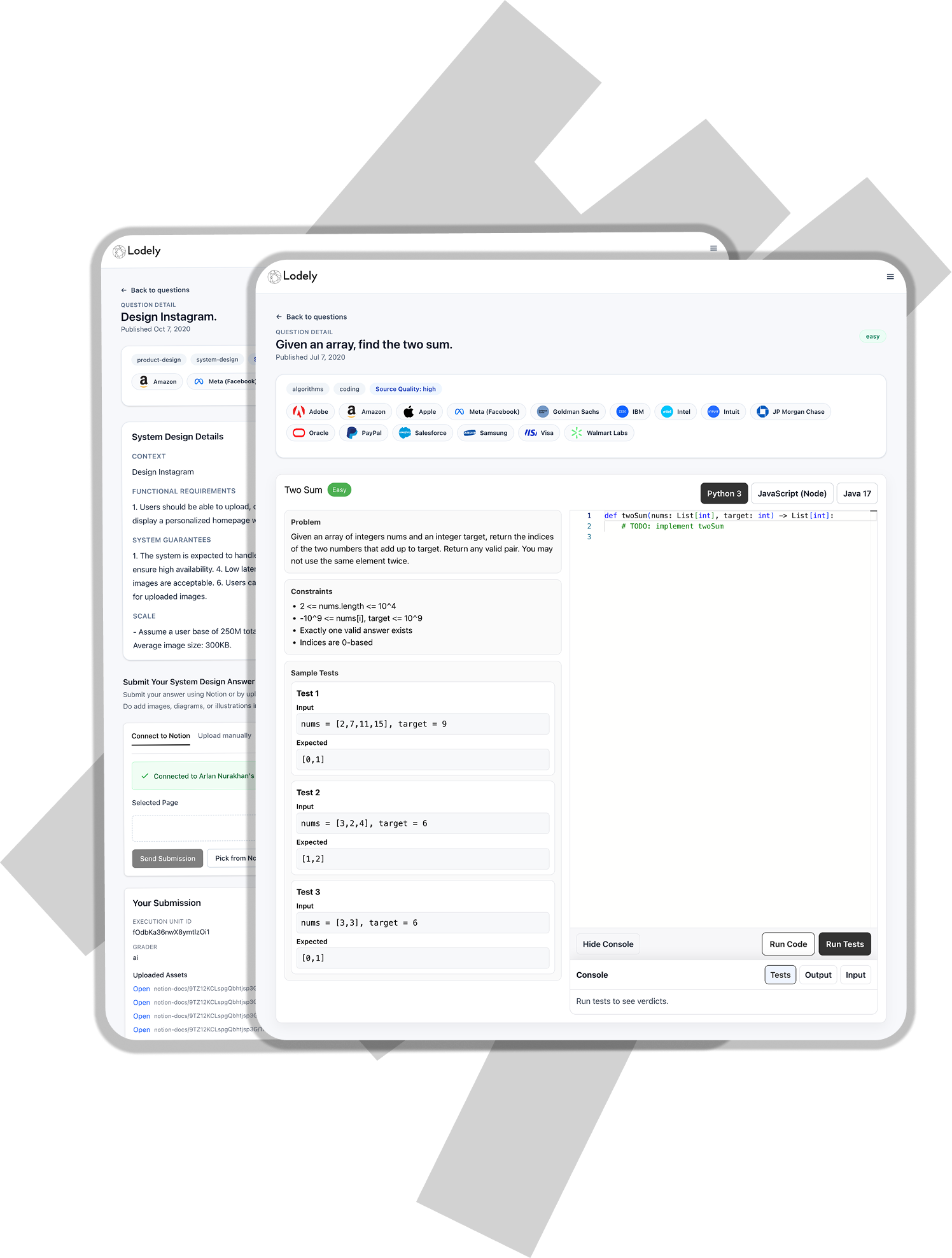
Create six stories based on Scale AI's published operating principles. Each story should state the decision you made, the metric you moved, and what you learned. Use Lodely to practice company-specific coding, system-design, and behavioral questions together so that switching between round types feels familiar.

Scale AI Interview Breakdown
Party Times
function partyPeakTime(events)- Given a list of party events where each event is represented as [startTime, endTime] (inclusive), find the time window during which the maximum number of parties overlap.
- Return [maxOverlap, peakStart, peakEnd] where peakStart and peakEnd define the earliest contiguous time range with the maximum overlap.
- If there are multiple windows with the same maximum overlap, return the earliest one.
1 <= events.length <= 10^40 <= startTime <= endTime <= 10^6All times are integers
events=[[1,5],[2,7],[4,6],[6,8]]
[3,4,6]
events=[[0,3],[1,2]]
[2,1,2]
Type: Interval sweep The Trick: When events happen, the starting and ending times can be updated. What It Tests: Defining event order, finding the earliest peak window, and handling ties.
Neuron States
function nextNeuronState(grid)- Given a 2D matrix of integers representing neuron values, compute the next state.
- A neuron is 'firing' if its value > 0.
- Count each cell's firing neighbors (up, down, left, right).
- Rules: if exactly 3 neighbors are firing, the cell becomes 6; if 0 or 1 neighbors are firing, the cell's value decreases by 2 (minimum 0); if more than 3 neighbors are firing, the cell's value decreases by 1 (minimum 0); if exactly 2 neighbors are firing, the cell's value stays the same.
1 <= rows, cols <= 1000 <= grid[i][j] <= 100
grid = [[0,5,0],[3,0,7],[0,2,0]]
[[0,3,0],[1,0,5],[0,0,0]]
grid = [[0,1,0],[1,2,1],[0,0,0]]
[[0,0,0],[0,6,0],[0,0,0]]
Type: Matrix simulation. The Trick: Calculate each cell's new state from the original state at the start of the pass. What It Tests: State isolation, edge handling, and discipline in translating rules into code.
Design a Pipeline to Mine Novel Examples from a Massive Unlabeled Corpus
Type: ML system design. The trick: Novelty, quality, and cost compete, so you'll need filters and feedback loops to measure it. What it tests: Data architecture, evaluation design, failure handling, and operational trade-offs.
The remaining questions broaden the evaluation. Design an Image Moderation ML System and Extend It to Video: Describe ingestion, sampling, classification, and human review, then discuss how temporal context affects the system design. The quality improvement initiative: Identify a reliability issue, connect it to a metric, and show how you achieved a sustained result. Tight deadline decision: Show how you reduced scope without skipping the analysis needed to protect quality.
What Comes After The Interview
The hiring committee reviews all evidence from the loop. After a positive decision, the recruiter discusses the level and package. Scale AI reported $231K total compensation in 2026 for software engineers at level 3, $370K for level 4, $476K for level 5, and $1.23M for level 6. The underlying reports combine salary, bonus, and private-company options. Ask how the option value was calculated and whether the company has provided liquidity.
Candidate Experiences
One recent software engineering candidate said the process started with a behavioral screen, followed by a straightforward programming question. Their final round included four or five interviews covering advanced coding, system design, and behavioral evaluation. One expected behavioral conversation became another system-design interview. They reported a neutral experience and did not receive an offer. Be prepared for a round that shifts further into system design.
Conclusion
Scale AI prioritizes fast, structured work and good judgment in data and model systems. Sign up for Lodely to practice the full loop so you can handle coding, architecture, and Credo stories with precision.
✉️ Get free faang interview cheat sheet and interview tips weekly
✉️ Get free faang interview cheat sheet and interview tips weekly
