


Squarespace Interview Questions: 5 Questions to Prepare for in 2026

The Squarespace software engineering interview process has three stages: a recruiter call, a technical screen, and a virtual loop. The most recent engineering loops involved coding, system design, code review, and behavioral interviews. If you're a front-end engineer, you may have a coding round and a UI implementation loop. Confirm the language and format early.
What to Expect: Squarespace Interview Process
The interview process includes a 30-minute recruiter screen, a 60-minute technical screen, and one-hour sessions on algorithms, object-oriented design or bug finding, system design, and behavioral topics. The emphasis varies by team and level. Senior backend engineers may review an existing service, while frontend engineers may build an interface without a framework.
Squarespace's engineering page says its teams maintain large-scale architecture serving millions while keeping a startup-style operating environment (Squarespace Engineering). That makes performance, maintainability, product usability, testing, and explicit trade-offs important signals throughout the loop.
How to Prepare and Pass Squarespace Interviews
If you code comfortably under time constraints, plan four to six weeks. If you need more practice building data structures or with design fundamentals, plan eight to twelve weeks. Frontend developers should practice simple browser APIs, event handling, timers, accessibility, and rendering performance. Backend developers should practice object modeling, debugging, API boundaries, and failure handling.
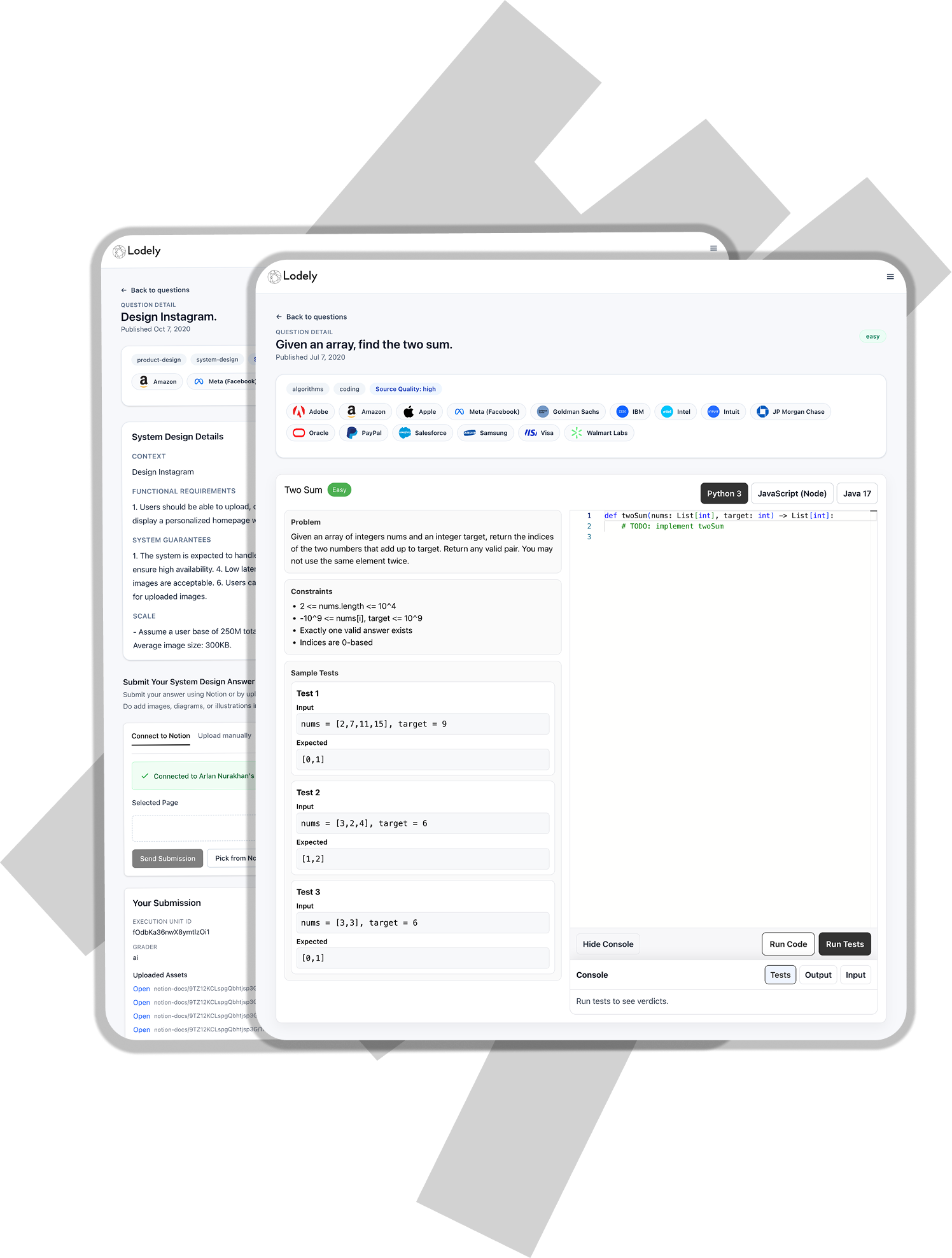
Practice coding and design in the same week. Use Lodely to rehearse Squarespace-specific questions alongside system-design and behavioral prompts in full-loop sessions. In every session, define constraints, explain your tradeoffs, and allocate time for tests.

Squarespace Interview Breakdown
Frontend System Design
Type: Client architecture for high-volume event explorer.
The interface may need to display about 1.5 million events without loading or rendering all of them in the browser. Define server-side aggregation, pagination, virtualization, URL-based filtering, and responsibility for query validation.
What It Tests: Component boundaries, state management, API design, performance, testing, and shareable application state.
Slideshow Frontend
Type: Plain JavaScript UI implementation.
The Trick - The automatic timer and user navigation timer should be the same. When the user clicks the next or prev button, reset the timer reliably. Don't add duplicate listeners. Keep the current slide, indicators, and transitions in sync.
What It Tests: DOM mastery, event lifecycle, state management, and maintainable UI code without framework helpers.
Menu Filters
Type: String filtering with simple Boolean expressions.
The Trick: Normalize matching across labels, categories, and tags. AND has higher precedence than OR, while empty inputs and extra whitespace need explicit handling.
What It Tests: Parsing, case handling, testing, and clean extension of a simple solution.
The final two questions cover additional skills. "Count Numbers Passing All Intervals" asks you to collapse unsorted intervals to their common intersection and count qualifying numbers. "Walk Me Through One Project End to End" requires you to explain the problem, your role, design tradeoffs, launch issues, and the metrics that prompted follow-up on the project. Choose one project, walk through it end to end, and make your personal ownership clear.
What Comes After The Interview
The technical loop allows team matching and level calibration before a written offer. Ask whether the opening is tied to one team and when the match becomes final. When an offer arrives, compare base pay, equity, bonus, and vesting separately. Squarespace's reported equity schedule can be back-loaded over four years.
Candidate Experiences
One recent frontend candidate described a plain-JavaScript take-home followed by a four-round virtual onsite. The sessions covered functional programming, dashboard system design, slideshow UI work, and behavioral questions. The candidate advanced to team matching but did not receive an offer. Prepare for practical browser work, and ask the recruiter how team availability affects the final decision.
Conclusion
Squarespace pays for readable code, product-centric design, and calm explanations in coding, review, and behavioral rounds. Use Lodely and its full editorials to work through these five questions, then complete timed runs before the loop.
✉️ Get free faang interview cheat sheet and interview tips weekly
✉️ Get free faang interview cheat sheet and interview tips weekly