


Stripe Interview Questions: 8 Questions to Prepare for in 2026

Stripe interviews tend to involve substantial practical engineering. Stripe's careers FAQ says, "Most people go through a recruiter screen, a technical or skills based interview, and then interviews with their team. Then it's a loop of implementation, integration, debugging, system design and discussion about experience."
Stripe's official engineering guide describes Bug Squash as collaborative work on a historical bug in an open-source project. Engineers can use their own laptop, development environment, and a supported language. This format rewards navigation, testing, and communication in unfamiliar code.
What to Expect: Stripe Interview Process
Your recruiter should explain which rounds correspond to your level. Some positions have a technical screen, while others have a more general loop. Reports from 2026 mention SWE-2 hiring processes with AI-assisted coding and integration sessions, a "Bug Squash," and an "Experiences and Goals" discussion. Ask whether AI tools are required, optional, or forbidden for your loop.
A common signal is production judgment. Read requirements, write maintainable code and documentation, isolate failures, and explain tradeoffs. Senior roles also involve greater architectural depth, deeper API design, and broader cross-team scope.
How to Prepare and Pass Stripe Interviews
If you're already familiar with code and systems, plan for four to six weeks. If you're not, plan eight to twelve weeks.
- Practice running tests, tracing requests and logs, and fixing small issues.
- Build integrations. Parse documentation, handle pagination, errors, and idempotency, and test retries.
- Design financial state carefully. Cover ledgers, reconciliation, duplicate requests, auditability, and failure recovery.
- Write impact stories. Describe a technical issue, a conflict, a major change, and a result of your leadership.
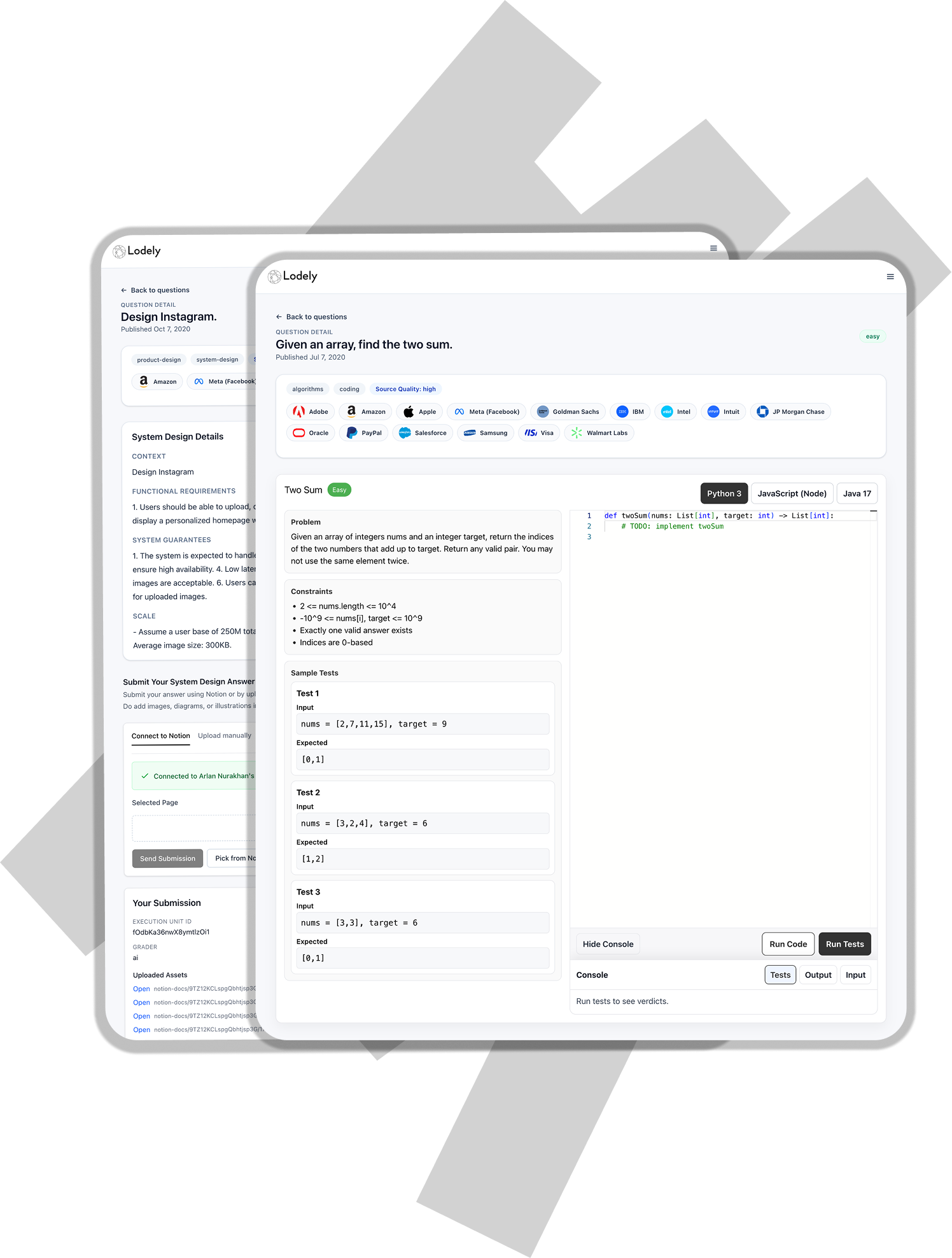
Use Lodely to practice Stripe coding, system-design, and behavioral interview questions in one loop. Part of the challenge is moving between hands-on work and high-level thinking.

Stripe Interview Breakdown
Transaction Audit
function findSuspicious(suspicious, activities, k)- Given known suspicious activities (each a list of field values), new activities, and a threshold k: a new activity is suspicious if at least k of its field values appear in the set of all suspicious field values.
- Newly identified suspicious activities add their field values to the suspicious set (chain reaction).
- Return sorted indices of all newly identified suspicious activities.
Each activity has exactly 3 fields1 <= k <= 30 <= activities.length <= 1000
suspicious = [["Brad","San Francisco","withdraw"]], activities = [["Joe","Miami","withdraw"],["John","San Francisco","deposit"],["Albert","London","withdraw"],["Diana","London","withdraw"],["Diana","San Francisco","withdraw"],["Joe","New York","updateaddress"]], k = 2
[2,3,4]
Type: Propagation across transaction attributes in a graph-like structure.
The Trick: New suspicious activities may expand the set, so one pass may miss later matches. Make the chain reaction explicit and prove when processing should stop.
What It Tests: State management, iteration, correctness, and threshold interpretation.
Get the Top API Users From Transaction Logs
function topApiUsers(logs, k)- Given API transaction logs as user IDs and integer k, return the top-k users by request count.
- Break ties by lexicographically smaller user ID first.
0 <= logs.length <= 10^51 <= k <= 10^5
logs=[alice,bob,alice,carol,bob,alice], k=2
[alice,bob]
logs=[u1,u2,u3], k=5
[u1,u2,u3]
Type: Frequency counting and ranking.
The Trick: Define tie-breaking and the case where k exceeds the number of users. Choose an approach that fits the input size rather than sorting blindly.
What It Tests:
- Hash maps
- Ordering
- Complexity
- Determinism
- Edge cases
Design a Stripe-Like Payment Processing System
Type: Large-scale system design.
The Trick: Model payment states, idempotency, retries, ledger entries, asynchronous updates, and reconciliation before splitting services.
What It Tests:
- API design
- API consistency
- API reliability
- API auditability
- API security limits
- API failure recovery
Five more questions complete the set. Describe a metrics service covers ingestion, aggregation, cardinality, storage, and query latency. Describe a technical decision and its impact covers evidence and tradeoffs. Lead a team through a major change covers planning and communication. Resolve a conflict covers listening and ownership. Design a rate limiter covers policy, distributed state, concurrency, and boundary behavior.
What Comes After The Interview
Ask when the panel will meet and whether the team match remains in place. Compare offers by level across base salary, equity, bonus, and vesting terms. In 2026, the U.S. median salary across levels L1 to L4 rises from $211,000 to $662,000, with equity making up the largest portion by L4.
Candidate Experiences
One recent SWE-2 candidate described screening, AI-assisted programming, Bug Squash, AI integration, and an Experiences and Goals discussion. They completed most programming work, fixed two bugs and isolated the third root cause, then finished all integration requirements and edge cases. The candidate was still waiting more than two weeks after the loop while the panel gathered feedback. Practice finishing cleanly, but also state partial progress and next steps when time expires.
Conclusion
Stripe encourages maintainable code, systematic debugging, and design decisions that prevent financial correctness issues. Practice these eight Stripe interview questions on Lodely to improve your speed and retain your production insight.
✉️ Get free faang interview cheat sheet and interview tips weekly
✉️ Get free faang interview cheat sheet and interview tips weekly