





9 TikTok Interview Questions to Expect in 2026

This guide provides a stage-by-stage playbook and nine questions based on what interviewers ask.
Software engineering interviews at TikTok differ by team, level, location, and specialty. Candidate reports describe a practical core: resume and project discussion, live coding, technical knowledge, system design for many experienced roles, and a final conversation about motivation and impact. Your recruiter is the source of truth for the role's process, but the same preparation principles apply across interviews.
What to Expect: TikTok Interview Process
Third-party interview guides commonly describe a process with 4-5 stages over about 3-5 weeks. The stages can include recruiter contact, an assessment or technical screen, multiple technical interviews, and an interview with a manager or HR.
Use that range to plan. The team can add a domain round, return to a design loop, or skip an online assessment. An Android SWE candidate in Singapore reported 5 one-hour interviews: 2 technical rounds, 2 system-design rounds, and 1 behavioral round. The rounds occurred in sequence after positive feedback.
Recruiter screen. The recruiter will ask about your background, how it aligns with the role, your location, and why you chose TikTok. Prepare a brief career story. Be ready to explain which team you will interview with and why its problems resemble work you have already done.
Assessment or technical screen. You may need to complete an online coding test or a live technical-screen call. Confirm the required programming language and platform in advance.
Technical interviews usually involve data structures, algorithms, correctness, and complexity. Backend reports also mention operating systems, threads, databases, and resume deep dives. A 2025 Glassdoor report describes technical fundamentals, coding, projects, and behavioral interviews.
System design Senior or specialized roles may include system design for a service, mobile app, frontend app, or machine-learning system. Expect to define requirements, interfaces, data flows, and bottlenecks, then defend your decisions.
Manager, behavioral, or HR interview questions. The next round could cover your previous work experience. Interviewers want to understand how you would fit within the company. Prepare examples of ownership, teamwork, conflict management, learning, and impact. Be ready to discuss compensation expectations and logistics, but let the interviewer decide when to raise those topics.
How to Prepare and Pass TikTok Interviews
Build your preparation plan around the process your recruiter provides. If your interviews span the 3-5-week window, use the gaps between rounds to prepare. Coding is front-loaded, so start there. Continue practicing design and behavioral questions throughout the process.
Explain your reasoning while coding. Restate the problem, input, output, and constraints. Describe the straightforward solution, how you would improve it, and the invariant that makes it correct. TikTok interviewers can evaluate only what you show them, so explain why the pointer moves, why the state is safe, and which test cases cover the edge cases.
Pick two projects you can discuss in depth. For each project, explain the architecture, your ownership, the hardest trade-off, a failure or constraint, and the result. Understand the technical fundamentals behind each project decision. If you used queues, caching, indexes, concurrency, monitoring, or another technical component, explain how each one works and behaves under load.
Prepare behavioral stories with engineering detail. Choose a story about risk, disagreement, unclear requirements, missed expectations, or cross-functional delivery. Give the context briefly, then explain your decision, the factors you considered, and what changed. Make sure the story supports technical follow-up questions and makes your contribution clear.
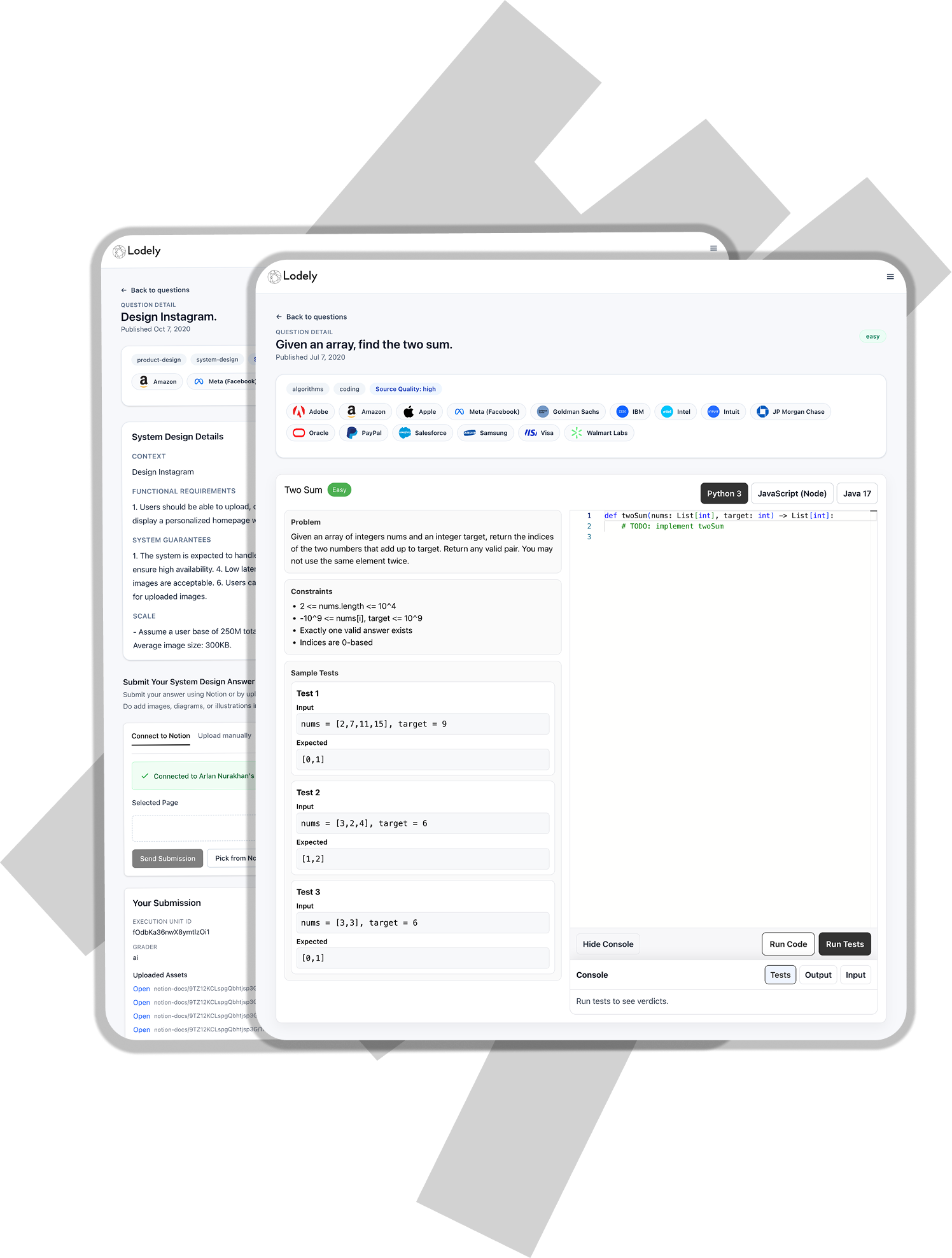
Lodely's TikTok plan combines TikTok coding, system-design, and behavioral questions. It reflects the breadth of recent TikTok loops and lets you switch formats without managing three separate preparation tracks.

TikTok Interview Breakdown
Practice these 9 questions for TikTok. They cover arrays, constrained search, scheduling, multi-pointer reasoning, product motivations, risk, and service design.
Move all zeros to the end of an array
function moveZeroes(nums)- Given an array of integers arr[], move all the zeros to the end of the array while maintaining the relative order of all non-zero elements.
1 <= n <= 10^5-10^9 <= arr[i] <= 10^9
arr = [0,1,0,3,12]
[1,3,12,0,0]
arr = [1,2,3,4,0,0]
[1,2,3,4,0,0]
Type: Array manipulation with a two-pointer approach.
The Trick: Preserve the order of non-zero elements while moving all zeros to the end of the array. Check memory use, stable order, and the role of the write pointer even when one example produces the correct output.
What It Tests: How you handle indexes, mutation, edge cases, and complexity analysis. Discuss empty arrays, arrays with no zeros, arrays with only zeros, and arrays where zeros are already at the end. Discuss why each element is processed a bounded number of times.
Print all possible solutions to the N-Queens problem
function solveNQueens(n)- The n-queens puzzle is the problem of placing n queens on an n x n chessboard such that no two queens attack each other.
- Given an integer n, return all distinct solutions to the n-queens puzzle.
- Each solution contains a distinct board configuration of the n-queens' placement, where 'Q' and '.' indicate a queen and an empty space, respectively.
1 <= n <= 9
n = 4
[[".Q..","...Q","Q...","..Q."],["..Q.","Q...","...Q",".Q.."]]
n = 1
[["Q"]]
Type: Backtracking with explicit constraint tracking.
The Trick: Track occupied columns and diagonals. Define a base case and restore the state after each recursive step. An indexing error is very easy to make and invalidates the logic.
What It Tests: Recursive decomposition, pruning, state management, and awareness of exponential search. Explain why every board you return is valid, why the traversal can reach every valid board, and how your constraints help avoid redundant scans.
Why do you want to work at TikTok?
Type: Behavioral motivation and role alignment.
The Trick: Answers such as "growth" or "social media" provide little evidence of fit. Link a specific TikTok product or engineering problem to your background, then explain why this role and team are the next logical step in that story.
What It Tests: Preparation, judgment, and interest beyond the brand name. Base your answer on your experience without pretending to know the team's private roadmap. End by explaining what you would contribute to the team.
The remaining coding questions cover several algorithmic skills. Meeting Intervals asks whether a person can attend all the meetings. Interviewers focus on how you order intervals, detect overlaps, and handle edge cases. Three Sum asks you to find unique triplets that sum to zero. Controlling duplicates and choosing a careful search strategy matter as much as finding a match.
Another behavioral question, When was the last time you took a risk?, asks you to explain a decision you made under uncertainty, the downside you considered, and what you learned.
The three design problems cover different kinds of state and scale. The browser history problem focuses on navigation semantics, data structures, and edge cases around revisiting pages. The key-value store problem covers partitioning, replication, consistency, failures, and hot keys. The search typeahead service problem covers prefix search, ranking, freshness, latency, and abuse controls.
What Comes After the Interview
After the last conversation, the recruiter may gather feedback, confirm team alignment, check your level, and prepare an offer. You may wait some time for an update. Follow up with a brief note that states your interest and mentions any deadline the recruiter needs to know. If the process switches teams, ask for an updated round list so you know what will be evaluated.
When looking at compensation for software engineering positions, account for base salary, bonus, and private-company equity. U.S. ByteDance data reports total compensation of about $207,000 at 1-2, $280,000 at 2-1, $461,000 at 2-2, $524,000 at 3-1, and $756,000 at 3-2. These self-reported or verified figures don't promise a specific TikTok offer.
Compare every component: employer, level, base, target bonus, equity value, grant value, vesting period, refresh grants, sign-on payment, and relocation. Two very similar equity packages in a private company could behave completely differently.
Candidate Experiences
Some recent candidates report substantial variation between teams. They describe multi-stage interview processes with a few domain-specific rounds in different orders. Backend and frontend engineers have reported coding, resume reviews, technical fundamentals, and design rounds. Confirm the loop for your team.
Some candidates report that later interviews are scheduled about a week after positive feedback from the previous round. Consider any individual timeline a hint rather than a guarantee.
To reduce uncertainty early, ask simple questions: How many conversations are there? Which types? Will we use the same coding or design editor, or a whiteboard? When do you usually give feedback? Keep high-level notes on each round type for reference.
Conclusion
Prepare to write clean code, define trade-offs clearly, discuss projects in depth, and tell behavioral stories based on your choices.
For a TikTok-specific practice mix, use Lodely to work through TikTok coding, system-design, and behavioral interview questions in one prep session.
✉️ Get free faang interview cheat sheet and interview tips weekly
✉️ Get free faang interview cheat sheet and interview tips weekly


