


Google Interview Questions: 7 from Real Interviews

A Google engineering interview typically includes a technical screen and interviews on coding, Googleyness, and leadership, plus system design for some senior roles. Candidates often report 45-minute sessions, but the exact process varies by job, level, location, and team. Confirm your specific loop with the recruiter.
Google also began testing a new format in 2026. Some junior or mid-level candidates on selected U.S. teams may use Gemini to understand code. The standard coding loop remains part of the process.
What to Expect: Google Interview Process
A recruiter may begin by asking what you do, which level you seek, where you are located, and what kind of work interests you. Before live interviews, Google may also require a hiring assessment, coding assessment, or both. The requirements vary, so ask your recruiter which assessments you will take and what each one covers.
During the technical screen, you will solve a technical problem, usually about data structures and algorithms, and explain your approach. Interviewers expect you to compare solutions, write clear code, analyze complexity, and possibly test the code without standard development tools. Some recent early-career loops included a technical screen, two or three coding interviews, and one Googleyness and Leadership interview.
Some L5 loops in 2026 included three coding interviews, one system-design interview, and one Googleyness and Leadership interview. Some L4 candidates receive system design; others do not. Domain-specific interviews may cover machine learning, infrastructure, security, mobile development, or role-specific design.
Candidates may use Google Drawings during virtual design interviews. Google's technical candidate guide recommends focusing on the content of an answer instead of the diagram's shapes. It also recommends practicing how to share a drawing in Google Meet. Other formats may appear, so test the required tools before interview day.
In 2026, Google began a limited Gemini pilot. Reporting based on Google's internal pilot document says selected junior and mid-level candidates on certain U.S. teams can use Gemini during a coding assessment. Interviewers assess how candidates write prompts, validate output, and identify bugs. AI access applies only to a confirmed pilot round. Do not use AI during any other interview unless Google allows it.
After the live loop, Google assembles your interview feedback for a hiring decision and level review. The hiring committee and team matching can happen in either order. It's possible to perform well and still wait for a team with approved headcount, so prepare for uncertainty after the loop.
How Is Google Hiring Doing in 2026?
Google's hiring in 2026 is concentrated in technical fields such as AI, Cloud, infrastructure, security, and large-scale systems. Alphabet had 198,933 employees at the end of the second quarter of 2026, up from 187,103 a year earlier. That is an increase of about 6.3% across Alphabet.
The live Google Careers search shows openings across early, mid, and senior levels worldwide. Current listings cover software for AI applications and agents, Vertex AI, site reliability, Cloud storage, embedded systems, security, and core infrastructure. Listings change continuously, so use them to identify active skill clusters rather than estimate your odds.
Early-career hiring continues. A current Google campus software engineering listing asks for programming experience and highlights distributed systems, machine learning, information retrieval, networking, security, and large software systems. It also lists experience with AI productivity tools. Fundamental skills remain central, while the role now expects engineers to work effectively with AI-assisted workflows.
Close role alignment matters in this market. Tailor your resume to the role and include specific evidence such as running a distributed system, improving reliability, building an ML system, working in a large codebase, or delivering a measurable product result.
How to Prepare and Pass Google Interviews
Give yourself four to six weeks if your coding, design, and behavioral fundamentals are good. If you need to rebuild graph algorithms, dynamic programming, concurrency, or distributed-systems knowledge, plan for eight to twelve weeks. Divide that time according to the rounds you've actually been assigned.
Practice coding without tool support. Write a solution in a plain document. State the invariant, time complexity, and edge cases. After coding, trace at least one normal case and one failure-prone boundary case by hand.
Expect progressive follow-ups. Candidates report initial problems that become harder as scale, memory, input format, or latency changes. Don't code too soon. A clear first solution gives you a stable base for the next constraint.
Drive system design from requirements. Establish users, traffic, consistency needs, failure modes, and recovery behavior before choosing components. Be ready to explain partitioning, ordering, retries, replication, and recovery.
Prepare behavioral evidence by level. Tell stories about ambiguity, conflict, mistakes, deadlines, feedback, and influence. What did you decide? What changed because of you? What would you do differently? Senior stories need team or organizational impact, not just personal execution.
Practice the confirmed AI format. If you're assigned the Gemini pilot, practice reading new code, asking an assistant for focused analysis, checking its claims, and explaining your own decision. If you're not assigned the pilot, keep AI out of the interview.
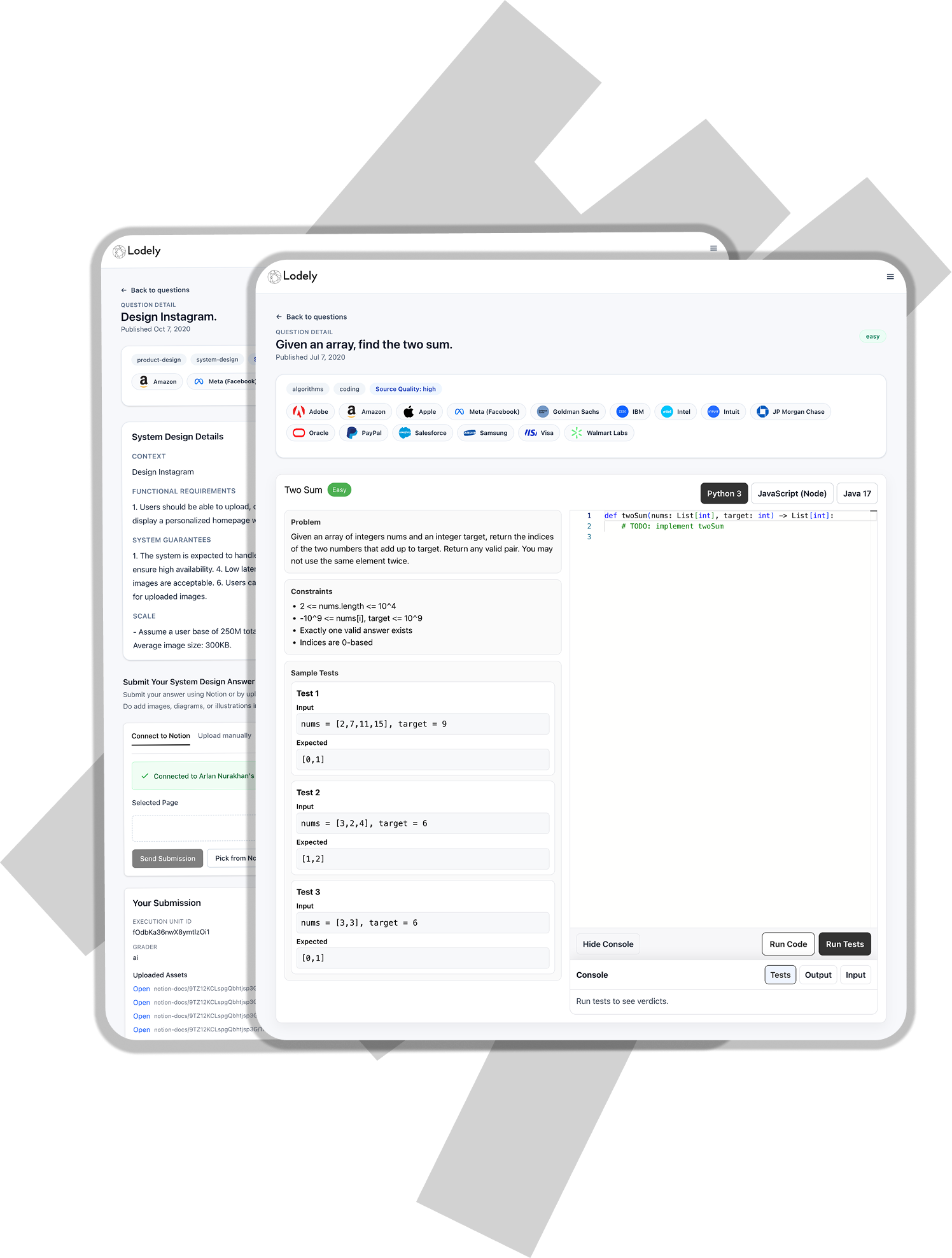
Use Lodely's Google-specific questions to practice the mix Google evaluates: coding, system design, and Googleyness-style behavioral judgment. Rotate formats during the week so you can switch among implementation details, architectural decisions, and leadership evidence without losing precision.

Google Interview Breakdown
Design a Reservation and Payment System for a Parking Garage
Design: System design, capacity and payments
Availability can change while a user selects a space and pays. The system must prevent two users from reserving the same space, place selections on hold, expire unconfirmed holds, and reconcile idempotent payments if availability changes during payment.
What It Tests: Requirements discovery, decision-making, transaction boundaries, failure recovery, and the distinction between availability reads and authoritative reservation writes. At scale, discuss garage partitioning, peak arrival traffic, and an audit history backed by durable writes.
Why Do You Think We Should Not Hire You?
Type: Googleyness and Leadership behavioral question about self-awareness.
Tip: Choose a genuine, specific weakness. Explain the system you use to manage it and the result. Disguised strengths sound evasive. Unmanaged weaknesses create doubt.
What It Tests: Judgment, honesty, coachability, and self-awareness. A new graduate might acknowledge limited production experience and explain how they learn quickly. A senior candidate should describe a tradeoff, the feedback they received, and its effect on the team's outcome.
Merge Intervals
Type: Sorting and interval processing.
What It Tests: Data transformation, correctness reasoning, complexity analysis, and concise implementation. Sorting drives the usual time complexity. Cover the empty-input assumption, one interval, nested intervals, and touching endpoints in your walkthrough.
Other questions:
Design a system to log messages in order. Define whether ordering is global or per producer. Discuss durable acknowledgements, leader failure, consumer offsets, retention, and the cost of strict global order.
Tell me about a time when you missed a deadline. Own the estimate or planning error. Explain when stakeholders learned about the risk, how you reduced its impact, and what changed in your planning afterward.
Generate Parentheses. Explain a constrained search that tracks how many opening and closing characters have been used. Show why pruning prevents invalid partial strings and how the output grows as the input increases.
Subarray Sum Equals K. Recognize that negative values make a simple expanding window unreliable. Explain how prefix sums and frequency counts identify earlier prefixes that produce the required difference.
What Comes After the Interview
Once the recruiter receives the interview feedback, Google determines whether the packet contains enough signal for the target level. Mixed feedback can lead to another interview.
Team matching is a source of uncertainty. You may meet hiring managers whose teams have approved openings and need your background. A match requires interest on both sides. Headcount can change while you wait, so keep other interview processes moving until you have a written offer.
Compensation data provides a reference point for evaluating an offer. U.S. software-engineer data, updated September 3, 2026, reports about $205K in annual total compensation for L3, $287K for L4, $425K for L5, and $636K for L6. As levels rise, the mix becomes more stock-heavy. Its L6 average includes $275K in base pay, $308K in annualized stock, and a $52K bonus.
If Google rejects your application, its application guidance says you must wait at least 90 days before applying to the same position again. Google also says technical applicants tend to be more successful after gaining 12 to 18 months of additional experience. Use any interview feedback to identify one or two concrete gaps before reapplying.
Candidate Experiences
Recent candidates report structured interview loops with uneven timelines. Early-career accounts mention three technical rounds and one Googleyness interview. Candidates emphasize explaining each solution, answering follow-up questions, and testing code by hand.
One senior candidate described detailed Googleyness follow-ups and an unexpected system-design round. Recent Glassdoor reports describe design interviewers probing partitioning, node failure, and consistency. Confirm your assigned rounds, then prepare one level deeper.
The timeline may be harder to predict than the interviews. One candidate's process lasted 254 days from the first step to an offer, including 147 days between hiring-committee clearance and a team-match call. That timeline is an outlier, but candidates commonly report waiting weeks or months for team matching. Ask your recruiter how often to check in and whether adjacent teams can consider you.
Conclusion
Google's 2026 SWE interviews test how clearly you reason, write and verify code, design from first principles, and demonstrate level-appropriate skills. Confirm the exact loop and tools, and keep other interview options open while the hiring committee and team-matching process continue.
Use Lodely for a final review of Google-specific coding, system-design, and behavioral questions. Focus on the format where you are weakest.
✉️ Get free faang interview cheat sheet and interview tips weekly
✉️ Get free faang interview cheat sheet and interview tips weekly


