


Meta Interview Questions: 10 from Real Interviews

Meta's typical software-engineering full loop includes four to six conversations lasting about 45 minutes each. The interviews focus on coding, design, and behavioral signals. Interviewers assess how you communicate, choose an approach, write clean code, verify your solution, design under ambiguous constraints, and explain the impact of your past decisions.
Your schedule depends on the role and target level. For example, product-engineer candidates may discuss product architecture, while infrastructure candidates may discuss distributed systems. Some candidates have also reported an online assessment or an AI-assisted coding interview. Confirm the schedule with your recruiter before finalizing your study plan.
The 10 questions below sample arrays, graphs, trees, prefix structures, large-scale product design, and conflict stories. Use them as timed practice. Meta's coding rounds move quickly, but you still need to explain and check your answer.
What to Expect: Meta Interview Process
Recruiters typically begin by discussing your experience, target position, location, and level. A technical screen usually follows. During the coding screen, discuss constraints, choose an approach, and write code in a shared editor. According to Meta's full loop guide, you should expect roughly two problems in 40 minutes. The code may not be compiled, so check it by hand.
The full loop includes four to six 45-minute interviews that often mix coding, design, and behavioral evaluation. Coding interviews are scored on Communication, Problem Solving, Implementation, and Verification. A correct function without an explanation provides incomplete evidence. State what each variable means, compare approaches, estimate time complexity and memory use, and demonstrate the solution with a small example.
The format varies by position. Systems-design interviews usually cover distributed systems, performance, scalability, availability, and failure scenarios. Product-architecture interviews focus more on APIs, data models, client-server separation, usability, and product evolution. In either format, define the requirements before building the components. Interviewers expect you to lead the conversation and respond to new constraints.
The behavioral interview lasts about 45 minutes. Meta's guide lists five signals: resolving conflict, growing continuously, embracing ambiguity, driving results, and communicating effectively. Prepare several real project examples that demonstrate those skills. Know which decisions you owned, which options you rejected, the outcome, and what you learned.
The process has changed. Many candidates in 2025 and 2026 described a 90-minute online assessment before the phone screen and an AI-assisted coding round during the onsite loop. One recent 2026 candidate report described a 45-minute technical screen followed by a conventional coding round, a 60-minute AI-assisted coding round, design, and behavioral interviews. Other candidates still described a traditional loop with two coding rounds. Ask whether your process includes an assessment, which design format it uses, and whether you can use AI tools in any round.
How to Prepare and Pass Meta Interviews
If your fundamentals are current, plan four to six weeks. If you need to rebuild your understanding of graphs, tree invariants, or system design, plan eight to twelve weeks. Include coding, design, and behavioral preparation from the first week. Delaying design and story preparation creates unnecessary risk.
Practice coding speed. Run 40-minute coding sessions with two questions. Use the first minute to confirm inputs, outputs, and corner cases. Explain a simple solution and then refine it. Reserve the last few minutes for a dry run. Meta explicitly evaluates whether you can find your own bugs and convince the interviewer that your solution is correct.
Cover breadth before obscure depth. Review arrays, strings, hash maps, stacks and queues, trees, graphs, heaps, sorting, recursion, and divide-and-conquer. The Meta guide explicitly says interviewers don't ask dynamic-programming questions. Breadth matters because time pressure rewards fast pattern recognition across implementations.
Practice without execution support. Use a plain editor several times each week. Write indexes, queue state, recursion limits, and null cases on paper. This discipline makes you faster even when the interview provides a more capable environment.
Separate the design tracks. For system design, rehearse requirements, rough scale, APIs, data model, major components, bottlenecks, failure modes, and trade-offs. For product architecture, add client behavior, usability, data ownership, protocols, and future product changes. Practice a full 35-minute design session and leave time for follow-up questions.
Create a behavioral story bank. Prepare six to eight stories that show how you resolve conflict, grow, navigate ambiguity, deliver results, and communicate. Use a simple situation, task, action, result structure, with most of the detail on your actions. Include a concrete result when you have one. Cover disagreements, mistakes, stakeholder communication, and what you would do differently.
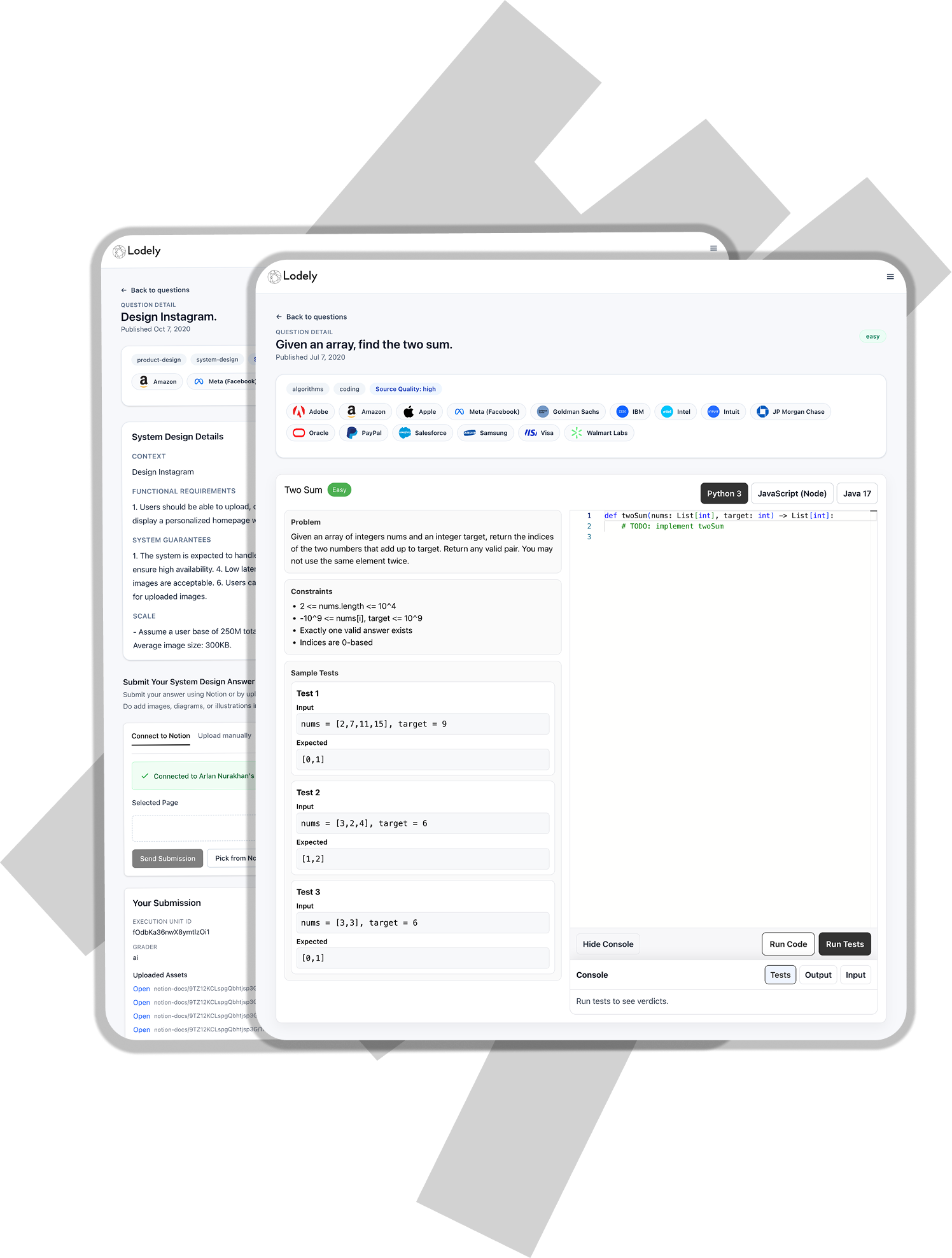
Use Lodely to practice Meta-specific coding, system-design, and behavioral questions. Detailed editorials explain the reasoning behind each answer, and target-company sets focus your practice on the patterns you're most likely to face.

Meta Interview Breakdown
Merge Sorted Arrays
function mergeSortedArrays(nums1, m, nums2, n)- You are given two sorted integer arrays nums1 and nums2, and integers m and n.
- Merge nums2 into nums1 as one sorted array and return nums1.
nums1.length == m + nnums2.length == n0 <= m, n <= 200-10^9 <= nums1[i], nums2[i] <= 10^9
nums1 = [1,2,3,0,0,0], m = 3, nums2 = [2,5,6], n = 3
[1,2,2,3,5,6]
nums1 = [1], m = 1, nums2 = [], n = 0
[1]
Type: Two pointers on sorted arrays.
The Trick: There is open capacity at the end of the destination array. Values at the beginning can be overwritten, so work backward from the largest elements to the smallest. Take care when one array still has elements after the other is exhausted.
What It Tests: Respecting the in-place constraint, maintaining correct pointer invariants, and handling empty arrays. Explain why reverse assignment avoids data loss, then dry-run the algorithm when every element in the second array is smaller than every element in the first.
Bipartite Graph
function isBipartite(n, edges)- Given an undirected graph with n nodes (labeled 0 to n-1) and a list of edges, determine whether the graph is bipartite.
- A graph is bipartite if you can partition its nodes into two sets such that every edge connects a node in one set to a node in the other set.
- Use BFS or DFS coloring to solve this.
1 <= n <= 10^40 <= edges.length <= 10^4edges[i].length == 20 <= edges[i][0], edges[i][1] < nNo self-loops or duplicate edges
n = 4, edges = [[0,1],[1,2],[2,3]]
true
n = 3, edges = [[0,1],[1,2],[0,2]]
false
Type: Graph traversal with two-color assignment.
The Trick: The graph may be disconnected. If you start at one node, you may miss an odd-length cycle in another component. Visit every component, alternate colors, and reject an edge when its endpoints share a color.
What It Tests: This checks graph representation, BFS or DFS, and invariant reasoning. Call out self-loops, isolated vertices, and disconnected components before you code.
Design Instagram
Type: Product architecture and high-scale system design.
The Trick: The first design decision is how to build the feed. Precomputing feed information improves read latency but creates heavy fan-out for accounts with many followers. Building the feed on demand avoids write amplification but requires more read work. A strong answer discusses this trade-off and suggests a hybrid solution.
What It Tests: Define the product scope before drawing the system. Cover image upload and storage, metadata, follows, feed creation, caching, pagination, content delivery, reliability, and observability. Make assumptions explicit. Explain what happens if an upload succeeds but feed creation is delayed.
The other seven questions expand on the same signals.
How do you handle a conflict? Describe a specific example, your actions, and the outcome. Focus on what you did without blaming the other person. Explain how you gathered information, changed the decision process, and kept the work moving.
Determine if a given binary tree is a binary search tree (BST). This tests whether you can carry valid lower and upper bounds through the whole tree. Comparing a node with only its parent and children misses deeper violations. Explain how you handle duplicate values and empty trees.
Squares of a sorted array. The largest square comes from one of the two ends. Compare absolute values and fill from right to left. Explain why the algorithm is linear time, and test an input containing only negative values.
Implement Trie. Support insertion, exact search, and prefix search. Distinguish an existing path from the end of a complete word. The interviewer will assess how you structure nodes, handle the empty string when it's in scope, and distinguish a full word from a prefix.
Design a chat service or feed API. Define product requirements and API boundaries. For chat, clarify ordering, delivery acknowledgments, offline users, and message history. For a feed API, clarify pagination, ranking, freshness, privacy, and recovery from duplicated or missing pages.
Designing Facebook's Newsfeed. Discuss fan-out, ranking, caching, privacy changes, and failure recovery. Explain where candidate posts come from, how the system scores them, and when cached feeds become stale. Map each component to a requirement and explain its purpose.
Tell me about a time when you dealt with a difficult person at work. This tests your judgment and empathy. Use a real example in which the difficulty affected you or the work. Describe the person's harmful behavior, how you addressed it directly, how you adjusted your approach, and how the change affected the team or project.
What Comes After The Interview
Ask your recruiter when you should expect an update. Meta's guide says you can follow up if you haven't heard within a week of the interviews. Even before a decision, you can discuss level, role, location, or team fit. Share deadlines from other processes with your recruiter.
Compensation varies by level and location. U.S. Meta software engineer salary data as of September 17, 2026, shows average annual total compensation of about $195,000 at E3, $305,000 at E4, $435,000 at E5, and $693,000 at E6. These are self-reported market figures, not guaranteed offers. Equity is a larger portion of compensation at higher levels, so evaluate base pay, target bonus, annualized stock, vesting, refreshers, and sign-on money separately.
If you're rejected, record the feedback while the interview is fresh. Note what you did, which questions you received, where you got stuck, which assumptions you missed, and where your explanation became unclear. Meta's feedback may be limited, but your notes will give you a concrete plan for the next interview.
Candidate Experiences
Candidate reports give clear, structured descriptions of what to prepare and how the rounds work. The main difficulty is maintaining pace. In coding rounds, candidates often need to solve two problems with enough time to test both. Candidates who explain each decision and hand-test edge cases after a mistake give interviewers more evidence than candidates who code silently.
Design is a recurring pressure point. Some candidates in 2025-2026 prepared for distributed systems but received product-architecture prompts; others expected a large-scale service but received an API-driven product. Ask your recruiter to confirm the format. During the interview, spend the first few minutes defining the product, users, scale, and success criteria so you don't give a well-organized answer to the wrong problem.
Reports on newer AI-assisted rounds emphasize verification. Candidates may work in a small codebase with tests and an AI assistant. The same engineering judgment applies: inspect the code, give the assistant a precise task, review every change, run relevant tests when allowed, and explain the result. Accepting AI-generated code without review is a weak signal even when the code is correct.
Behavioral rounds are direct. Interviewers will follow up if your story focuses on the team without explaining your role. Gather relevant numbers, but don't claim a metric you didn't track. A clear before-and-after result, your decision, and what you learned provide evidence of ownership.
Conclusion
Meta interviews look for fast, verifiable coding, structured design decisions, and evidence of impact. Practice all three tracks within time limits. Use Lodely to work through Meta interview patterns, compare your reasoning with detailed editorials, and keep coding, system-design, and behavioral preparation connected through the final week.
✉️ Get free faang interview cheat sheet and interview tips weekly
✉️ Get free faang interview cheat sheet and interview tips weekly
