


Microsoft Interview Questions: 5 from Real Interviews

Microsoft software-engineering interviews typically combine live coding with discussions of design, testing, past projects, and collaboration. Microsoft's technical-interview guidance says technical rounds last 45 minutes each, while its general hiring guidance says most roles use two to four interviews lasting up to an hour. The order and timing vary by team and role, so use your recruiter's schedule to finalize your preparation plan.
Across formats, clarify the problem, choose a sensible approach, write runnable code, test it, and explain the trade-offs. Give examples that show how you handle ambiguity and disagreement. Interviewers need evidence of both a tested solution and clear communication.
What to Expect: Microsoft Interview Process
Microsoft reviews your application first. The company says a hiring team may schedule a short screening chat after reviewing your resume, and each team handles this step differently. Software-engineering roles may also use a coding assessment or technical screen before the full loop. Ask the recruiter whether the assessment is pass/fail, whether it includes coding, and which environment you'll use.
During the full loop, you'll likely speak with engineers, managers, and cross-functional partners. Microsoft's hiring page describes two to four interviews lasting up to an hour, held by phone, Teams, or in person. The actual count varies: one entry-level engineer reported three 45-minute rounds, while an SWE II candidate described a screen followed by five loop interviews. Experience level, specialization, and team practices can change the count.
Microsoft's official technical-interview guidance says interviewers assess problem solving, design, coding, and testing. Plan before coding, use a language you know well, and write and run executable code in a third-party coding tool. Interviewers also assess algorithms, data structures, distributed systems, service architecture, resiliency, replication, partitioning, and security edge cases.
Technical rounds combine behavioral and technical questions, with topics carrying across the conversation. A project you discuss before coding may return during a design prompt, and an earlier technical choice may lead to questions about customer impact. Prepare for those transitions. Treat time without an open editor as part of the interview.
After the loop, the interview team provides feedback and the recruiter communicates next steps and timing. Ask when to expect an update and whether the role is tied to one team or allows broader team matching.
How to Prepare and Pass Microsoft Interviews
Start with the recruiter's email and the job posting. Next, list every confirmed interview format, the technical area, and the roles of the people you will meet. If the schedule says only “technical interview,” ask whether that means coding, low-level design, large-scale design, or a project deep dive.
If your fundamentals are current, use a four-week plan. Spend week one on core data structures and common patterns, week two on timed coding with spoken explanations and testing, week three on system design with role-based topics, and week four on full mock loops that mix technical and behavioral questions. If you are rebuilding fundamentals, stretch the same sequence across eight weeks.
Plan before you type. Clarify the input and constraints, work through a small example, and name the data structure you want to use. This gives the interviewer a chance to point out a flawed assumption before you spend the rest of the round on it.
Write code that can run. Microsoft says not to use pseudocode. Keep functions small and names meaningful. Don't build a framework for a small problem. Once the core code works, test empty input, duplicate input, boundaries, malformed spacing, and other relevant cases.
Treat test cases as part of the answer. Describe the solution's complexity, then walk through a normal case and at least two edge cases. For design problems, testing covers failure handling, monitoring, capacity limits, data loss, concurrency, and security.
Prepare two project stories at different depths. Have a two-minute summary and a ten-minute technical version. Be specific about your contribution, constraints, alternatives, outcome, and what you would change now. The interviewer may open your resume to a detail you treated as a footnote.
Build a behavioral story bank. Prepare examples of conflict, blocked work, failure, customer impact, prioritization, learning, and influencing without authority. Use situation, task, action, result, and learning as a compact structure. Your actions should make up most of the answer.
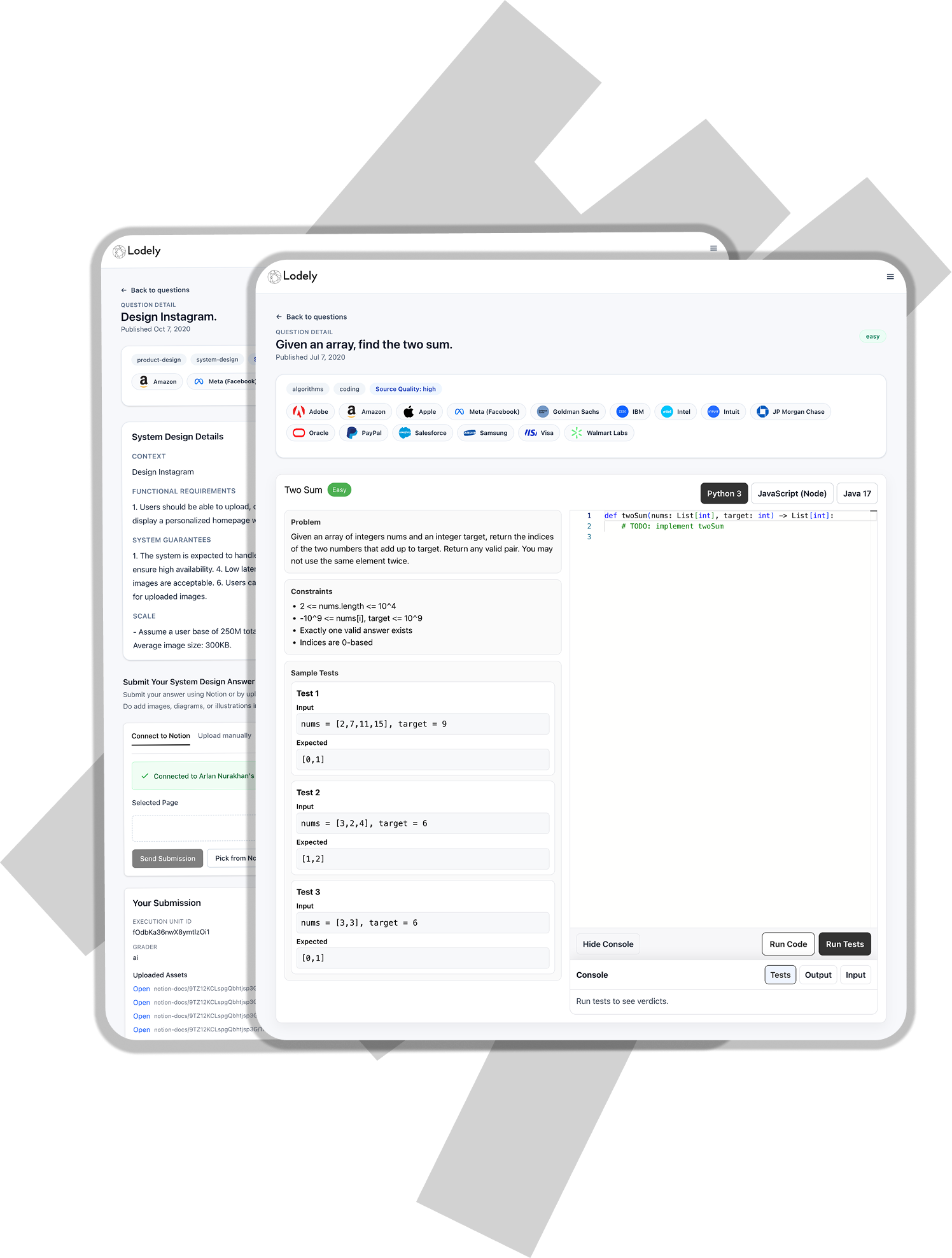
Use Lodely to practice Microsoft coding, system-design, and behavioral questions in one session. This teaches you to identify the format, choose a structure, and work efficiently under the time limit.

Microsoft Interview Breakdown
The set includes five questions: two coding problems, one system-design question, and two behavioral questions. Rehearse the first three in full.
Reverse a Sentence
function reverseWords(s)- Given an input string s, reverse the order of the words.
- A word is defined as a sequence of non-space characters.
- The words in s will be separated by at least one space.
- Return a string of the words in reverse order concatenated by a single space.
- Note that s may contain leading or trailing spaces or multiple spaces between two words.
- The returned string should only have a single space separating the words.
- Do not include any extra spaces.
1 <= s.length <= 10^4s contains English letters (upper-case and lower-case), digits, and spaces ' '
s = "the sky is blue"
"blue is sky the"
s = " hello world "
"world hello"
Type: String parsing with two pointers or tokenization.
The Trick: The input may contain leading or trailing spaces and multiple spaces between words. Reverse the words and leave exactly one space between them. Clarify whether you may use split and join helpers, and explain the memory use.
What It Tests: Edge-case handling, string manipulation, complexity analysis, and test coverage. Before finishing, walk through inputs containing only spaces, one word, and repeated internal spaces.
Product of Array Except Self
function productExceptSelf(nums)- For a given integer array, create an output array where each element at position i is the product of all the input array's elements except the one at position i.
1 <= nums.length <= 10^5-30 <= nums[i] <= 30The product of any prefix or suffix fits in a 32-bit signed integer
nums = [1,2,3,4]
[24,12,8,6]
nums = [-1,1,0,-3,3]
[0,0,9,0,0]
Type: Array traversal using prefix and suffix products.
The Trick: Division fails the intended constraints and is awkward around zero values. Build the result from products to the left and right of each position. Explain how to reuse the output array without increasing auxiliary space.
What It Tests: This checks whether you can find an efficient linear-time solution, reason about zeros and negative values, and state your space requirements precisely. Test one zero, multiple zeros, a single-element array, and mixed signs.
Design a Leaderboard System
Type: Large-scale system design for real-time score updates and ranked reads.
The Trick: “Leaderboard” can describe several products. Choose the global, regional, friend, tournament, or time-window view before setting the storage method. Define tie-breaking rules, update latency, read latency, durability, and whether submitted scores can decrease.
What It Tests: This evaluates requirements, APIs, data modeling, partitioning, caching, concurrency, and recovery. Explain how you would retrieve top players, a single player's rank, and nearby ranks without scanning the full population. Then explain how periodic boards close and become history.
The two behavioral questions cover the remaining topics. What do you do if your team is blocking you? This question tests whether you can distinguish a dependency from a conflict, communicate the impact early, present options, and escalate without blame. Give a specific example from your work, including dates or milestones, your actions, and the outcome.
Why do you think you would be a good fit for Microsoft's mission? Product enthusiasm alone isn't enough. Connect Microsoft's mission to the team's real customers, a project you've completed, and the engineering contribution you'd like to make. Name the team's problem space and give the interviewer a concrete reason to believe you can help.
Run all five questions as one sequence on Lodely. That exposes a common weakness before interview day: being comfortable with each topic separately but losing structure when the format changes from code to design to behavioral.
Microsoft Software Engineer Compensation by Level
Offer stakes vary by level. Current United States reports put average annual total compensation at $157,000 for level 59, $184,000 for level 60, $192,000 for level 61, $207,000 for level 62, $243,000 for level 63, and $268,000 for level 64. These crowdsourced figures aren't guaranteed. Individual offers can vary with location, specialty, competition, and stock value.
The structure matters as much as the total. Reported packages combine base salary, annualized stock, and bonus. The stock component tends to increase with level, and reported RSU schedules normally vest 25% per year over four years. Compare the exact grant, vesting cadence, target bonus, sign-on payment, and refresh policy rather than first-year cash alone.
Ask the recruiter to confirm the numeric level. Microsoft has adjacent numeric levels, so “SDE II” or “Senior” alone doesn't explain the package or expected scope. Compare the job description and compensation at the same level.
What Comes After the Interview
After the loop, send a brief thank-you note to the recruiter. Reference one substantive part of the conversation and reiterate your interest. Don't email to correct every answer. If you found a material error, state the correction once and keep it short.
If your promised update date passes, ask the recruiter about status, next steps, and a revised timeline. Delays can reflect scheduling or comparison with other candidates; they don't reveal the outcome by themselves. Continue other interviews until you have a written offer.
When you receive an offer, confirm the numeric level, team, manager, location, base salary, annual bonus target, stock, vesting schedule, sign-on payment, and deadline. Ask whether the equity figure is the full grant or an annualized amount. If the role or level differs from what you discussed, address that before negotiating other details.
Candidate Experiences
Recent candidate accounts focus on executable code and resume depth. One successful 2025 U.S. candidate reported an online assessment followed by three 45-minute interviews: one technical, one behavioral, and one mixed. Interviewers asked about resume experience in every round, and the candidate was expected to write unit tests and run the code.
A detailed February 2026 SWE II account describes an initial screen followed by five interviews covering coding, system design, project experience, and a senior interview. The candidate reported behavioral or experience questions in every interview and additional optimization requirements for several coding problems. Another candidate in the same thread described an assessment followed by four interviews, further showing how team and level affect the process.
Another early 2026 candidate completed three 45-minute interviews with managers and an engineer. Coding was prominent, but the loop also covered cross-functional conflict, unresponsive teammates, production incidents, and work history. This account matches Microsoft's public guidance: interviewers consider implementation, problem solving, testing, design judgment, and past experience.
Use candidate reports to identify patterns. Your exact questions may differ. The consistent themes are runnable code, evidence of testing, clear explanations, and specific examples of your work. The number of rounds and discussion topics vary.
Conclusion
Microsoft software-engineering interviews assess clear planning, runnable code, solid testing, sound design trade-offs, and evidence that you work well with others. Learn your loop, practice all five example questions end to end, and rehearse the same transitions among coding, system design, and behavioral discussion on Lodely.
✉️ Get free faang interview cheat sheet and interview tips weekly
✉️ Get free faang interview cheat sheet and interview tips weekly