


LinkedIn Interview Questions: 9 Questions to Prepare for in 2026

LinkedIn's software-engineering process starts with a recruiter conversation and a technical screen, followed by role-specific interviews with engineers and leaders. Recent staff-level candidates reported completing five interviews in one day. Interviews can include coding problems, system-design questions, a project deep dive, a craftsmanship question, and a conversation with a host and a manager.
Your loop depends on the level and team. Confirm every round with your recruiter, especially any AI-assisted coding round. Regardless of format, each loop tests whether you can understand the problem, make decisions, test your work, and explain its value to the user or business.
What to Expect: LinkedIn Interview Process
According to LinkedIn's engineering careers page, engineers can be evaluated on communication, coding, craftsmanship, engineering design or architecture, and leadership. After the technical screen, candidates typically complete several interviews that evaluate implementation, product-focused system design, past work, and collaboration.
Candidates for Senior and Staff roles report many sessions lasting 45–60 minutes. Coding follow-ups can cover concurrency and production concerns. Design questions often use LinkedIn products such as notifications, search, messages, and recommendations. Define the user experience before choosing the infrastructure.
How to Prepare and Pass LinkedIn Interviews
If your fundamentals are current, take four to six weeks. If you're rebuilding algorithms or distributed systems depth, take eight to twelve weeks. Rotate among coding, system-design, and behavioral practice throughout your preparation.
- Make your code complete. State assumptions, choose a data structure, implement cleanly, and trace edge cases. Practice extending a solution with expiration, thread safety, or scale.
- Design the product first. Clarify users, latency, privacy, freshness, ordering, and failure behavior. Then define APIs, data, services, and operational metrics.
- Prepare two detailed stories. Walk through one project from the initial problem to the post-launch results. Use the second to show how you influenced a disagreement, including the decisions and outcomes.
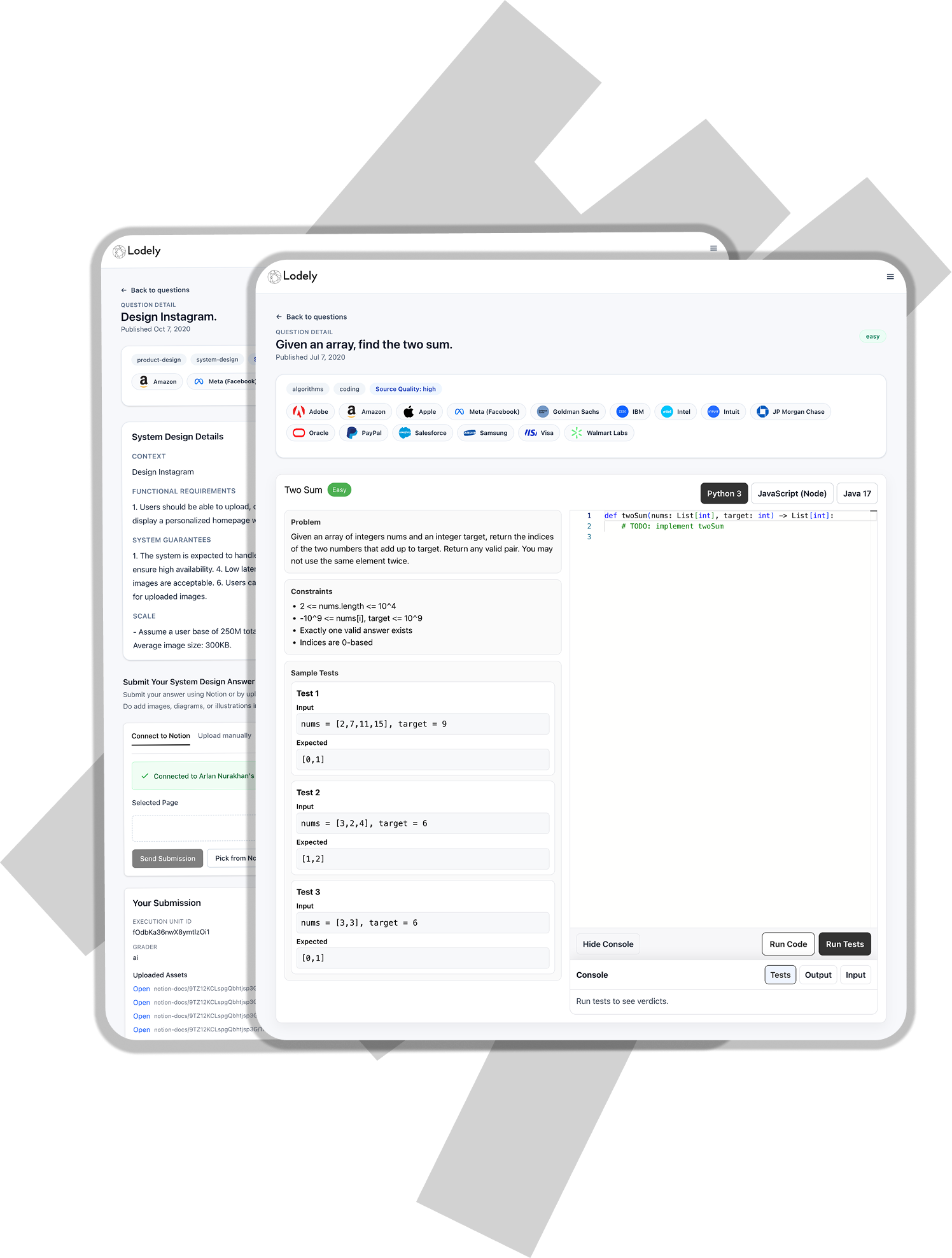
Use Lodely each week to switch among LinkedIn coding, system-design, and behavioral questions. This helps you identify gaps between the formats before the full loop.

LinkedIn Interview Breakdown
Implement LRU Cache
function lruCacheOperations(operations, arguments)- Design a data structure that follows the constraints of a Least Recently Used (LRU) cache.
- Implement the LRUCache class: LRUCache(int capacity) initializes the cache with positive size capacity. int get(int key) returns the value of the key if it exists, otherwise returns -1. void put(int key, int value) updates the value if the key exists, otherwise adds the key-value pair.
- If the number of keys exceeds the capacity, evict the least recently used key.
- The get and put operations must each run in O(1) average time complexity.
1 <= capacity <= 30000 <= key <= 10^40 <= value <= 10^5At most 2 * 10^5 calls will be made to get and put
['LRUCache', 'put', 'put', 'get', 'put', 'get'], [[2], [1,1], [2,2], [1], [3,3], [2]]
[null, null, null, 1, null, -1]
['LRUCache', 'put', 'get', 'put', 'get', 'get'], [[1], [1,10], [1], [2,20], [1], [2]]
[null, null, 10, null, -1, 20]
Type: Hash-map and linked-structure implementation.
The Trick: Reads and writes both change recency, and an insertion at capacity must remove the correct entry. Each operation should run in constant average time. Explain every pointer and ordering update.
What It Tests: Data-structure composition, invariants, edge cases, complexity, and readiness for concurrency or expiration follow-up.
Valid Parentheses
function isValid(s)- Given a string s containing just the characters '(', ')', '{', '}', '[' and ']', determine if the input string is valid.
- An input string is valid if: Open brackets are closed by the same type of brackets.
- Open brackets are closed in the correct order.
1 <= s.length <= 10^4s consists of parentheses only '()[]{}'.
s = '()'
true
s = '()[]{}'
true
s = '(]'
false
Type: Stack-based string validation.
The Trick: Reject a closing bracket when the latest unmatched opener has a different type. Finish by checking that no opener remains.
What It Tests: Choosing a minimal structure, handling malformed order, and testing empty, nested, and adjacent groups.
Permutations
Type: Backtracking over distinct values.
The Trick: Keep a clear used-state invariant and output in the requested lexicographic order. Explain why each branch yields one unique arrangement.
What It Tests: Recursive state, pruning, output-sensitive complexity, and careful backtracking.
The other six questions broaden the scope. Design a person search with typeahead autocomplete for LinkedIn covers low latency, ranking, freshness, and privacy. Walk me through one project end-to-end assesses ownership and what you learned after launch. LinkedIn Valid Number tests exact parsing of signs, decimals, and scientific notation. Personalized InMail Drafting System covers grounding, privacy, safety, and human review in an AI product. Distributed Messaging System covers ordering, durable delivery, offline sync, and attachments. Influence an architecture decision without being the final decision-maker asks how you communicate tradeoffs and build alignment.
What Comes After The Interview
Talk to the recruiter about when feedback will be compiled and whether team matching or leveling is included in the decision. If an offer comes through, compare base salary, annualized equity, bonus, vesting, and expectations at that level.
Candidate Experiences
Reports from 2026 frequently describe follow-up questions after the initial answer. Candidates mention questions about deduplication, thread safety, failure recovery, engineering quality, and cross-team decisions. In a September 2026 Staff-loop report, one interview included an AI-assisted coding round, though that format is not guaranteed. Prepare for it only when your recruiter confirms it.
Conclusion
LinkedIn rewards clear implementation, product-aware design, and evidence of ownership. Finish with a timed mixed practice session on Lodely so each answer is specific to the company and round.
✉️ Get free faang interview cheat sheet and interview tips weekly
✉️ Get free faang interview cheat sheet and interview tips weekly


