


Adobe Interview Questions: 9 from Real Interviews

Adobe's software engineering process starts with a Talent Partner, then a hiring manager and role-specific team interviews. Technical roles can include coding, system design, project depth, and behavioral judgment. The team decides the mix, so confirm your schedule before narrowing your preparation.
This guide covers Adobe's team-specific process, a targeted preparation plan, and nine questions spanning coding, system design, machine learning, and behavioral judgment.
What to Expect: Adobe Interview Process
After review, Adobe's hiring guide lists a Talent Partner call, hiring-manager conversation, and skills assessment or team interviews. Technical roles can add coding, system design, or portfolio review. Your recruiter will specify the formats for your product group and level.
A recent MTS-2 frontend candidate reported an HR screen and five rounds covering data structures, JavaScript, React, machine coding, frontend system design, and behavioral questions. This reflects one team-specific loop. Ask about language, editor, design scope, and technical content in the manager round.
How to Prepare and Pass Adobe Interviews
Give yourself four to six weeks if fundamentals are current, or eight to twelve weeks if you’re rebuilding algorithms and system design.
- Match the role. Frontend developers need framework internals, state, browser behavior, and practical UI work. Backend and platform developers need APIs, storage, concurrency, reliability, and operational trade-offs.
- Practice complete coding rounds. State constraints, choose an approach, code cleanly, test edge cases, and explain complexity.
- Build ownership stories. Cover production failures, prioritization, and stakeholder pressure with the decision, trade-off, and result.
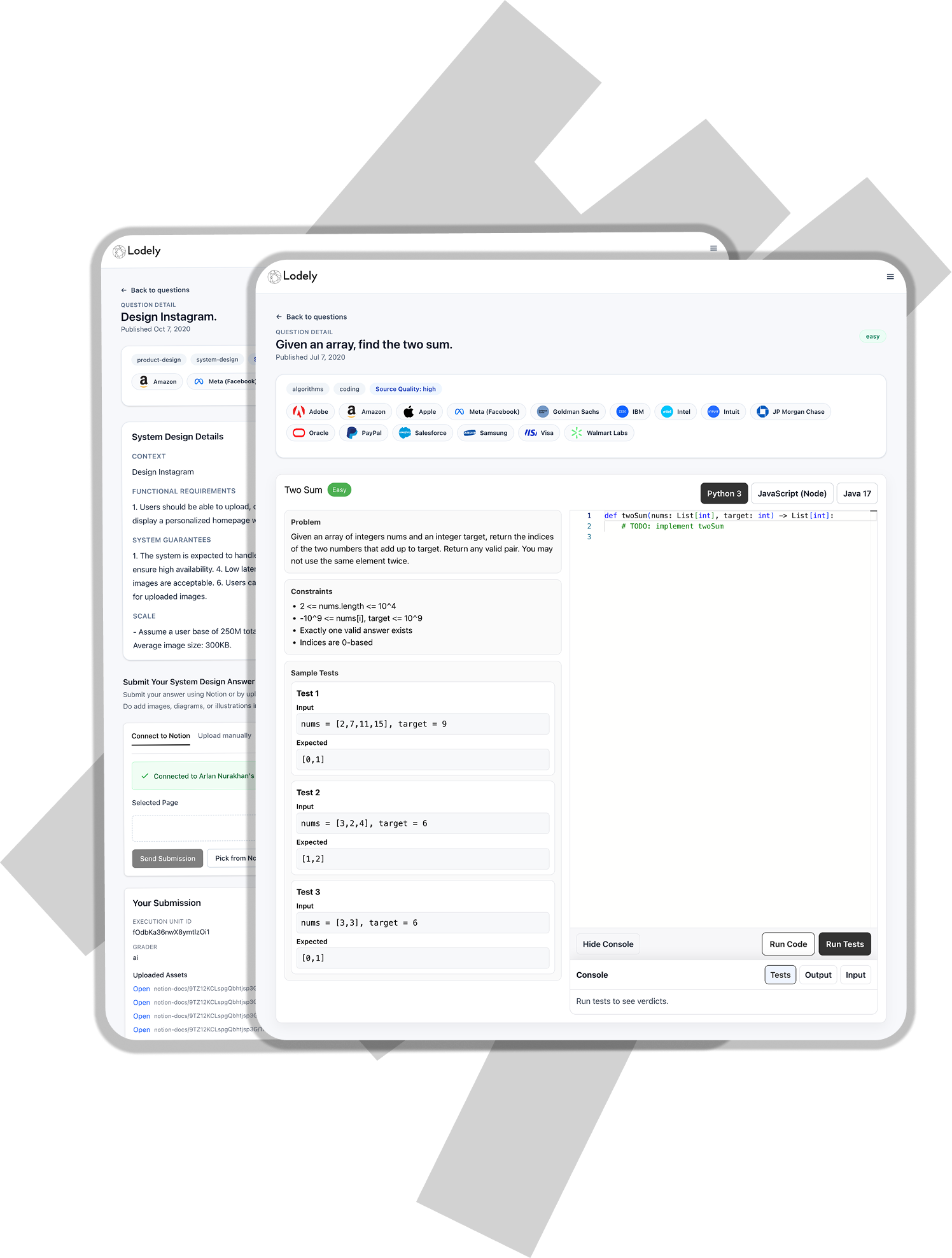
Use Lodely to rotate through Adobe-focused coding, system-design, and behavioral questions. Mixing formats in one practice schedule reveals gaps before the loop.
Adobe Interview Breakdown
React Team Builder with Role Constraints
Type: Practical React implementation with state and validation rules.
The Trick: Keep minimum and maximum role constraints consistent while adding players, showing details, and sorting. Test for accidental state mutations.
What It Tests: Component boundaries, predictable state updates, constraint handling, and testable UI logic.
Auto-Complete Search System
Type: Prefix-retrieval coding and ranking.
The Trick: Define how top predictions change as frequencies update. A fast read path needs both efficient prefix lookup and a strategy for refreshing rankings.
What It Tests: Data structures, ranking, caching, update cost, and API trade-offs.
How Do You Prioritize Tasks?
Type: Behavioral judgment and program management.
The Trick: Use a real conflict among deadlines, dependencies, customer impact, and technical risk. Show how you aligned stakeholders instead of listing a private to-do list.
What It Tests: Scope awareness, communication, evidence-based trade-offs, and ownership.
Six questions remain: Edit Distance (dynamic programming), Top K Frequent Elements (counting and selection), Data Leakage, Missing Data, and Loss Functions (model validity and metrics), Implement LRU Cache (constant-time lookup and eviction), Recommendation System Evaluation (offline metrics and online experiments), and Meeting Interval Conflicts (sorting and overlap boundaries).
What Comes After The Interview
Adobe says the hiring team debriefs before Talent communicates the decision. An accepted offer includes eligibility documentation, a background check, and a conflict-of-interest questionnaire. Confirm level, team, base, bonus, equity, vesting, and deadline before comparing offers.
Candidate Experiences
One recent MTS-2 candidate described five rounds covering JavaScript execution, React internals, state-management trade-offs, and production incidents. A team change added about three weeks to the process, and the candidate received an offer 37 to 39 days after the first interview. The loop combined algorithms, product implementation, and project discussion. Prepare to explain both frontend internals and production decisions.
Conclusion
Adobe values clean code, depth, and ownership stories. Practice the nine selected questions in Lodely as a mixed loop, then focus your final review on the format where your explanations are least precise.
✉️ Get free faang interview cheat sheet and interview tips weekly
✉️ Get free faang interview cheat sheet and interview tips weekly

