


Twitter Interview Questions in 2026: 7 Examples

Twitter, now called X, does not have a single public software-interview process; each team has its own. Recent candidate reports describe an initial screen followed by hands-on technical interviews and, depending on the role, possible additional coding, system-design, project, and behavioral interviews. You need to reason through tradeoffs quickly and apply that reasoning to a real-time social product.
What to Expect: Twitter Interview Process
Reports vary enough that you should ask the recruiter for the exact process. An engineering interview may include a background screen, live coding or feature building, and a later loop covering design and previous work. A mobile-engineering interview may also require you to rebuild a product feature in the language you're moving to while an engineer observes your decisions.
Expect technical questions about the product itself: feeds, APIs, connection graphs, abuse controls, and services that remain available during traffic spikes. In senior-role interviews, expect a requirement change and questions about skew, retries, and partial failures.
How to Prepare and Pass Twitter Interviews
Plan six weeks: two on coding and data structures, two on distributed feeds and APIs, and two on project stories and timed mocks. Before coding, practice turning a fuzzy request into users, constraints, interfaces, and success metrics.
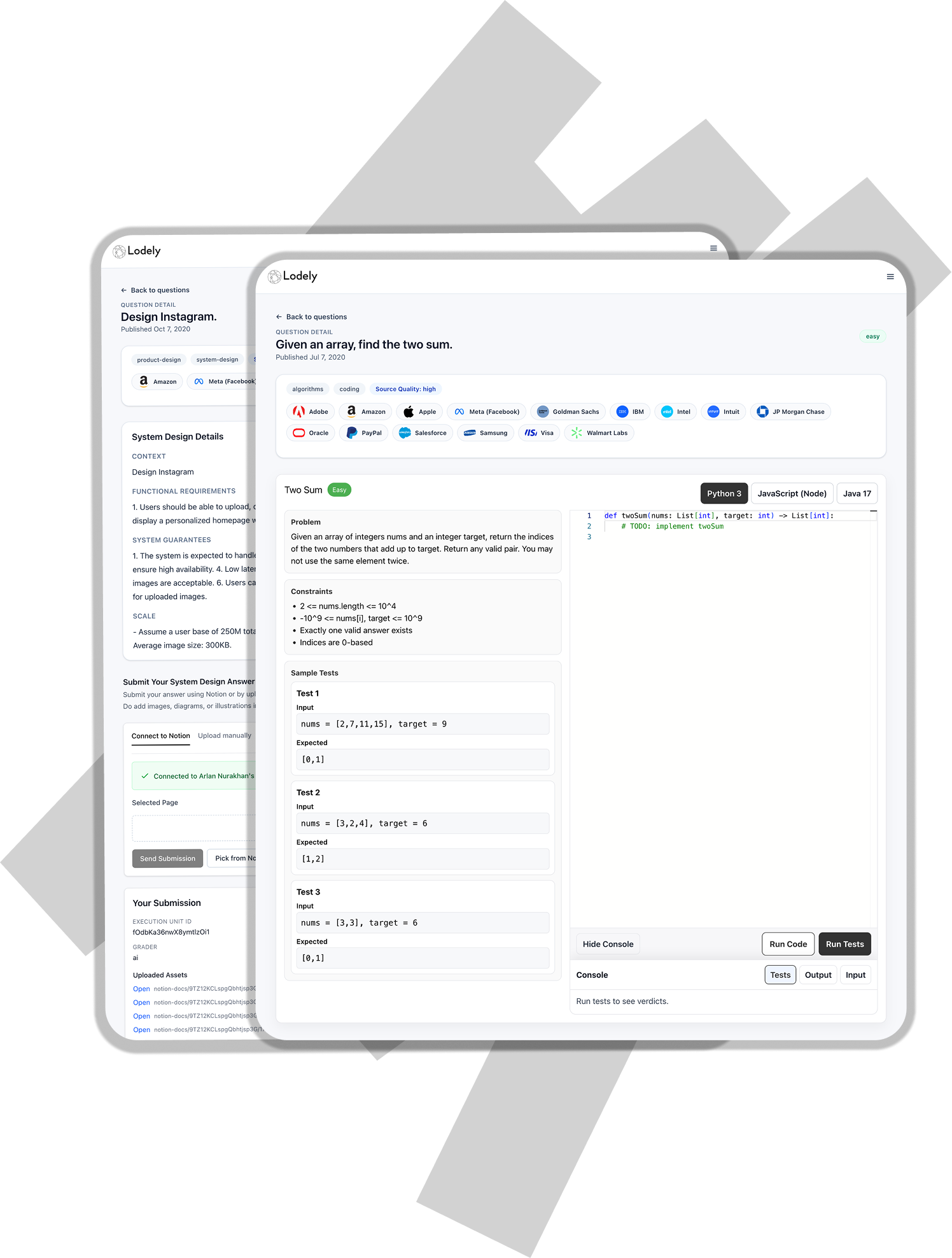
Use Lodely to practice questions as they appear in Twitter interviews, then compare your answer with the editorial. Learn the underlying pattern so changes in surface details do not derail your solution.

Twitter Interview Breakdown
Tell Me About the Most Complex Project You Have Led
Type: Behavioral and technical deep dive. What It Tests: Scope, leadership, and technical judgment. The Trick: Explain why the project was complex, state the decisions you made, quantify the impact, and make your contribution clear.
Design Remote Tic-Tac-Toe
Type: System and object design. What It Tests: State synchronization, turn validation, and failure recovery. The Trick: Define who controls the authoritative game state and how the system recovers from a connection loss.
Create a Customized Newsfeed
Type: Product system design. What It Tests: Ranking input, fan-out strategy, freshness, and observability. The Trick: State the problem's latency or relevance requirement before deciding whether precomputed or request-time work is better.
Other examples are Twitter API design, People You Might Know, why you want to join Twitter, and offensive comment identification and blocking. They assess interface design, graph reasoning, motivation, and safety.
What Comes After The Interview
When closing on a hire, the team takes into consideration the technical output, the amount of work, and if it is the right role for the candidate. Reported average U.S. compensation in 2026 is $183K for entry-level SWEs and rises to $507K for Staff SWEs. Equity and bonuses make up a larger share of compensation at higher levels.
Candidate Experiences
A recent Android candidate described a multiround process that began with a screening call. Next, a team engineer asked the candidate to rebuild some existing Kotlin code and explain it while working. The candidate found the round difficult but the conversation positive and did not receive an offer. Practice coding a small part of a product while explaining state, tests, and tradeoffs.
Conclusion
Twitter interviews test technical reasoning across real-time systems, product safety, and hands-on coding. Use Lodely's real interview questions to practice these patterns under time pressure and tighten your explanations.
✉️ Get free faang interview cheat sheet and interview tips weekly
✉️ Get free faang interview cheat sheet and interview tips weekly