AlgoMonster Review: Pros, Cons & Final Verdict

AlgoMonster bets you don't need 3,000 problems to pass a coding interview. You need 48 patterns. Learn the patterns, internalize the templates, and you can decompose almost any problem a FAANG interviewer throws at you. That's a bold claim — here's whether it actually holds up.
Most interview prep platforms give you a mountain of problems and let you figure out the connections yourself. AlgoMonster flips the script: it starts with the pattern, teaches you why it works, gives you a reusable code template, then drills you on variations. The promise is a shorter, more efficient path to interview readiness — completable in 4 to 8 weeks instead of months of aimless grinding.
This review covers what AlgoMonster actually delivers, where the pattern-based approach hits its limits, and who should (and shouldn't) use it.
What Is AlgoMonster?
AlgoMonster was built by ex-Google engineers who noticed the same thing most interview candidates eventually realize: coding interviews recycle the same underlying patterns over and over. Two pointers. Sliding window. BFS/DFS. Topological sort. If you can recognize the pattern, you can solve the problem — even if you've never seen that exact question before.
The platform is structured around 48 explicit coding patterns, each taught through a consistent framework: identify the pattern, understand why it applies, sketch the approach, implement it using a reusable template, and analyze the time/space complexity. There are 231 lessons and problems total, supported by roughly 700 interactive illustrations and diagrams.
One thing to know upfront: AlgoMonster is entirely text and diagram-based. There are no video walkthroughs. If you're someone who needs to watch a person code through a solution on screen, this isn't the platform for you. But if you learn faster by reading and interacting with visualizations, AlgoMonster's format is deliberately designed for that.
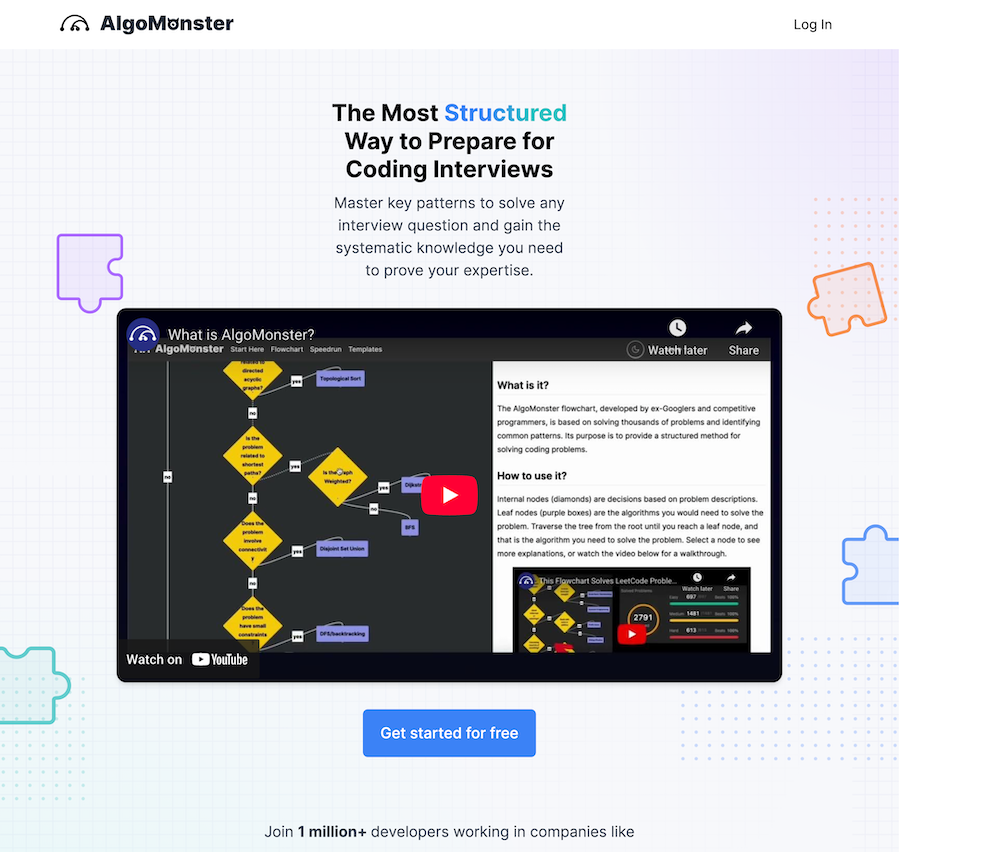
Additional features include decision flowcharts (visual guides for identifying which pattern fits a problem), a Speedrun mode for timed practice, and basic coverage of system design and behavioral interview topics.
The Pattern-Based Approach: Does It Actually Work?
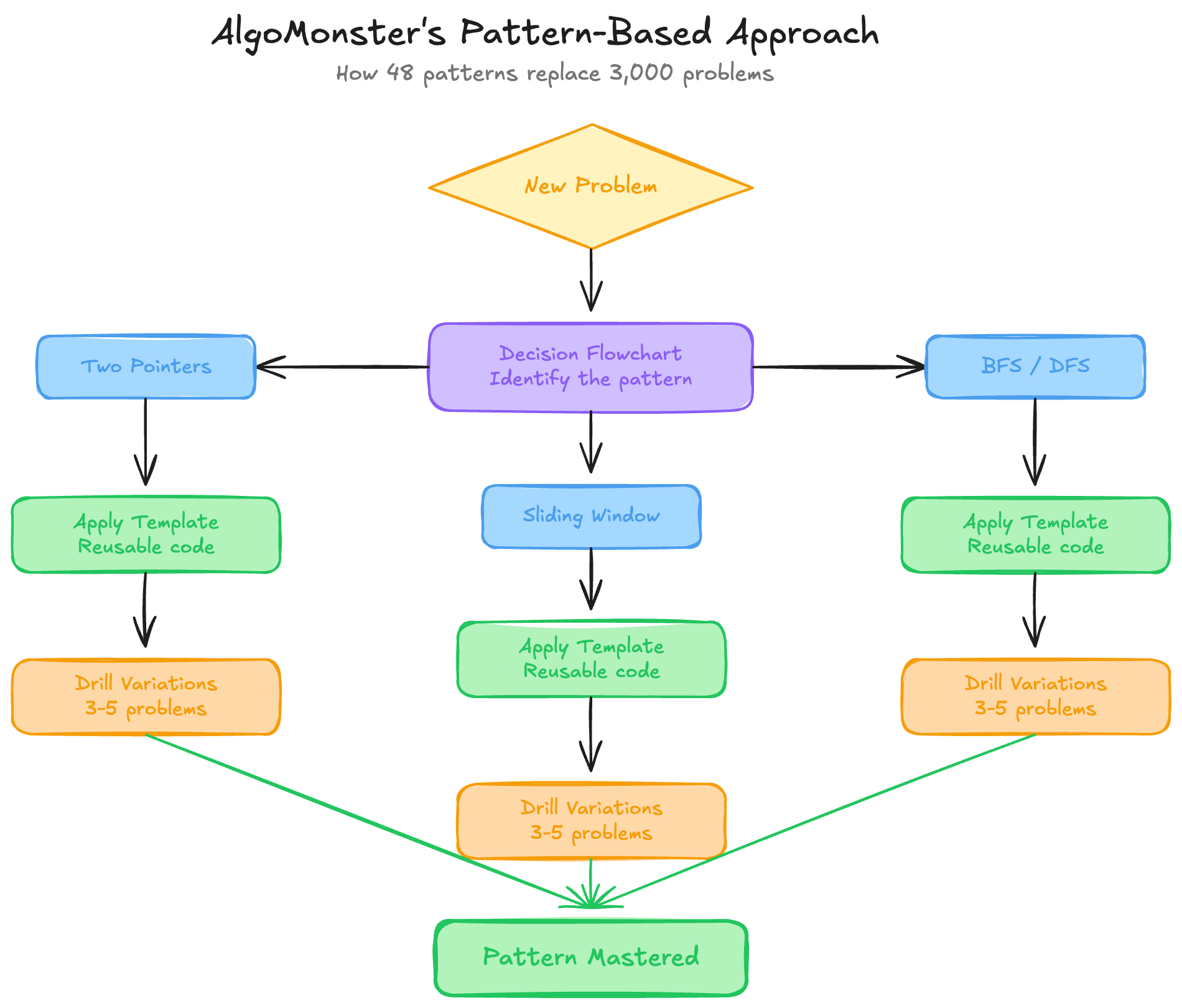
The core bet behind AlgoMonster is that pattern recognition beats brute-force problem grinding. Instead of solving 500 problems and hoping the connections click, you learn 48 templates and apply them deliberately.
Here's how a typical AlgoMonster lesson flows: you're introduced to a pattern (say, binary search on a sorted array). The lesson explains the underlying logic — not just "how" but "when" and "why." Then you get a code template: a generalized implementation you can adapt to variations. Finally, you work through 3-5 problems that use that pattern, each with slightly different twists.
The decision flowcharts are an underrated feature. When you encounter a new problem, the flowchart walks you through a series of questions — Is the input sorted? Are you looking for a contiguous subarray? Is it a tree or graph? — that lead you to the most likely pattern. It's like having a cheat sheet for problem categorization, which is exactly what most candidates struggle with under pressure.
Speedrun mode lets you practice under time constraints, cycling through problems with a running clock. It's a useful simulation of real interview pressure, though the problem pool is limited compared to LeetCode's timed contests.
Users report meaningful improvement from the pattern-based approach. The structured framework helps candidates move from "I have no idea where to start" to "I can identify the pattern and write a template-based solution" — which is exactly the skill gap that separates candidates who struggle from candidates who pass.
What AlgoMonster Gets Right
Efficiency is the headline feature. AlgoMonster is designed to be completed in 4 to 8 weeks. That's not marketing fluff — the curriculum is compact enough to finish in that window if you're putting in 1-2 hours per day. For engineers with a job search deadline (interview in 6 weeks, recruiter just reached out), this matters enormously. You can't finish LeetCode's 3,000 problems in 6 weeks, but you can finish AlgoMonster.
The visualizations are excellent. With ~700 interactive diagrams and illustrations, AlgoMonster does a better job of making abstract concepts concrete than most competitors. Trees, graphs, array manipulations — seeing the data structure change step by step makes patterns click faster than reading pseudocode alone.
Lifetime access removes subscription anxiety. AlgoMonster offers a lifetime plan ($459) that covers all current and future content. For engineers who job-hop every 2-3 years and revisit interview prep each time, this pays for itself after two cycles. No annual renewal fees, no worrying about price increases.
The structured curriculum eliminates decision paralysis. You don't stare at a list of 3,000 problems wondering which ones to do. AlgoMonster tells you: start here, do these problems, move to the next pattern. For engineers whose biggest bottleneck is deciding what to study (not the studying itself), this is the real value.
Affordable compared to the alternatives. Even at the lifetime price of $459, AlgoMonster is cheaper than 3+ years of LeetCode Premium ($159/year) or stacking multiple annual subscriptions. The annual plans ($119-$299/year depending on promotions) are competitive with everything else in the market.
Where AlgoMonster Falls Short
231 problems isn't enough volume for top-tier interviews. Pattern recognition is necessary but not sufficient. You also need the speed and fluency that comes from solving hundreds of problems. AlgoMonster's 231 problems will teach you the frameworks, but you'll almost certainly need to supplement with LeetCode for volume practice — especially for companies like Google that are known for pulling from a massive question pool.
No video walkthroughs at all. This is a deliberate design choice, not an oversight — but it's still a limitation for visual learners who process information better through video. If you're used to watching NeetCode or AlgoExpert walk through solutions on screen, AlgoMonster's text-and-diagram format may feel dry.
System design coverage is basic. AlgoMonster includes some system design content, but it's introductory at best. If you're interviewing for senior roles (L5+) where system design is a major round, you'll need a dedicated resource. The system design section is a nice bonus, not a replacement for proper prep.
No mentorship, coaching, or live interaction. AlgoMonster is entirely self-paced and self-guided. There's no way to ask questions, get feedback on your solutions, or practice with a real person (beyond the general community). If you're stuck on a concept, you're on your own.
Pattern memorization vs. deep understanding. This is the philosophical risk of template-based learning. If you internalize the templates without truly understanding the underlying logic, you'll struggle when an interviewer tweaks a problem in unexpected ways. AlgoMonster's templates are powerful tools — but tools are only as good as the person using them. You need to understand why the template works, not just that it works.
AlgoMonster Pricing at a Glance
AlgoMonster offers simple pricing with no monthly option:
- Free tier: Limited access to a subset of problems and patterns
- Pro Yearly: $119–$299/year (price varies by promotions)
- Pro Lifetime: $459 (one-time payment, all current and future content)
No free trial beyond the free tier. No monthly billing.
For a deeper breakdown of what each tier includes, how the pricing compares to every major competitor, and how to get the best deal, check out our full AlgoMonster Pricing Breakdown.
Who Should (and Shouldn't) Use AlgoMonster
AlgoMonster is a great fit if you:
- Have limited time (4-8 weeks) and need an efficient, structured plan
- Prefer reading and interactive diagrams over watching videos
- Want a framework-based approach that teaches transferable patterns, not just individual problem solutions
- Like having clear progression: start here → end here → you're ready
- Want lifetime access to avoid recurring subscriptions
AlgoMonster probably isn't for you if:
- You learn best through video explanations (try NeetCode or AlgoExpert instead)
- You need a massive problem bank to build speed and fluency
- You're prepping for system design-heavy senior interviews
- You want coaching, mentorship, or live feedback on your solutions
- You need comprehensive behavioral interview prep
How AlgoMonster Compares to the Competition
AlgoMonster vs. LeetCode: Different tools, different purposes. LeetCode is a gym with every machine imaginable — you can train anything, but you need your own program. AlgoMonster is a structured 8-week training plan that covers the essentials. Most serious candidates use both: AlgoMonster to learn patterns, LeetCode to practice volume.
AlgoMonster vs. AlgoExpert: AlgoExpert bets on video quality; AlgoMonster bets on pattern frameworks. AlgoExpert has fewer problems (160 vs. 231) but premium video walkthroughs. AlgoMonster has no video but better structural organization and reusable templates. Your choice comes down to learning style: do you watch or do you read?
AlgoMonster vs. NeetCode: NeetCode offers a comparable curated problem set (NeetCode 150) with free YouTube video explanations. NeetCode Pro adds an interactive environment for $119/year. AlgoMonster's edge is the explicit pattern templates and decision flowcharts; NeetCode's edge is video quality and the free tier's depth. Both are solid — NeetCode leans toward video learners, AlgoMonster toward systematic readers.
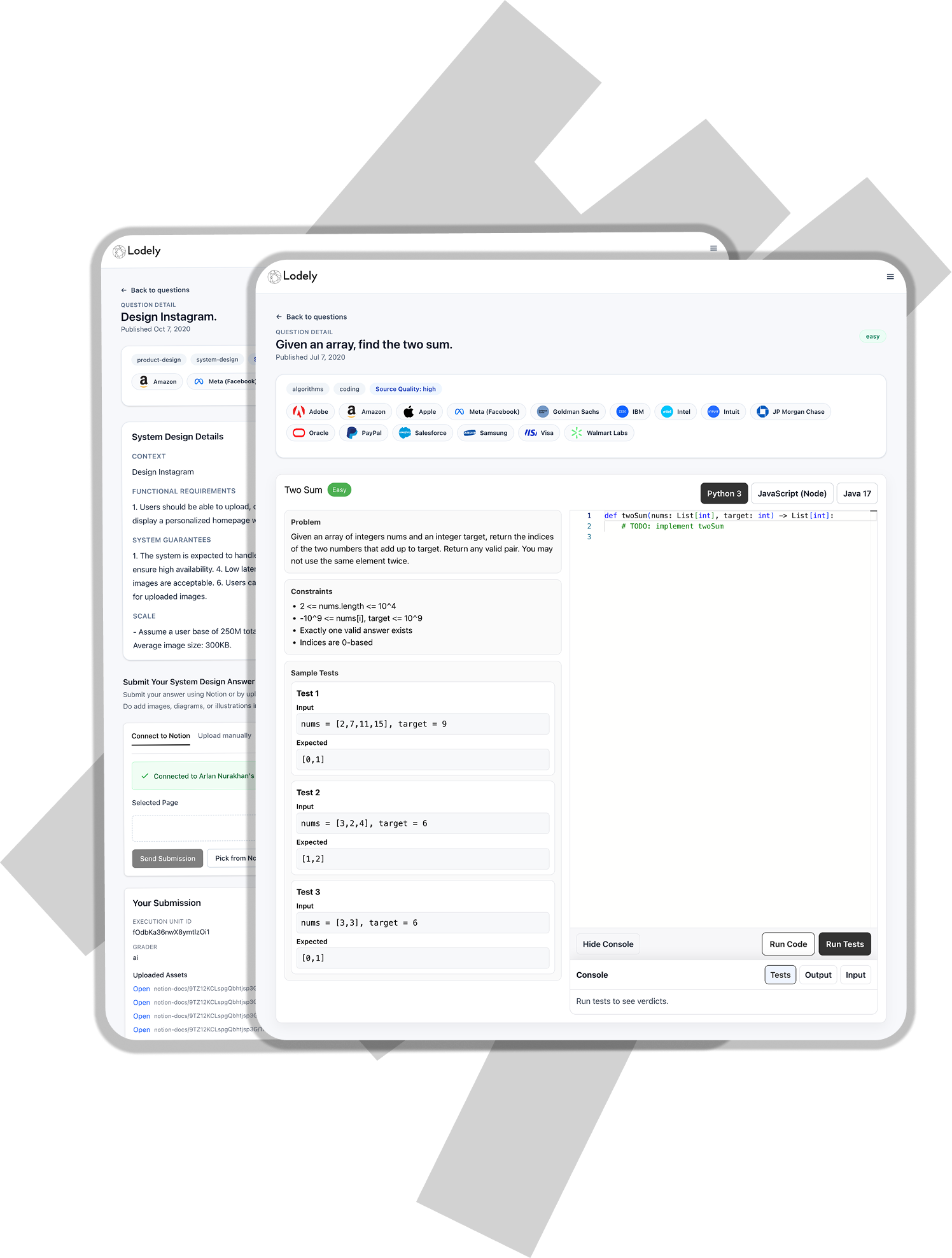
AlgoMonster vs. Lodely: AlgoMonster teaches you 48 coding patterns well. But coding interviews are only one piece of the loop — you've still got system design, behavioral, and company-specific rounds to prep for. Lodely takes a different approach entirely: instead of covering one slice deeply, it provides a guided path through the full interview process. That includes 4,000+ real interview questions, system design frameworks, behavioral coaching, and company-specific prep guides for 1,000+ companies. If AlgoMonster is your coding pattern textbook, Lodely is the full study plan that tells you what to work on next across every round.
Final Verdict: Is AlgoMonster Worth It?
AlgoMonster is one of the best resources for learning coding interview patterns efficiently. The 48-pattern framework, reusable templates, and compact curriculum make it possible to go from "I don't know where to start" to "I can recognize and solve most standard patterns" in under two months. For engineers with limited time and a preference for structured, text-based learning, it's hard to beat.
But it's not a complete interview prep solution. The problem bank is too small for volume practice, system design coverage is introductory, behavioral prep is minimal, and there's no coaching or feedback loop. Plan on using AlgoMonster as one piece of your prep stack — not the whole thing.
If you want a single platform that guides you through every stage of interview prep — from pattern mastery to system design to behavioral rounds to company-specific strategies — Lodely is built for that full journey. But for pure pattern-based coding prep, AlgoMonster delivers exactly what it promises.
Bottom line: Best-in-class for pattern learning. Just know that patterns alone don't get offers.
FAQ
Can I finish AlgoMonster in 4 weeks? Yes, if you're putting in 1.5-2 hours per day. The curriculum is designed to be completable in 4-8 weeks depending on your pace and prior experience. Engineers with some coding interview exposure can move through the earlier patterns quickly and spend more time on advanced topics like dynamic programming and graph algorithms.
Is AlgoMonster enough for a Google interview? For the coding rounds specifically, AlgoMonster's pattern framework gives you a strong foundation. But Google interviews also include system design (for mid-senior roles), behavioral questions, and a broad range of problem difficulty that often exceeds AlgoMonster's 231-problem set. You'll want to supplement with additional practice on LeetCode and dedicated system design prep.
Should I get the lifetime plan or the annual plan? If you're confident you'll revisit interview prep in the future (most engineers do every 2-3 years), the lifetime plan at $459 breaks even after roughly 2-3 years of annual renewals. If this is a one-time job search and you'll finish the curriculum in 6-8 weeks, the annual plan is the better financial choice.
How does AlgoMonster compare to just doing the Blind 75 on LeetCode? The Blind 75 is a curated problem list, but it doesn't teach you why those problems are grouped together or give you reusable templates. AlgoMonster's value is the teaching layer on top: it explains the pattern, gives you a framework, and then drills you on variations. If you've tried the Blind 75 and found yourself memorizing solutions rather than understanding approaches, AlgoMonster's structure might be what's missing.
✉️ Get free faang interview cheat sheet and interview tips weekly
✉️ Get free faang interview cheat sheet and interview tips weekly