NeetCode Review: Pros, Cons & Final Verdict

"Just do NeetCode 150" has become the default answer on every coding interview subreddit, Blind thread, and Discord server. Someone asks how to prepare for a Google interview, and within minutes, three people link the same curated problem list. But is following a YouTube channel's roadmap actually enough to land a top-tier offer — or is NeetCode coasting on hype?
NeetCode started as one engineer's YouTube channel and evolved into a full platform with free roadmaps, curated problem sets, and a paid Pro tier. The value proposition is hard to argue with: hundreds of high-quality video explanations for free, plus a structured study path that cuts through LeetCode's chaos. But "free and popular" doesn't automatically mean "sufficient."
This review breaks down what NeetCode actually offers, where the free content hits its ceiling, whether Pro is worth paying for, and what's missing from the equation entirely.
What Is NeetCode?
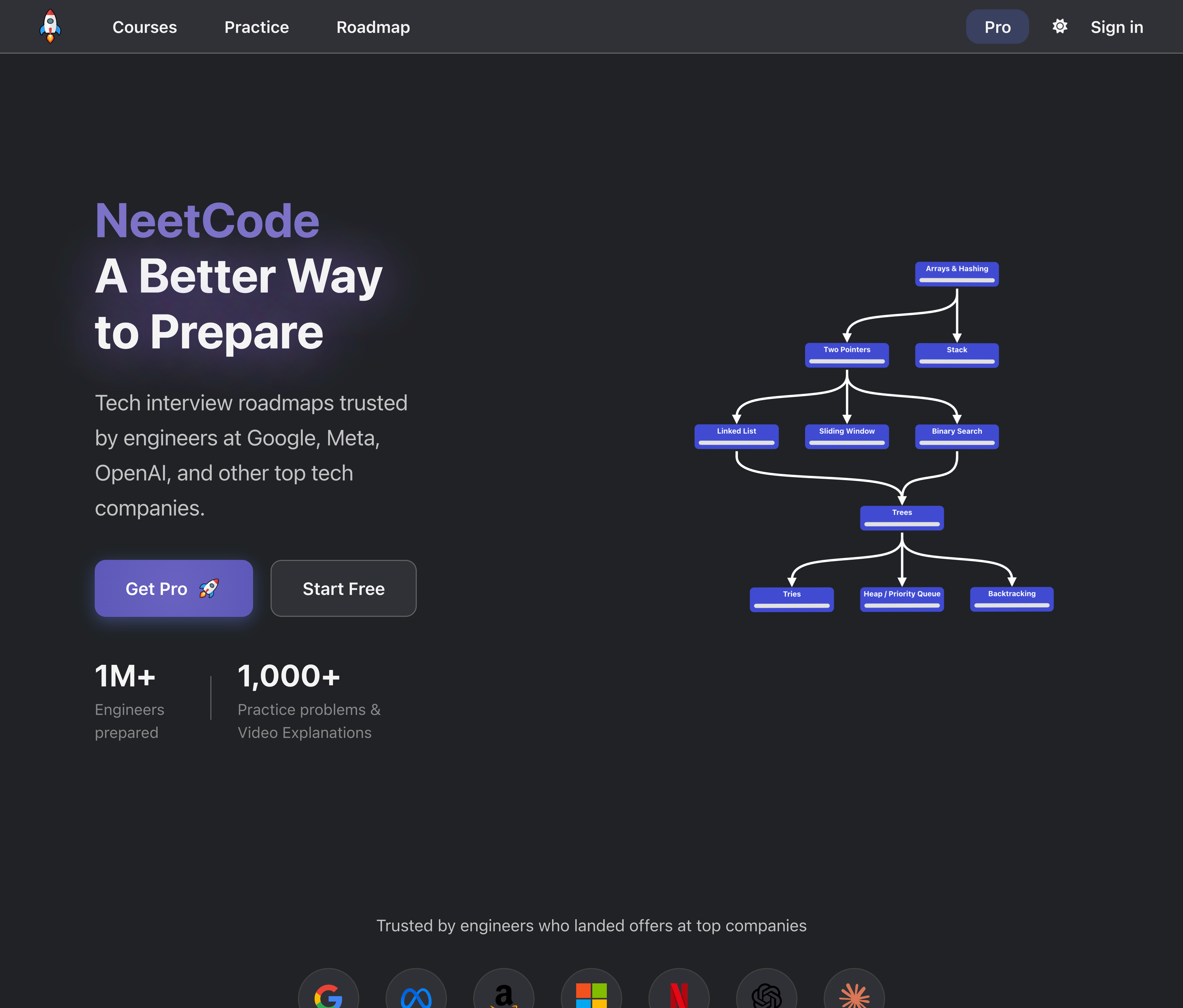
NeetCode was created by Navdeep Singh, a former software engineer at Google and Amazon. It started as a YouTube channel in 2021 where Navdeep recorded himself solving LeetCode problems with clean, beginner-friendly explanations. The channel grew to over 770,000 subscribers and 88 million views — making it one of the largest coding interview prep channels on the platform.
The brand eventually expanded beyond YouTube into NeetCode.io, a dedicated website that organizes the content into structured roadmaps and study plans. The site offers two tiers: a generous free tier and a paid Pro subscription.
The signature products are the NeetCode 75 (a condensed list of the most essential problems) and the NeetCode 150 (an expanded version that covers more patterns and edge cases). Both are organized by topic — arrays, two pointers, sliding window, trees, graphs, dynamic programming — with a suggested order that builds concepts progressively.
NeetCode's philosophy is simple: you don't need to solve 3,000 problems. You need to solve the right 150 problems deeply, understand the patterns they represent, and build fluency through deliberate repetition.
Free vs. Pro: What You Actually Get
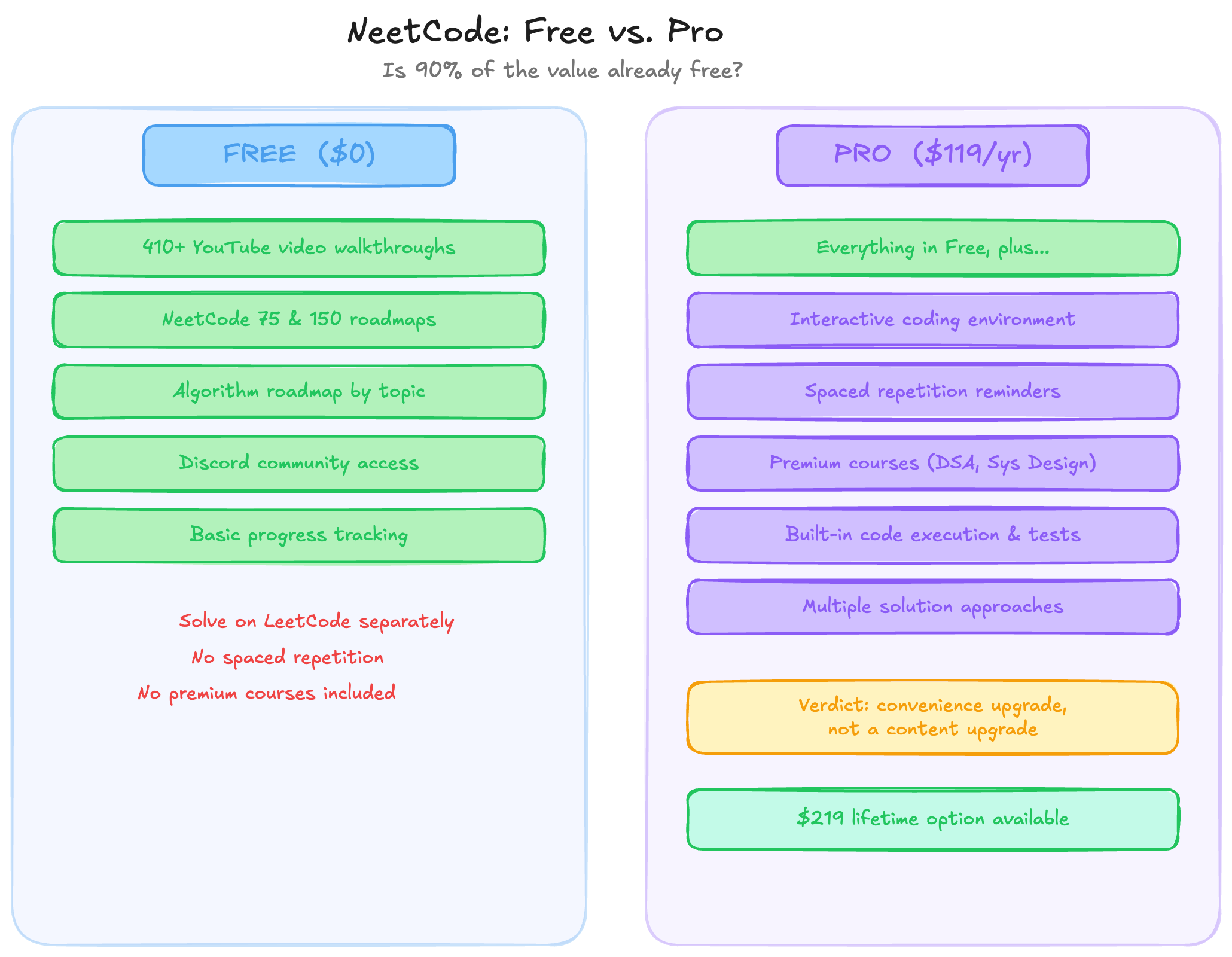
This is the first question most engineers ask, because NeetCode's free tier is unusually generous. Here's the honest breakdown:
Free tier includes:
- All 410+ YouTube video explanations (full walkthroughs, not teasers)
- The NeetCode 75 and NeetCode 150 curated problem lists
- An algorithm roadmap organized by topic and difficulty
- A practice plan with suggested study order
- Access to the Discord community
- Progress tracking on the roadmap (basic)
NeetCode Pro ($119/year or $219 lifetime) adds:
- An interactive coding environment (solve problems directly on NeetCode.io instead of switching to LeetCode)
- Enhanced progress tracking with spaced repetition reminders
- Premium video courses (Algorithms & Data Structures for Beginners, Advanced Algorithms, System Design for Beginners)
- Built-in code execution and test cases
- Solution explanations with multiple approaches
The honest question: is 90% of the value already free? For many engineers, yes. The YouTube videos and curated lists are the core product, and they cost nothing. Pro's main advantage is convenience — the integrated coding environment and spaced repetition save time switching between YouTube and LeetCode. The premium courses add structured learning paths, but the individual topic videos are already available for free.
Pro tip: If you're disciplined enough to track your own progress and don't mind solving problems on LeetCode while watching NeetCode videos in a second tab, the free tier covers a lot of ground. Pro makes the experience smoother, not fundamentally different.
What NeetCode Gets Right
The video explanations are excellent. This is NeetCode's superpower. Navdeep's teaching style is clear, methodical, and assumption-free. He doesn't skip steps, doesn't wave his hands through the tricky parts, and doesn't assume you already know the trick. Each video starts with the problem, walks through the brute force approach, explains why it's suboptimal, and then builds toward the optimal solution step by step. For engineers who've stared at a LeetCode editorial and thought "how was I supposed to come up with that?", NeetCode's videos fill the gap.
The curated roadmap eliminates LeetCode's biggest problem. LeetCode's catalog is vast and unstructured. You can spend weeks solving random problems without building coherent pattern recognition. NeetCode 150 solves this by selecting problems that build on each other: you learn two pointers before sliding window, binary search before binary search on answer, trees before graphs. The progression is deliberate and well-designed.
The free tier is absurdly generous. Most competitors gate their best content behind a paywall. NeetCode gives away 410+ video walkthroughs, the full 150-problem roadmap, and community access for free. This isn't a teaser or a freemium trap — it's a complete study resource. The paid tier adds convenience, not essential content.
The community is active and helpful. NeetCode's Discord has become one of the better places to discuss coding interview prep. Engineers share progress, ask questions about specific problems, and compare approaches. Having a community of people working through the same roadmap creates accountability that solo grinding doesn't.
NeetCode 150 is well-curated. The problem selection covers the patterns that actually appear in interviews at top companies. Arrays, strings, linked lists, trees, graphs, dynamic programming, greedy algorithms, backtracking — each category includes problems at increasing difficulty that build genuine pattern fluency. It's not just a random subset of LeetCode; it's a deliberately sequenced curriculum.
Where NeetCode Falls Short
No built-in code editor on the free tier. On the free tier, NeetCode is essentially a video playlist plus a checklist. You watch the video on NeetCode.io or YouTube, then open LeetCode in another tab to actually solve the problem. It works, but it's friction — and friction compounds over hundreds of problems. Pro fixes this with an integrated environment, but that's a paid upgrade.
System design coverage is weak. NeetCode has a "System Design for Beginners" course in the Pro tier, but it's introductory at best. If you're interviewing for mid-level or senior roles where system design is a full interview round, NeetCode's coverage won't prepare you adequately. You'll need a dedicated resource for topics like distributed systems architecture, database design, and scalability patterns.
No behavioral interview content. Zero. NeetCode doesn't address the behavioral round at all — no STAR method frameworks, no "tell me about a time" coaching, no tips for leadership principle questions. For companies like Amazon where behavioral is heavily weighted, this is a significant gap.
No mock interview platform. You can practice problems, but you can't practice the interview itself. There's no way to simulate the experience of explaining your thought process to another person in real time, handling hints, managing your time, or dealing with the pressure of being watched. Solving problems alone in your apartment is fundamentally different from solving them in a 45-minute interview with a senior engineer.
Not a standalone learning system. NeetCode assumes you already know basic data structures and algorithms. If you can't implement a binary search tree from scratch or don't understand graph traversal fundamentals, NeetCode's problem walkthroughs will feel like they're skipping steps. The "Algorithms & Data Structures for Beginners" Pro course addresses this somewhat, but the core 150 roadmap is built for engineers who already have foundations in place.
NeetCode 150: The Roadmap That Took Over Reddit
The NeetCode 150 deserves its own section because it's become the de facto starting point for coding interview prep. If you search any tech career subreddit for "how to prepare for coding interviews," someone will recommend it within the first three comments.
What makes it work: the list is organized into 15 topics, each with 5-15 problems ranging from easy to hard. You don't just solve random problems — you build competency within a pattern (say, sliding window) before moving to the next category. Each problem has a corresponding video explanation, so you're never stuck without a path forward.
The NeetCode 75 is a condensed version for engineers with less time — it covers the same topics but with fewer problems per category. It's a good option if you have 3-4 weeks instead of 6-8, but the 150 is the more thorough choice.
Where NeetCode 150 hits its ceiling: it's a curated list, not a curriculum. There's no teaching layer that explains why these problems are grouped together or gives you generalizable templates. You learn by watching solutions to individual problems and noticing the patterns yourself. AlgoMonster, by contrast, leads with the pattern and then applies it to problems — a more systematic approach for engineers who want explicit frameworks.
How NeetCode Compares
NeetCode vs. LeetCode: NeetCode is a layer on top of LeetCode, not a replacement. NeetCode curates which problems to solve and explains how to solve them. LeetCode is where you actually practice (unless you're on NeetCode Pro). Most engineers use both together — NeetCode for guidance, LeetCode for execution.
NeetCode vs. AlgoExpert: Both offer curated problems with video explanations. AlgoExpert's videos are more polished and production-heavy; NeetCode's are more numerous and free. AlgoExpert has 160 problems; NeetCode covers 150 in the main roadmap but offers 410+ video explanations total. For budget-conscious engineers, NeetCode's free tier is hard to beat. For engineers who prefer premium production quality, AlgoExpert has the edge.
NeetCode vs. AlgoMonster: Different learning philosophies. NeetCode teaches through problem walkthroughs (watch → understand → replicate). AlgoMonster teaches through explicit patterns and reusable templates (learn pattern → apply template → drill variations). NeetCode is better for video learners; AlgoMonster is better for systematic readers who want a framework-first approach.
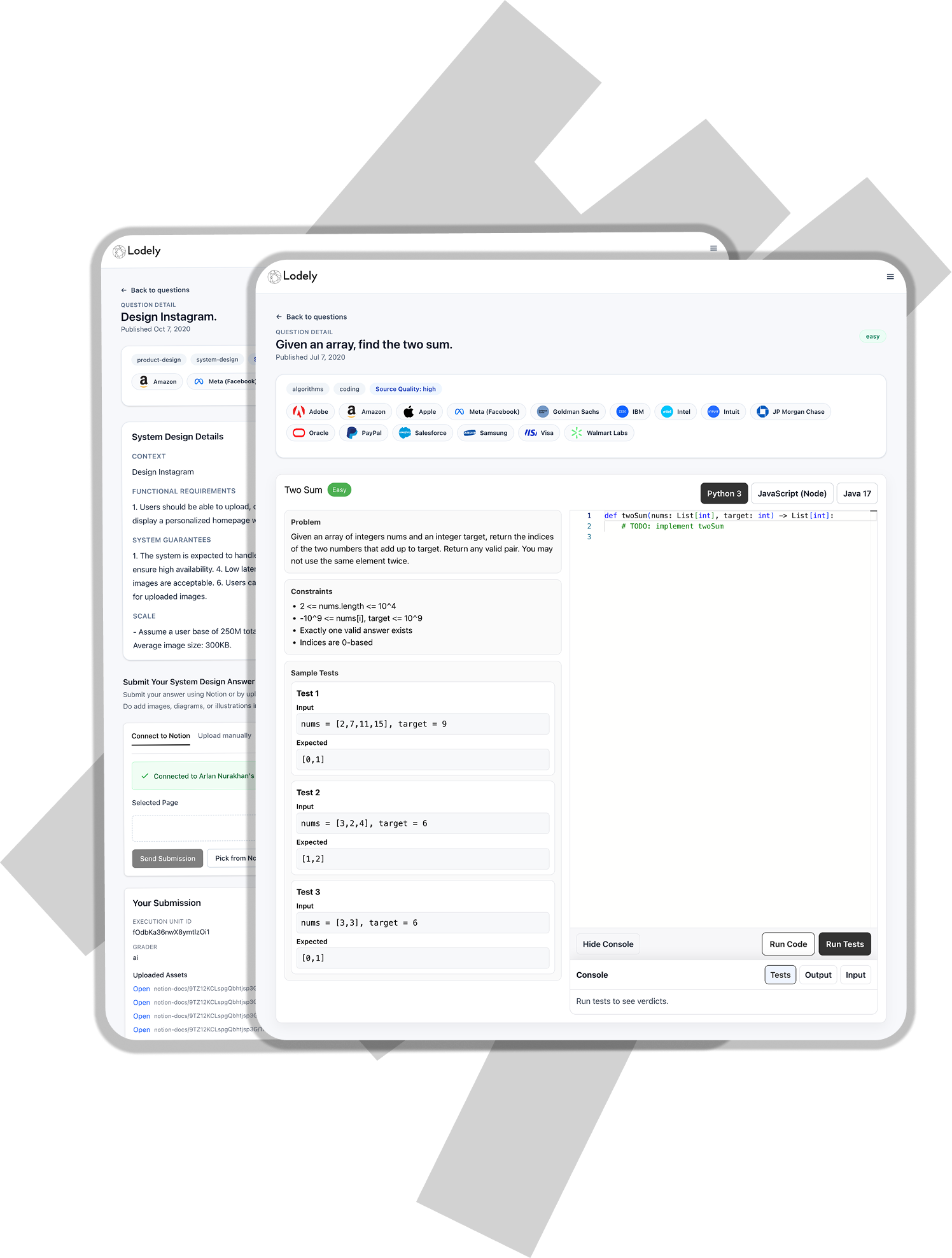
NeetCode vs. Lodely: NeetCode is excellent at one thing: teaching you how to solve curated coding problems through video. But coding rounds are just one part of the interview loop. System design, behavioral, and company-specific rounds are equally important — and NeetCode doesn't cover them. Lodely takes a fundamentally different approach by guiding you through the entire interview prep process: 4,000+ real interview questions, system design frameworks, behavioral coaching, and prep guides for 1,000+ specific companies. Where NeetCode gives you a curated problem list, Lodely gives you a personalized roadmap across every round. It's the difference between having great study materials and having a prep system that tells you exactly what to work on next.
Final Verdict: Is NeetCode Worth It?
The free tier is a no-brainer. If you're starting coding interview prep and don't want to spend money, NeetCode 150 plus the YouTube videos is one of the best free resources available. Full stop.
NeetCode Pro at $119/year is worth it if you value the integrated coding environment, spaced repetition, and the convenience of not switching between tabs. The $219 lifetime option makes sense if you expect to revisit interview prep in future job searches. But be clear about what you're paying for: convenience features, not fundamentally different content.
The bigger gap isn't free vs. Pro — it's what NeetCode covers vs. what interviews actually require. NeetCode prepares you for coding rounds. It does not prepare you for system design, behavioral interviews, or company-specific question patterns. If you're targeting top-tier companies with multi-round interview loops, NeetCode is one piece of a larger strategy.
For engineers who want a single platform that covers the full journey — coding, system design, behavioral, company-specific prep, and structured guidance on what to work on next — Lodely is purpose-built for that. But as a free coding prep resource, NeetCode has earned its reputation.
Bottom line: Best free coding interview prep available. Just don't mistake one piece of the puzzle for the whole picture.
FAQ
Is NeetCode 150 enough for Google or Meta interviews? For the coding rounds, NeetCode 150 provides a strong foundation. But Google and Meta interviews typically include system design (for mid-level and above), behavioral rounds, and sometimes pull from a broader problem set than NeetCode covers. Use NeetCode 150 as your core coding prep, then supplement with additional LeetCode practice and dedicated system design and behavioral preparation.
Should I do NeetCode 75 or NeetCode 150? If you have 6-8 weeks, do the 150 — it covers more patterns and edge cases per topic. If you have 3-4 weeks or less, the 75 is a solid compressed version. Both follow the same topic progression, so the 75 is a subset of the 150, not a different curriculum.
Is NeetCode Pro worth paying for? If you're disciplined enough to manage your own progress tracking and don't mind solving on LeetCode while watching NeetCode videos separately, the free tier covers the essential content. Pro's value is in convenience: integrated coding, spaced repetition, and a smoother workflow. The $219 lifetime option is the best deal if you plan to use it across multiple job searches.
Can I use NeetCode if I'm a complete beginner? NeetCode's core roadmap assumes you understand basic data structures (arrays, linked lists, trees, graphs) and fundamental algorithms (sorting, searching). If you're starting from zero, you'll want to build those foundations first. NeetCode Pro's "Algorithms & Data Structures for Beginners" course can help, but most complete beginners should work through an introductory CS course before tackling NeetCode 150.
✉️ Get free faang interview cheat sheet and interview tips weekly
✉️ Get free faang interview cheat sheet and interview tips weekly