


Accenture Interview Questions: 7 Questions to Prepare for in 2026

Accenture's software engineering process varies by business unit and level. It usually includes a skills check followed by technical and role-specific interviews. Interviewers assess how clearly you explain your work, apply technical fundamentals, and connect decisions to client outcomes.
What to Expect: Accenture Interview Process
Accenture's hiring guidance describes formal interviews, a technical assessment, and a recruiter conversation for experienced hires. Experienced candidates may move from the recruiter screen to a developer interview, then to a final manager or behavioral interview. Campus candidates may complete aptitude, communication, and coding assessments before their interviews.
Interview content depends on the role. A Java interview may cover object-oriented programming, APIs, databases, and projects listed on your résumé. Cloud and data roles may focus more on the relevant stack. Be ready to explain what you owned, how you debugged problems, and how your team measured the results.
How to Prepare and Pass Accenture Interviews
Split your preparation period in half. Use the first half to review your target stack and two projects from start to finish. Use the second half for timed coding, behavioral stories, and mock explanations of your design choices.
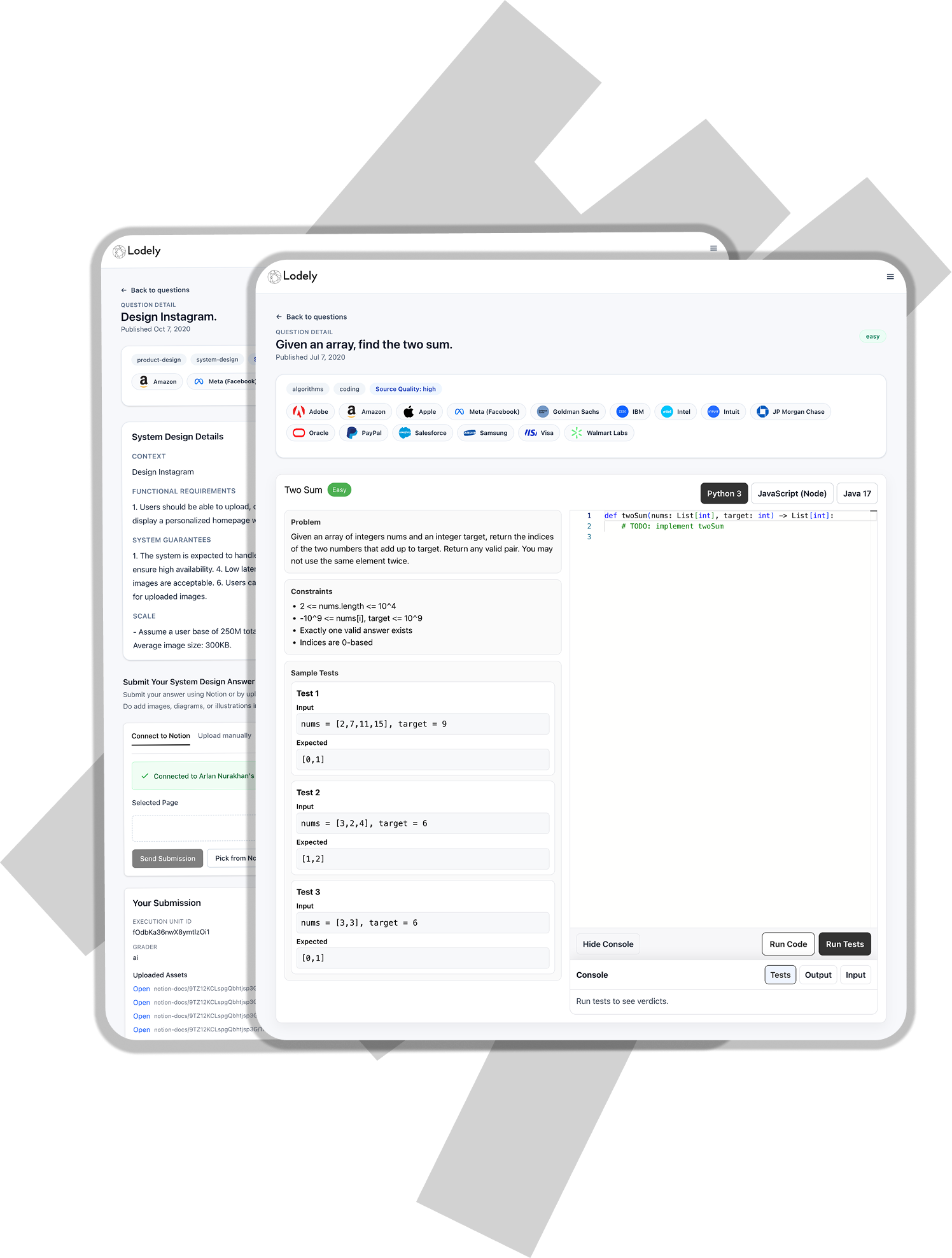
Prepare six stories about leadership, feedback, conflict, prioritization, failure, and client impact. Use Lodely to practice company-specific coding, system-design, and behavioral prompts in full mock interviews.

Accenture Interview Breakdown
Tell me about yourself
Type: Behavioral opener.
The Trick: Give a 60- to 90-second answer that connects your current scope, relevant strengths, and reasons for pursuing the role.
What It Tests: Level, relevance, and communication.
Given an array nums with n distinct numbers in [0, n], return the missing number
function missingNumber(nums)- Given an array nums containing n distinct numbers in the range [0, n], return the only number in the range that is missing from the array.
1 <= nums.length <= 10^40 <= nums[i] <= nAll numbers of nums are unique
nums = [3,0,1]
2
nums = [0,1]
2
Type: Array / coding. The Trick: Large inputs expose repeated scans and avoidable storage, so explain the invariant you choose. What It Tests: Boundary handling, complexity analysis, and whether you can justify correctness.
Tell me about a time you demonstrated leadership
Type: Behavioral.
The Trick: Choose an example in which you led without formal authority and explain the action you took.
What It Tests: Ownership and team judgment.
The remaining four examples cover core concepts and judgment. "What is encapsulation?" checks whether you can explain an object-oriented programming concept clearly. The feedback question tests whether you can offer a specific, useful observation while respecting a peer's ownership. "How do you prioritize tasks?" should address impact, dependencies, deadlines, and risk. For "Why Accenture?", connect the role and client work to the practice you want to join.
What Comes After The Interview
Recruiting timelines vary by business unit. Before you leave, confirm the next step, expected timing, and decision owner. Compensation varies by location and level. Use the package data below as a benchmark, then ask how base salary, bonus, and equity apply to the role.
Candidate Experiences
One recent software engineering candidate described a three-step process: recruiter review, a technical discussion with a developer, and a behavioral interview. The interviews took place over several days. Prepare to discuss projects and behavioral examples with the same depth you bring to technical questions.
Conclusion
Accenture looks for relevant technical experience, project ownership, and clear evidence of teamwork. Use Lodely to practice company-specific questions, then tighten each answer before the technical and final interviews.
✉️ Get free faang interview cheat sheet and interview tips weekly
✉️ Get free faang interview cheat sheet and interview tips weekly