


6 Airtable Interview Questions to Expect in 2026

Airtable software engineering interviews begin with a recruiter call, followed by a technical screen and a multi-round virtual loop. The process tests coding, system design, product judgment, and behavioral skills. It varies by role: product engineers may receive a coding assignment, while recent early-career candidates have reported an assessment, a technical screen, and several one-hour interviews.
What to Expect: Airtable Interview Process
Airtable's product-engineering process has been described as a recruiter screen, a compensated coding assignment, four onsite interviews, and reference checks. The onsite may include algorithms, system design, behavioral questions, and product wireframing. Other software-engineering routes may use a live technical screen before coding and design interviews, so confirm your path with the recruiter.
Airtable says it supports 500,000 companies and 50 million apps and agents, with 700 employees across five offices (Airtable). At that scale, interviews may cover data modeling, dependencies, responsive UIs, and workflows.
How to Prepare and Pass Airtable Interviews
If your fundamentals are current, give yourself four to six weeks. If you're rebuilding them, plan for eight to twelve weeks. Practice graph traversal, hashing, file systems, date calculations, and complexity analysis. For system design, focus on collaborative data products, permissions, synchronization, and failure recovery.
Mix Airtable coding prompts with system design and behavioral questions. Before writing code, state your assumptions. Test edge cases aloud and keep a short record of your mistakes. That way, each timed session targets a specific weakness.

Airtable Interview Breakdown
Circular Reference
Type: Graph traversal and serialization.
The Trick: Dictionaries may point back to objects already being processed. Track object identity, distinguish repeated references from new objects, and choose a representation that can be reconstructed safely.
Tests: cycle detection, state management, API design, and type reference handling.
Files Building
Type: Dependency graph processing
The Trick: Distinguish files available at the start from those unlocked after another target is processed. For large rule sets, build an adjacency map and track indegrees instead of rescanning every dependency.
What It Tests: Graph modeling, topological thinking, efficient updates, and independent tasks.
Duplicate Files
Type: File traversal and content deduplication.
The Trick: Comparing every pair becomes impractical at one million files. Group files by a cheap attribute such as size, compare hashes within each group, and verify contents only when needed.
What It Tests: Progressive filtering, I/O awareness, memory trade-offs, and equality definitions.
The remaining three questions cover product-oriented implementation problems. Column Type asks you to infer types across overlapping columns and define precedence rules for compatible types. Finish Day covers calendar arithmetic across weekends, holidays, and very long intervals. Files Backup requires recursive traversal, staged hashing, and bandwidth-aware deduplication across up to two terabytes and one million files.
What Comes After The Interview
The hiring team reviews evidence from the full loop and may adjust your level before making an offer. Ask when the debrief occurs and whether reference checks happen before or after level approval. Compare base pay, equity, bonus, vesting, and expected refresh grants. Equity usually makes up more of the package at higher levels.
Candidate Experiences
One recent new-grad candidate described an assessment, a recruiter call, and a one-hour dependency-graph screen. The later loop included one-hour coding and system-design interviews, a hiring-manager behavioral conversation, and an AI-assisted coding round. The interviews took about eight hours in total, and the candidate received a rejection two days later without detailed feedback. Prepare for several distinct formats.
Conclusion
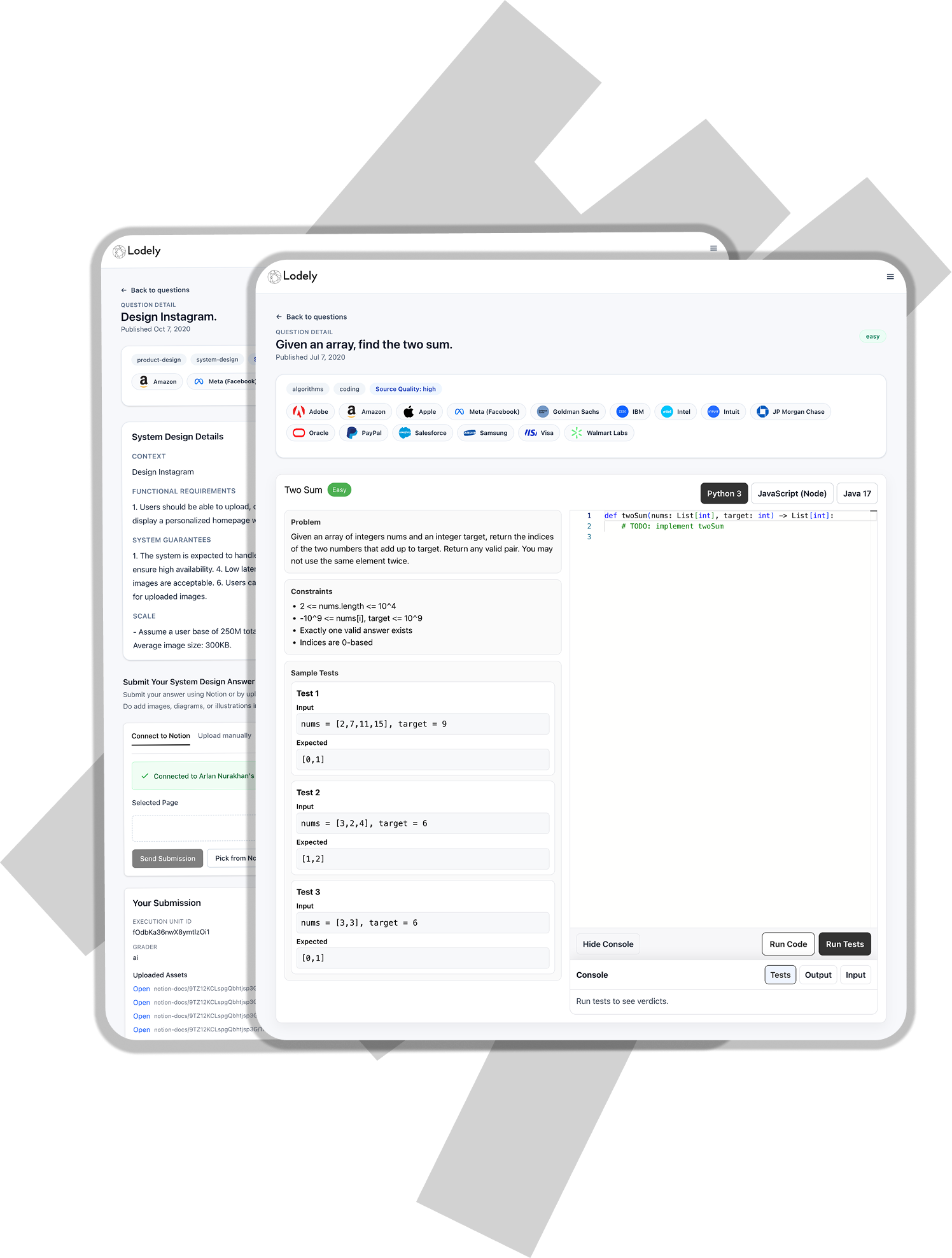
Airtable evaluates clear modeling, practical code, product judgment, and steady communication across several interview formats. Practice these six questions on Lodely with editorial explanations, then rehearse your spoken answers within the time limits your recruiter confirms.
✉️ Get free faang interview cheat sheet and interview tips weekly
✉️ Get free faang interview cheat sheet and interview tips weekly
