10 Amazon Interview Questions to Expect in 2026
There are 4 interviews of 55 minutes each for the SDE II interview loop. There are 5 interviews of 55 minutes each for the SDE III interview loop. Both interview loops assess technical skills and experience as seen through Amazon Leadership Principles. Often the same interview will assess both technical skills and Leadership Principles. Each interviewer at Amazon will typically ask 2-3 behavioral questions about a time they successfully or unsuccessfully did something in the past, depending on the technical signal provided in the interview. (Amazon SDE II interview prep, Amazon SDE III interview prep)
It changes how you should be preparing. Even a correct algorithm can leave weak evidence on Ownership or Dive Deep. A polished behavioral story does not cover a systems design that omits the reliability trade-offs. You need strong examples, working code, and clear trade-offs at the level that Amazon expects for this role.
What to Expect: Amazon Interview Process
This will depend on the level and team. A technical phone screen may come before the loop. Amazon's SDE III material describes a 60-minute screen divided between Leadership Principles and coding or system design, before the final loop expands to several interviewers. (Amazon SDE III interview prep)
Four sessions of 55 minutes for SDE II and five sessions of 55 minutes for SDE III. Candidates for the SDE II role can expect at least one software system design problem. For coding problems, Amazon looks for syntactically correct, scalable, robust, and well-tested code. Pseudocode is not accepted. Amazon SDE II interview prep
It can also be combined with multiple formats:
- Coding and data structures. You'll explain the problem, pick an approach, write code to solve it, test it with edge cases, and analyze its time and space complexity. Readability and maintainability are as important as the final result.
- Low level design. You're supposed to design low-level classes and interfaces and responsibilities in the system. Interviewers will expect to see some code implementation in the class. So you should have some time to code.
- High-level system design. You'll determine what requirements the system must fulfill, estimate the size of the system, choose what tools and components to use, and justify tradeoffs between availability, consistency, latency, security, and cost.
- Leadership Principles. You will give examples from your experience. Amazon recommends STAR and asks you to include metrics where they add useful evidence.
Amazon says that a Bar Raiser also joins the loop. The Bar Raiser is a specially trained interviewer that sits outside the hiring team and ensures that standards are consistent for hiring across teams. The Bar Raiser can run a behavioral session, a coding session, or a design session. The label doesn't indicate which format the interview will be in. Amazon interview process
Recent accounts point to more mixing inside individual sessions. InterviewQuery's synthesis places Leadership Principles in technical rounds, design discussions, and Bar Raiser sessions that also include coding. A 2026 US SDE II report describes one such session moving from Leadership Principles into low-level design and implementation. Treat your recruiter's agenda as the most accurate description of your loop. (InterviewQuery Amazon candidate reports, 2026 SDE II report)
How to Prepare and Pass Amazon Interviews
If you're up to date on your fundamentals, give yourself 4-6 weeks. 8-12 weeks if you're rebuilding your knowledge of graph algorithms, object-oriented design, distributed systems, etc. The idea is to cover all three formats and have the knowledge be repeated enough that you can explain your thinking when you produce the work.
- Build a story bank first: - Customer impact, disagreement, failure, ownership, ambiguous decisions, results - Write down the situation, your responsibility, the steps you took personally and the result (measurable) - Rehearse about alternatives, mistakes, and lessons learned
- Practice full coding sessions. Requirements and examples first. Write code that can be executed. Testing. Test normal cases, empty cases, duplicates, and failure cases. Time and space complexity. One possible improvement if you had one extra hour to work on the problem.
- Low-level and high-level design should be kept separate. Low-level design should be thinking about entities, interfaces, extensibility, and implementation. High-level design should be thinking about APIs, storage, traffic, failure, observability, and tradeoffs. Don't let an architecture conversation take up your time that was meant to be spent writing code in your low-level design session.
- Match depth to level. SDE I requires clean code and problem solving. SDE II requires component design and tradeoffs. SDE III requires system-level architectural awareness, stable systems, maintainability, security, leadership beyond one component. (Amazon SDE III interview prep)
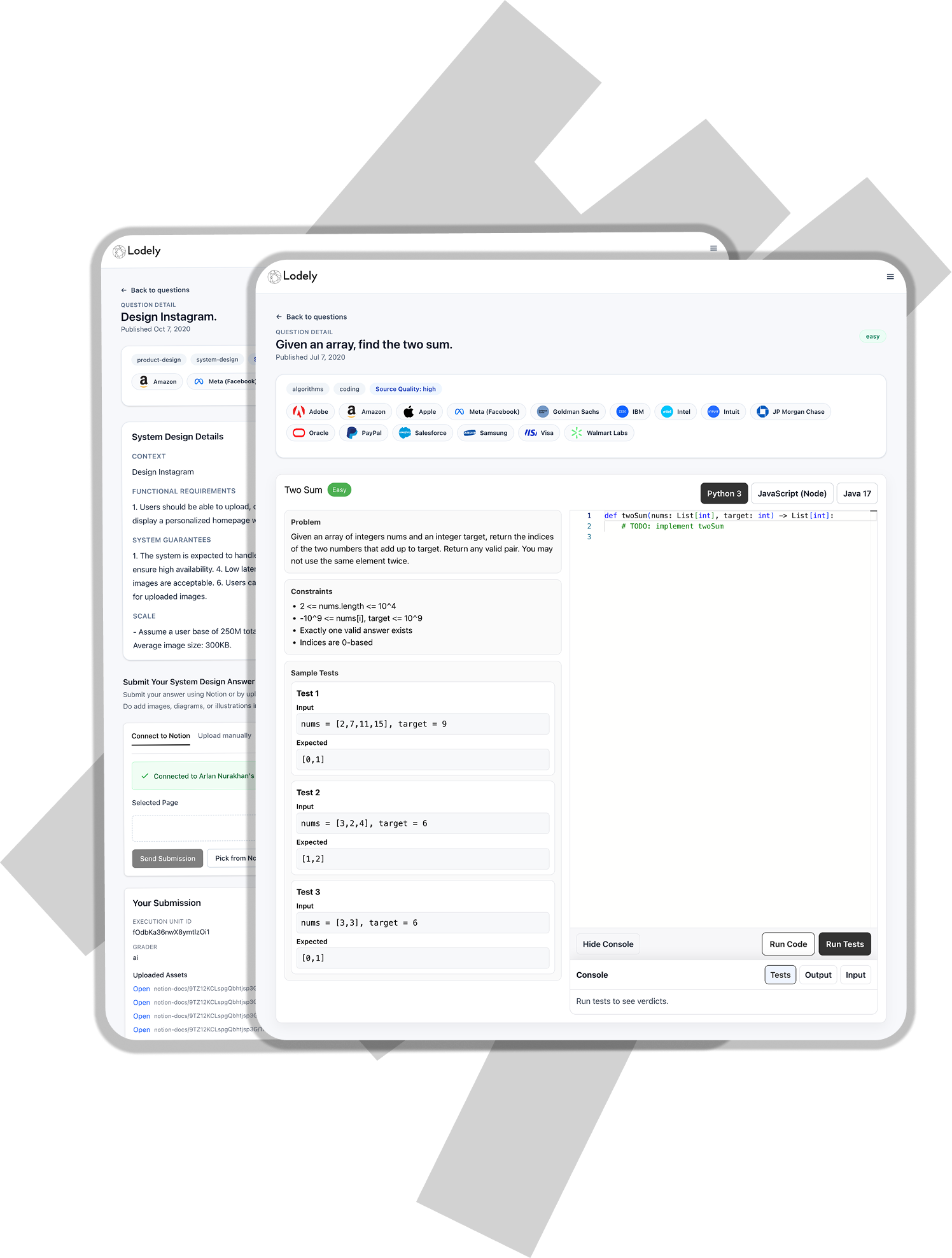
Practice the full Amazon loop on Lodely: coding question -> system design -> leadership principles question. Practicing them back to back will show you where you're losing time, or struggling to explain your decisions.
Amazon Interview Breakdown
Playlist
Type: array and hash-map coding question.
You are given a list of songs with the names and durations of the songs. You are given a target duration. You have to return two songs, which have a combined duration of the target duration, or return an empty list when there are no such songs.
The trick was that you need to know if you can have duplicate durations. And obviously you can't reuse the same song. A nested scan is easy to implement but scales poorly. Using a hash is the way to keep track of what you need for each duration, but also keeps the relationship between duration and song intact.
What It Tests - Your ability to problem-solving and clarifying, choosing the right data structure, handling duplicates correctly, and explaining time and space complexities without prompting.
Design a Rate Limiter
Type: Distributed system design.
We also needed to throttle requests across a cluster, not just a single application server. This was a must since we needed low latency and high availability for this service because every protected request passes through it.
The trick: When moving traffic around different servers, the local counters are inconsistent. You must tell me: 1. What rate limit key to use. 2. What algorithm to use. 3. What shared state to store. 4. What happens when the state is slow or unavailable. Be explicit about when you are failing open or fail closed.
The question will test you on: Requirement gathering, distributed state, consistency, atomic updates, hot-keying, failure policy, and operational decisions. If you do well, it will also show you how to address configuration changes, metrics, and how clients will know a request was rejected.
Tell Me About a Time You Went Above and Beyond for a Customer
Type: Behavioral question, Customer Obsession / Ownership Leadership Principle.
Select a story with a real customer, with a clearly articulated gap and an action you were able to do beyond your assigned task. The customer can be an external user, or a team that relied on your work.
The Trick: Extra effort is a weak form of evidence. Explain how you knew what the customer needed, why the normal path wasn't enough, what you gave up, and what changed as a result. Focus on your decisions instead of the team's general activities.
What It Tests: How you handle customer situations, your initiative, scope, tangible impact, and whether you can honestly assess the cost of your decision.
The rest of the questions are variations of the same preparation set.
- Valid Anagram problem focuses on frequency counting, assumptions of input, and whether or not we need to sort the string or just count.
- Parking Garage Reservation and Payment System provides real-time availability, consistency of reservation, payment reliability, check-in status, and recovery from partial failures.
- Course Schedule Course Schedule is a problem that tests you knowledge on graph modeling and cycle detection. You should be able to explain one of the possible solutions based on traversal (DFS or BFS) or by counting dependencies. Also, you should be able to explain why the cycle prevents the graph from being completed.
- This problem is a standard prefix sum and frequency count problem. A simple sliding window won't work due to negative numbers. You have to think about the nature of the data.
- Disagreement With Your Manager - Have Backbone; Disagree and Commit and Earn Trust Use a respectful disagreement with evidence, a decision point, and commitment after the decision
- The problem asks for a solution to move all zeroes to the end of the array, while maintaining the order of nonzero numbers. Explain the meaning of each pointer and test with arrays that are filled with no zeros and all zeros.
- In Design a URL Shortener, we will discuss identifier generation, redirects, storage, caching, expiration, prevention of abuse, and an access pattern that is heavily read-oriented. The main API should be defined first, before the full architecture of the service.
The mixture is important. Amazon can review your code, design, and Leadership Principles in separate sessions or in one session. Be able to switch between them cleanly.
What Comes After the Interview
Interviewers then submit their own feedback and attend a debrief. Amazon's public Candidate Promise targets a final decision within five business days after the loop, with possible exceptions for team availability, logistics, and holidays. (Amazon interview process)
Amazon says that if you receive an offer, compensation discussions may take several days or one and a half weeks. You should consider the full compensation package and not just the base salary. Location, title, sign-on, and stock options can dramatically impact the value over time. (Amazon interview process)
Levels.fyi's latest data for the US was updated on 27 August 2026. It showed the median total compensation for L4 SDE I is $188,000, L5 SDE II is $273,000, L6 SDE III is $392,000 and L7 Principal SDE is $685,000. Amazon's reported RSU schedule is backloaded at 5% in year 1, 15% in year 2, and 40% in year 3 and year 4. (Levels.fyi Amazon software-engineer compensation)
The importance of a year-by-year breakdown is tied to backloading. Compare your cash, sign-on bonus, and stock awards year by year. If the position or level is different from what you expected, ask the recruiter how the interview evidence translated to the final level before you assess the package.
Candidate Experiences
There are three repeated stories in recent reports. Leadership Principles are present in each loop: InterviewQuery reports that they were part of the technical and design rounds, with one interviewee citing that they had 13 to 15 behavioral questions across one loop. Amazon SDE II reports from Glassdoor for the year 2025 also list Leadership Principles, as well as data structures, object-oriented design, reasoning, and a Bar Raiser. (InterviewQuery Amazon candidate reports, Glassdoor AWS SDE II reports)
In terms of coding skills, design depth can override solid coding skills at SDE II level. One candidate from the US, interviewed between July 31 and August 19, 2026, reported that he did very well on data structures, but got rejected because he was missing the depth in low-level and high-level design. The candidate's primary correction was to timebox clarification, define responsibilities earlier, and leave enough time to implement (2026 SDE II report).
The five-business-day target is a goal, not every single result. One candidate reported receiving a successful result after 16 days, while others described recruiter or team-matching delays. Use the five-day mark as a good time to follow up, not to infer the decision. (Candidate timing thread from July 2026, Amazon Candidate Promise)
These are all one-on-one stories, with different teams. The main takeaway is to prepare for your Leadership Principles for any interviewer, leave some time for implementation, and be able to showcase your design depth for the level.
Conclusion
Amazon rewards working code, defensible design decisions, and evidence from your own experience. Practice the Amazon interviews on Lodely as a mixed loop. Make sure to work through every answer under intense follow-up, and be prepared to demonstrate both technical knowledge and judgment when you step into the room.
✉️ Get free faang interview cheat sheet and interview tips weekly