OpenAI Interview Questions: 6 Questions to Prepare for in 2026

OpenAI's hiring process starts with application review and introductory calls, then moves into role-specific assessments and a four-to-six-hour final loop. Engineering candidates are judged on solution design, code quality, performance, testing, communication, and collaboration. This guide covers the process, its difficulty, preparation, six representative questions, candidate experiences, and reported software engineer compensation.
Depending on the role and team, you may face live coding, a take-home project, a technical test, or several assessments. Follow your recruiter's materials to determine whether you may use AI or other tools for each task.
What to Expect: OpenAI Interview Process
The official OpenAI interview guide provides the clearest baseline. The hiring team typically takes about one week to review an application. You may then speak with a recruiter or hiring manager about your background, motivation, and goals. Be prepared to explain why the specific team excites you and which recent OpenAI work connects to your experience.
The next step is a skills assessment. OpenAI lists pair coding, take-home projects, and technical tests as possible formats, and some roles use more than one. Candidates usually hear within one week whether they are moving forward.
Tool rules vary by assessment. OpenAI says some exercises include AI tools while others measure independent problem-solving. Don't assume that an online interview report's tool rules apply to your assessment. Read your exercise materials and ask your recruiter if the boundary is unclear.
Final interviews usually last four to six hours and involve four to six people over one or two days. They're virtual by default, with an onsite option in San Francisco. The format depends on your field, so applied product engineers, infrastructure engineers, and research engineers shouldn't expect identical loops. Engineering interviews evaluate solution design, code quality, performance optimization, test coverage, decision-making, and response to feedback.
OpenAI says candidates should normally receive a decision within one week after the final loop. The team may also request professional references. Scheduling, additional conversations, or team matching can extend the published timeline.
How Difficult Is the OpenAI Interview?
OpenAI says its final interviews are designed to push people beyond their comfort zones. Recent candidates have similarly described difficult technical rounds, even when they rated the interviewers highly.
The difficulty comes from being evaluated on several dimensions at once. Interviewers judge code correctness alongside structure, tests, performance, and explanation. System design evaluation covers both success and failure paths, while behavioral answers should isolate your contribution.
Coding prompts expand under pressure. An interviewer may extend a small utility or class with state, persistence, concurrency, or recovery requirements. Implement the correct core first, and name the tests you'll run before the interviewer introduces the next constraint.
Block diagrams are only part of system design. Be prepared to discuss data ownership, consistency, scaling, retries, and failure isolation. Products at OpenAI's scale also require cost and latency tradeoffs. Say what you're optimizing before you choose storage, queues, caches, or replication.
Communication remains part of the score. Silent implementation hides your judgment, so explain the constraint, the tradeoff, and what evidence would change your decision. OpenAI's rubric names communication and collaboration alongside technical quality.
How to Prepare and Pass OpenAI Interviews
Follow the format your recruiter gives you. Prepare for implementation, system design, project deep dives, and behavioral questions. OpenAI Recruiting Advice includes guidance on ownership, agency, curiosity, and impact. Demonstrate those qualities throughout the process, including the final behavioral interview.
Practice coding in a production-like style. Give functions and classes well-defined contracts. Handle empty inputs and boundary values, then test normal paths, failures, and recovery. Preserve working behavior when a new requirement arrives.
Start the system design discussion with users, traffic, latency, availability, and consistency. Confirm whether model serving is in scope. Trace one request before scaling the design, then test overload, duplicate work, partial failure, and a regional outage.
Prepare one technical project in depth. Explain the original constraint, your exact contribution, the alternatives you rejected, and what happened after launch. Use numbers only when you can defend their source. If you're a senior engineer, expect repeated questions about why you made each decision.
Prepare a specific reason for wanting to join OpenAI. Review the team's latest work and connect it to something you've worked on, studied, or learned. Explain the problem you want to work on, why you think OpenAI is the best place to solve it, and what you can contribute now.
If your process spans six to eight weeks, rotate between formats. One practice day could pair an implementation interview with design; the next could pair a project deep dive with an ownership story.
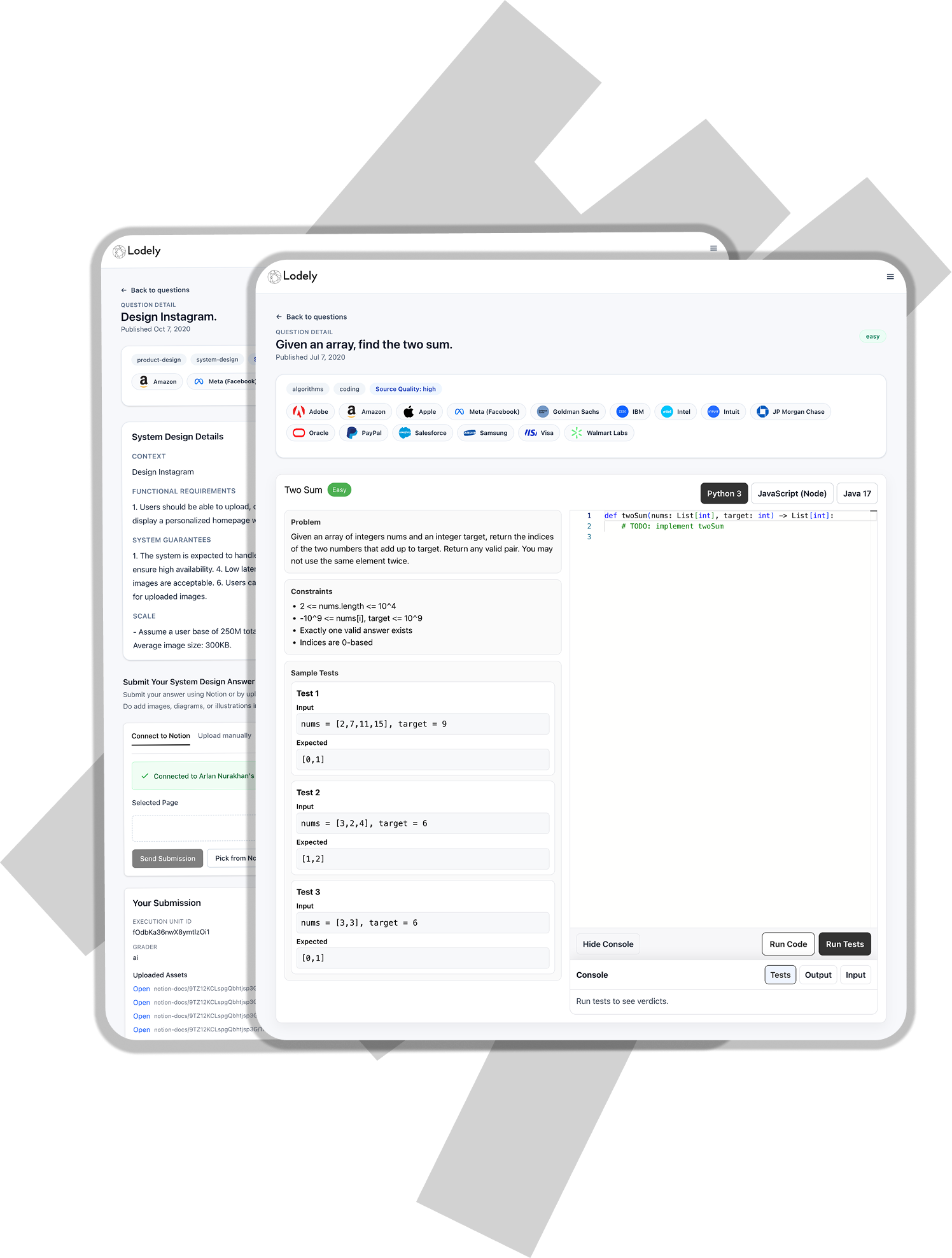
Use Lodely to practice that OpenAI-specific mix of coding, system design, and behavioral questions.

OpenAI Interview Breakdown
The six questions below span the range of an OpenAI software engineering loop.
Plant Infection Part 3: Recovery After D Days
function infectionCount(grid, d, t)- You are simulating a plant infection that spreads across a grid.
- The grid contains: - "." (healthy cell) - "I" (infected cell) - "#" (wall, never changes) Each day, the simulation proceeds in two phases: 1.
- Recovery: Any cell that was infected exactly d days ago recovers to ".".
- 2.
- Spread: Any healthy "." cell adjacent (4-directional: up, down, left, right) to at least one infected "I" cell becomes infected.
- Initially infected cells (present at day 0) are considered to have been infected at day 0.
- On day d, they recover.
- Given the grid, recovery period d, and target day t, return the number of infected cells at the end of day t.
- Day 0 is the initial state (no spread or recovery happens).
- Simulation steps occur on days 1, 2, 3, etc.
1 <= grid.length, grid[0].length <= 501 <= d <= 10000 <= t <= 1000Grid cells are ".", "I", or "#"
grid = [[".","I","."],[".",".","."],[".",".","."]], d = 5, t = 2
7
grid = [["I","#","."],[".","#","."],[".",".","."]], d = 10, t = 3
4
Type: This is a grid simulation where infected cells spread to four-directional neighbors, recover after a fixed number of days, and cannot cross walls.
The order of operations controls the result. Recovery happens before spread, and cells infected today can't spread until tomorrow. If old and new state are mixed, the infection wave can move too far in one step.
What It Tests: Precise temporal reasoning, state management, and boundary control. Track the time each cell became infected, or group cells by infection time.
Tell Me About a Time You Made a Mistake
Type: This is an ownership-focused behavioral question. Use a real decision or action that had negative consequences.
The Trick: Weak answers downplay the mistake, blame an ambiguous process, or spend most of the story proving it was harmless. Choose a case where there were real stakes. State the error clearly, then focus on diagnosis, repair, and the change you carried into later work.
What It Tests: OpenAI's published hiring values include openness to feedback, teamwork, and results. Explain who was affected, how you communicated the problem, what you changed, and how you verified the fix.
Design Slack
Type: This is a multi-tenant, real-time system design problem covering channels, direct messages, threads, files, search, and integrations.
The Trick: Address permission-aware history and failure behavior alongside real-time delivery because they determine safety. Specify ordering guarantees, sources of truth, client reconnection, and gap filling. Search, exports, and bots must respect workspace and channel membership.
Interviewers assess your decomposition, scale, isolation, and operational judgment. Walk through how the system sends, fans out, persists, indexes, and replays messages. Then discuss hot channels, duplicate delivery, regional failure, retention policies, and audit logs.
Other questions:
- IP Iterator: Convert each address to a number, state whether the endpoints are inclusive, and handle octet boundaries. Use a clear parsing strategy and a simple representation that eliminates edge cases.
- Why do you want to work at OpenAI? Relate your experience to a particular area of OpenAI's work. Your answer should stand up to follow-ups about tradeoffs, safety, and why a specific team fits better than a general interest in AI.
- Design rate-limit handling for a free-tier chat product: Separate hard quotas from temporary throttling, return useful usage reset information, preserve the chat requests, and prevent retry storms. Cover both backend and client execution.
Use the OpenAI plan on Lodely to work through these questions as a loop.
What Comes After the Interview
OpenAI states that it aims to make a decision within one week after final interviews and may request references.
OpenAI software engineer data, updated September 1, 2026, reports U.S. annual compensation from about $253,000 at L2 to $1.39 million at L6, with a median near $880,000. Leveling can affect the offer as much as negotiation.
At higher levels, equity makes up much of the compensation. Public reports list about $273,000 in base and $380,000 in annualized stock at L4. At L6, it reports about $389,000 in base, $973,000 in stock, and $27,000 in bonus. Ask about valuation, vesting, liquidity, and whether the package changes after team matching.
When reviewing an offer, consider the role's scope, manager, location, compute resources, and interaction with the research or product teams it supports. High total compensation cannot offset a mismatch in ownership or work style.
Candidate Experiences
Recent candidate reports describe varied processes. During 2025 and 2026, candidates reported assessments, technical and behavioral interviews, pair coding, system design screens, and AI agent architecture screens. Across these formats, candidates consistently described in-depth interviews under time pressure.
In coding rounds, candidates have written utility functions, stateful classes, serialization logic, and small services. These tasks can involve several components and behaviors. Follow-up questions usually test the robustness of the original design.
System design reports also vary. Some candidates describe collaborative interviewers who help define the scope; others describe a hands-off style that requires the candidate to drive requirements and depth. Prepare to lead the discussion by asking useful questions, stating assumptions, and moving forward.
Candidates have reported practical, language-agnostic coding; scale-focused system design; project presentations in some onsite loops; and a pilot agentic coding round. Treat the official OpenAI preparation packet as the authority on AI tool use.
Prepare behavioral examples that show motivation, ownership, and an ability to work through uncertainty. Explain how your technical answer changed after feedback, when you fixed a mistake, and how you made progress without a full playbook.
Conclusion
OpenAI interviews assess solution correctness, clear reasoning, and your ability to adapt as constraints change. After preparing your coding, systems, projects, and behavioral stories, use Lodely to rehearse that OpenAI-style mix until you can recognize the patterns consistently and explain them with confidence.
✉️ Get free faang interview cheat sheet and interview tips weekly
✉️ Get free faang interview cheat sheet and interview tips weekly