


Apple Interview Questions in 2026: 8 Examples

Apple software engineering interviews vary by team and role. Recent candidates reported combinations of live coding, system design, debugging, low-level concepts, project discussions, and behavioral interviews. Start by asking your recruiter which formats your team plans to use.
What to Expect: Apple Interview Process
Apple's hiring process can include recruiter screening, a hiring-manager discussion, technical interviews, an interview loop, and a final discussion. A May 2026 process review describes seven possible stages, from application review through offer negotiation, and says the process can take two months or longer depending on the role. Individual teams may skip or combine stages.
Recent reports include a 45-minute manager discussion with a coding task, a one-hour domain-focused manager screen, and an exercise debugging an existing implementation (Glassdoor). Use the recruiter briefing to confirm your loop.
What Makes Apple's Interview Process Different
Apple's Software and Services team includes apps, frameworks, cloud infrastructure, operating systems, machine learning, security, graphics, media, wireless systems, and quality engineering (Apple Software and Services). One team may focus on network messaging, another on C++ ownership and low-level debugging, and another on Swift and image-processing math. Prepare for the domain named in the job description.
How to Prepare and Pass Apple Interviews
Build your study plan from the job description and recruiter briefing. Track the skills named in the posting, the skills confirmed by the recruiter, and the skills you still need to learn. Review core data structures, explain your invariants, test edge cases, and state runtime and memory use. Add the technical layer for your role, such as distributed systems, memory and concurrency, or product APIs and accessibility.
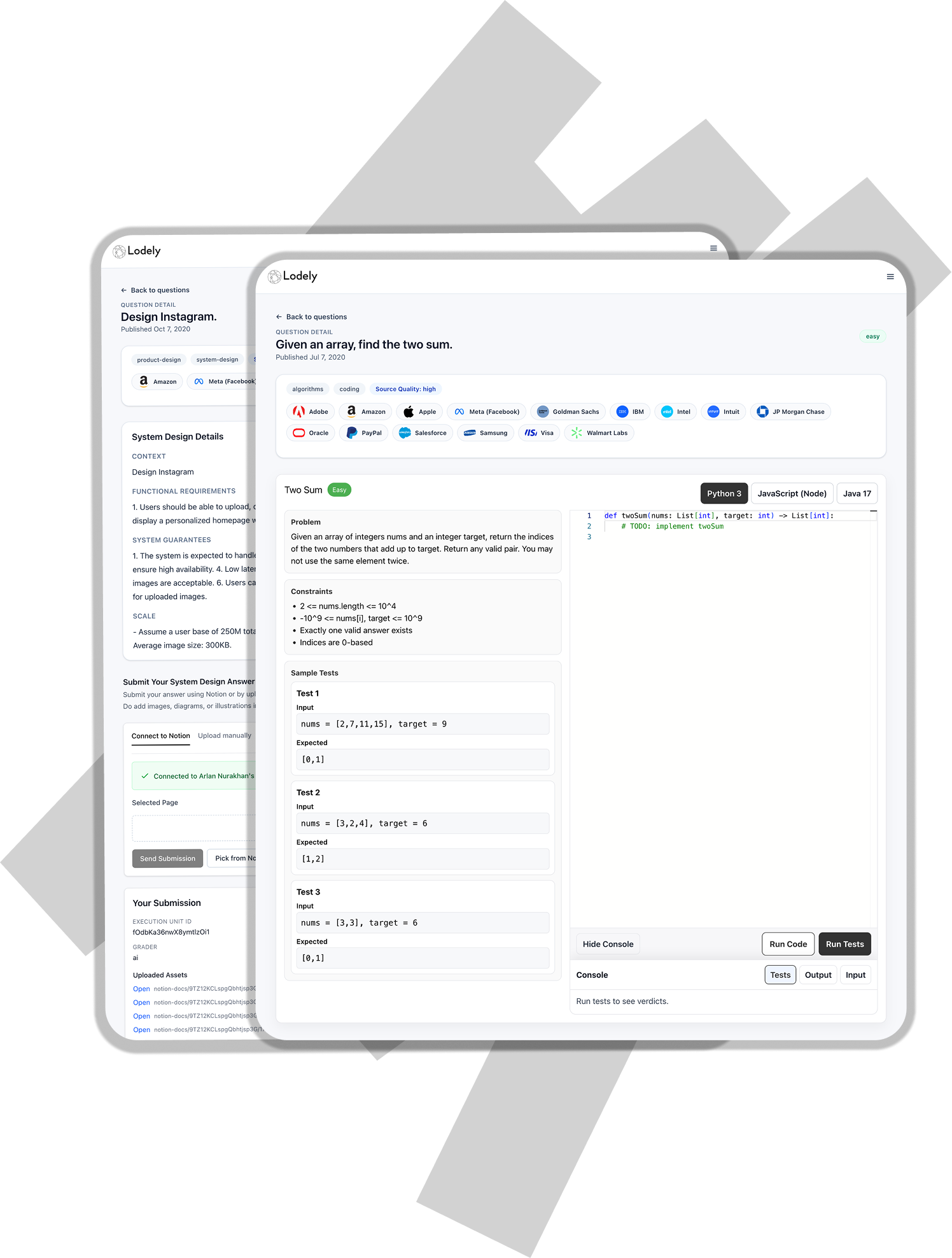
Allow four to six weeks if your fundamentals are current and eight to twelve weeks if you're rebuilding them. Use Lodely to review Apple coding, system-design, and behavioral questions across the full loop.

Apple Interview Breakdown
Prepare for these eight questions.
Linked List Cycle
// ListNode has fields: val (number), next (ListNode or null)
function hasCycle(head)- Given head, the head of a linked list, determine if the linked list has a cycle in it.
- There is a cycle in a linked list if there is some node in the list that can be reached again by continuously following the next pointer.
- Return true if there is a cycle in the linked list.
- Otherwise, return false.
The number of the nodes in the list is in the range [0, 10^4]-10^5 <= Node.val <= 10^5pos is -1 or a valid index in the linked-list
head = [3,2,0,-4], pos = 1
true
head = [1,2], pos = 0
true
Type: Linked-list traversal with constant-space pointer tracking. The Trick: Explain why the slow and fast pointers must meet when a cycle exists. Use the invariant to handle an empty list, a single node, and a self-cycle. What It Tests: Pointer safety, loop conditions, proof of correctness, and complexity analysis. Compare an $O(n)$ visited-node set with the $O(1)$ two-pointer solution.
Design a Messaging Platform
Type: Large-scale system design for real-time delivery, storage, media, and multi-device state. The Trick: Define whether the system supports direct messages, groups, read receipts, search, media, and encryption before drawing services. Explain delivery order, retries, and offline behavior. What It Tests: Capacity planning, data modeling, API boundaries, partitioning, failure handling, and tradeoffs among latency, availability, and consistency.
Why Do You Want to Work at Apple?
Type: Motivation and behavioral fit. The Trick: Choose a team or technical area, connect it to relevant work you've done, and explain what you want to contribute. What It Tests: Preparation, credible motivation, and alignment with the team's work.
The remaining five questions cover distinct skills. Valid Parentheses tests stack use and early rejection of mismatched closing characters. Reverse a Linked List tests careful pointer updates and iterative versus recursive reasoning. Subarray Sum Equals K tests prefix sums and frequency maps when negative values prevent a sliding-window solution. Calculate the Trapped Rainwater Between Bars in a Given Array tests boundary reasoning and a space-efficient two-pointer approach. Design a Typeahead Box for a Search Engine covers latency, ranking, prefix retrieval, caching, freshness, and abuse prevention.
Apple Software Engineer Compensation by Level
An offer may include base salary, annualized stock, and a bonus. Public estimates put yearly total compensation of $168,000 at ICT2, $240,000 at ICT3, $357,000 at ICT4, and $488,000 at ICT5. Compare base, stock, bonus, vesting, and refresh grants separately.
What Comes After The Interview
Team-specific debriefs, additional conversations, and scheduling can create long gaps. Ask your recruiter for the expected timeline and confirm the team, level, location, reporting line, equity schedule, bonus target, and sign-on terms before accepting an offer.
Candidate Experiences
One recent candidate described recruiter and hiring-manager stages before the manager outlined a technical loop of three or four 45-minute sessions and an executive conversation. The team defined the format after those initial conversations. Ask your recruiter to confirm the stages and timing for your role.
Conclusion
Apple evaluates technical depth, clear reasoning, and preparation for the hiring team's domain. Use Lodely to practice the coding, design, and behavioral questions in your loop.
✉️ Get free faang interview cheat sheet and interview tips weekly
✉️ Get free faang interview cheat sheet and interview tips weekly