


Hudson River Trading Online Assessment: Questions Breakdown and Prep Guide

Thinking about “Cracking HRT’s Assessment” but not sure what you’re getting into? You’re not alone. Candidates see a mix of high-signal algorithmic coding, probability/expectation puzzles, and hands-on simulations that feel close to real trading systems — and the hardest part is knowing which patterns to master.
If you want to walk into the Hudson River Trading Online Assessment (OA) confident, prepared, and ready to execute under time pressure, this guide is your playbook. No fluff. Real breakdowns. Strategic prep.
When to Expect the OA for Your Role
HRT calibrates its OA by role and level. The challenge you see will mirror what you’d build or analyze on the job.
- New Grad & Intern (Software/Algo/Infrastructure) – Expect an OA within 1–2 weeks of recruiter contact. For many campuses, this is the primary technical screen.
- Software Engineer (Core C++ / Infrastructure / Full-Stack) – Standard. You’ll typically get a HackerRank- or CodeSignal-style link with 2–3 coding problems focused on algorithms, data structures, and careful implementation.
- Algo Developer / Quant Developer – Expect coding plus probability/expectation, combinatorics, and sometimes simple simulations. Precision and reasoning under uncertainty are emphasized.
- Platform / Data / Tools – Similar OA, but data parsing, streaming windows, and memory/performance awareness may be included.
- Senior Roles – Some candidates go straight to live technical screens or a take-home-like practical task, but many still receive a short OA as a first filter.
Action step: When you get the invite, ask for the platform, duration, languages allowed, and whether probability/MCQ sections are included. Calibrating to the exact format is half the battle.
Does Your Online Assessment Matter?
Yes — and at HRT, it’s a strong signal.
- It’s the first cut. Your resume gets the invite, your OA gets the interviews.
- They keep your code. Interviewers may review your OA solutions to seed questions later.
- Speed and rigor both count. HRT cares about correctness, time complexity, numerical stability, and implementation details (off-by-ones, overflow handling).
- It mirrors the work. Expect patterns that resemble real HFT problems: streaming windows, order-book-like simulations, bit tricks, and expectation calculations.
Pro Tip: Treat the OA like a live trading system in miniature: write clean, deterministic, and efficient code; test small cases quickly; and watch for performance footguns.
Compiled List of Hudson River Trading OA Question Types
Build muscle memory around these categories and representative problems:
- Sliding Window Maximum — type: Deque / Time-Series
- Number of Orders in the Backlog — type: Heaps / Simulation (Order Book)
- K Closest Points to Origin — type: Geometry / Heap / Quickselect
- Find Median from Data Stream — type: Two Heaps / Streaming
- Reservoir Sampling / Random Pick Index — type: Sampling / Streaming
- New 21 Game — type: Probability / DP / Expectation
- Random Pick with Blacklist — type: Math / Hash Mapping / Randomization
- Daily Temperatures — type: Monotonic Stack / Next-Greater-Element
- Maximum Subarray Sum (mod m) — type: Prefix Sums / Balanced BST / Mod Arithmetic
- Erect the Fence — type: Convex Hull / Computational Geometry
- Find the Duplicate Number — type: Floyd’s Cycle / Binary Search on Answer
- Counting Bits — type: Bit DP / Popcount Patterns
- Subarray Sum Equals K — type: Prefix Hashing
- LRU Cache — type: Design / LinkedHashMap
- Count of Smaller Numbers After Self — type: Fenwick Tree / Merge Sort
How to Prepare and Pass the Hudson River Trading Online Assessment
Think training camp: build reflexes you can trust under a clock.
1. Assess Your Starting Point (Week 1)
- Benchmark on arrays/hashes, heaps, stacks/queues, sliding window, graph basics, bit ops, and probability DP.
- Time yourself on 2–3 problems a day. Track fail points (overflow, off-by-one, TLE).
- Decide your primary language. For HRT, C++ and Python are both common; C++ shines for performance-heavy tasks.
2. Pick a Structured Learning Path (Weeks 2-6)
- Self-Study (LeetCode/HackerRank)
Best for disciplined learners. Focus on streaming, heaps, deque patterns, bit manipulation, and modular math. - Mock Assessments
Timed, proctored sessions that simulate OA pressure and I/O quirks. - Mentorship / Coaching
A software engineer career coach can push code quality (naming, structure, tests) and help you narrate trade-offs.
3. Practice With Realistic Problems (Weeks 3-8)
- Build a set of 40–60 HRT-style problems: sliding windows, heaps, simulation, probability DP, bit ops, geometry basics.
- Always code with a timer, then refactor for clarity and micro-optimizations only if needed.
- Stress test: randomized inputs, pathological cases (duplicates, zeros, extremes).
4. Learn Hudson River Trading-Specific Patterns
Expect to see or benefit from:
- Order book mechanics (matching, partial fills, priority queues)
- Streaming stats (rolling min/max, median, quantiles with two heaps)
- Probability & expectation (DP over states, linearity of expectation)
- Bit tricks (masks, popcount, parity, fast set ops)
- Numerical robustness (overflow guards, integer vs float, stable comparisons)
- Geometry lite (convex hull intuition, cross-product orientation tests)
- Deterministic randomness (seed control, reproducible sampling where required)
5. Simulate the OA Environment
- Practice on the exact platform when possible (HackerRank/CodeSignal environments).
- Use stdin/stdout; avoid slow I/O. In C++, prefer fast I/O and reserve() where appropriate.
- Respect constraints. If n is 2e5, O(n log n) is usually fine; O(n^2) likely isn’t.
- Dry-run on sample tests, then immediately build your own edge cases.
6. Get Feedback and Iterate
- Save your solutions and revisit them after 24 hours. Would you read this in production?
- Post-mortem every miss: what was the first wrong assumption?
- Track a personal bug list (overflow, bounds, tie-breaking, integer division) and review it before each practice.
Hudson River Trading Interview Question Breakdown
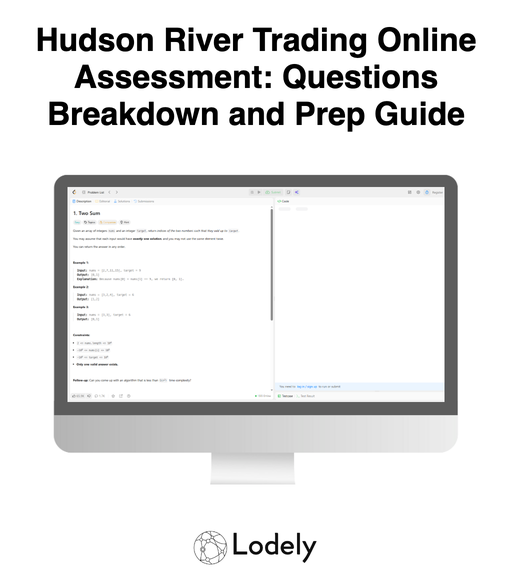
Here are featured sample problems inspired by common HRT themes. Nail these patterns and you’ll cover most of the OA terrain.
1. Sliding Window Maximum on Price Stream
- Type: Deque / Time-Series
- Prompt: Given an array of prices and a window size k, return the maximum in each window as it slides across the array.
- Trick: Maintain a decreasing deque of indices; drop out-of-window indices from the front and smaller values from the back for O(n).
- What It Tests: Time-series thinking, amortized data structures, off-by-one and indexing precision.
2. Order Book Backlog Simulation
- Type: Heaps / Simulation
- Prompt: Process a stream of buy/sell orders (price, amount, side). Match against the opposite book when possible; otherwise, add to backlog. Output total backlog size.
- Trick: Max-heap for buys, min-heap for sells; match greedily. Watch for partial fills and large volumes.
- What It Tests: Priority-queue mastery, careful state updates, correctness under many edge cases.
3. Expected Value with Bounded Random Walk
- Type: Probability / DP
- Prompt: Compute the probability or expected payoff of a game where you draw uniformly from a bounded set until a threshold is reached (e.g., New 21 Game variant).
- Trick: Use DP with sliding window sums to keep O(n) time. Apply linearity of expectation when it simplifies derivations.
- What It Tests: Translating probability to DP recurrences, numerical stability, and boundary handling.
4. Streaming Median
- Type: Two Heaps / Streaming
- Prompt: Support add(num) and findMedian() in near real-time for an incoming number stream.
- Trick: Maintain a max-heap for the lower half and min-heap for the upper; rebalance by at most one element.
- What It Tests: Streaming data structures, amortized balancing, tie-breaking and integer vs float median.
5. K Closest Points to Origin
- Type: Geometry / Heap / Quickselect
- Prompt: From n 2D points, return the k closest to the origin.
- Trick: Use a max-heap of size k or Quickselect/partition for average O(n). Compare squared distances to avoid sqrt.
- What It Tests: Geometry-lite intuition, performance-aware selection, avoiding unnecessary floating point operations.
6. Bit Tricks: Unique Number Among Triplicates
- Type: Bit Manipulation
- Prompt: Given an array where every number appears three times except one that appears once, find the single number.
- Trick: Count bits modulo 3 or use finite-state bitmasks (ones/twos) to track frequency per bit.
- What It Tests: Low-level reasoning, constant-space solutions, correctness under negative numbers and 32/64-bit concerns.
What Comes After the Online Assessment

Passing the HRT OA isn’t the finish line — it’s your entry ticket. After that, the focus shifts to deeper problem-solving, systems understanding, and precision under pressure.
1. Recruiter Debrief & Scheduling
Expect an email within a few days. You’ll get high-level feedback and dates for the next steps. Ask about interview themes (algorithms, probability, systems) and the languages they’re comfortable seeing.
2. Live Technical Interviews (Algorithms & Data Structures)
Pair with engineers on a shared editor or whiteboard-style tool. Expect:
- Interactive problem-solving (variants of OA themes)
- Complexity analysis and alternative approaches
- Careful edge-case reasoning and small test design
Pro Tip: Be explicit about invariants (“this deque is decreasing by value”) and why they guarantee correctness.
3. Language/System Deep Dive
Common for core dev roles:
- C++ specifics (value categories, RAII, move semantics, memory layout, const-correctness)
- Performance profiling instincts (allocations, cache locality, branch prediction)
- Python candidates: algorithmic clarity, data model knowledge, and performance trade-offs
4. Quant/Probability Discussion (Role-Dependent)
For algo/quant-leaning roles:
- Expectation/variance calculations, conditional probability, independence
- Simple simulations or reasoning about distributions
- Translating math into clean, testable code
5. System Design & Performance
For mid/senior:
- Design a component like a simplified market data aggregator, an alerting pipeline, or a low-latency stats service
- Emphasis on throughput, latency, failure modes, determinism, and backpressure
6. Behavioral & Team Fit
Collaborative style matters. Expect prompts on:
- Debugging under time pressure
- Handling ambiguous requirements
- Owning mistakes and post-mortems
Pro Tip: Use STAR. Keep answers crisp and outcome-oriented; highlight collaboration and learning loops.
7. Final Loop & Offer
A multi-interview sequence combining algorithms, systems, and values. If successful, you’ll receive a call with next steps and an offer package. Come prepared with market data and your priorities to negotiate thoughtfully.
Conclusion
You don’t need to guess; you need to prepare with intent. The HRT OA is challenging but predictable if you:
- Diagnose weak areas early (streaming, heaps, probability DP, bit ops)
- Practice under timed, platform-accurate conditions
- Write code that’s both correct and performance-aware
Treat the OA like a miniature trading system problem: precise, efficient, and robust. Do that, and you’ll turn the assessment from a gate to your fast track.
For more practical insights and prep strategies, explore the Lodely Blog or start from Lodely’s homepage to find guides and career resources tailored to software engineers.
✉️ Get free faang interview cheat sheet and interview tips weekly
✉️ Get free faang interview cheat sheet and interview tips weekly


