


NVIDIA Interview Questions in 2026: 10 Examples

NVIDIA interviews usually progress from phone screens to virtual or onsite sessions. Technical interviews may include coding, and each conversation typically lasts 30 to 60 minutes. The mix varies by team: inference roles may cover GPU serving, while systems and machine learning teams may focus on performance, distributed training, or low-level fundamentals.
You need solid coding skills and a clear explanation of how design choices affect system throughput, latency, and reliability, as well as the engineers who work with the system. The ten questions below cover that range.
What to Expect: NVIDIA Interview Process
NVIDIA's current hiring guidance describes phone interviews followed by virtual or in-person sessions, with an onsite visit required before a full-time offer. You may meet the hiring manager, team members, and people from other groups. The company says decisions usually arrive within a few weeks.
Use the recruiter call to confirm the loop, coding environment, technical domain, and whether you'll face system design, machine-learning fundamentals, or a project deep dive. For GPU-heavy roles, review parallelism, memory movement, utilization, profiling, and failure recovery alongside algorithms and data structures.
How to Prepare and Pass NVIDIA Interviews
Give yourself 4 to 6 weeks if your fundamentals are current or 8 to 12 weeks if you're rebuilding systems depth.
- Give a complete technical explanation. Define constraints, state the approach, write clean code, test boundaries, and explain complexity. For design, set latency and availability targets first.
- Match the job's technical focus. CUDA, compiler, graphics, networking, AI infrastructure, and embedded roles need different depth. Prepare one relevant project in detail.
- Build concise evidence stories. Cover a complex project, deadline, conflict, and limited resources. Explain your decision, tradeoff, result, and what changed.
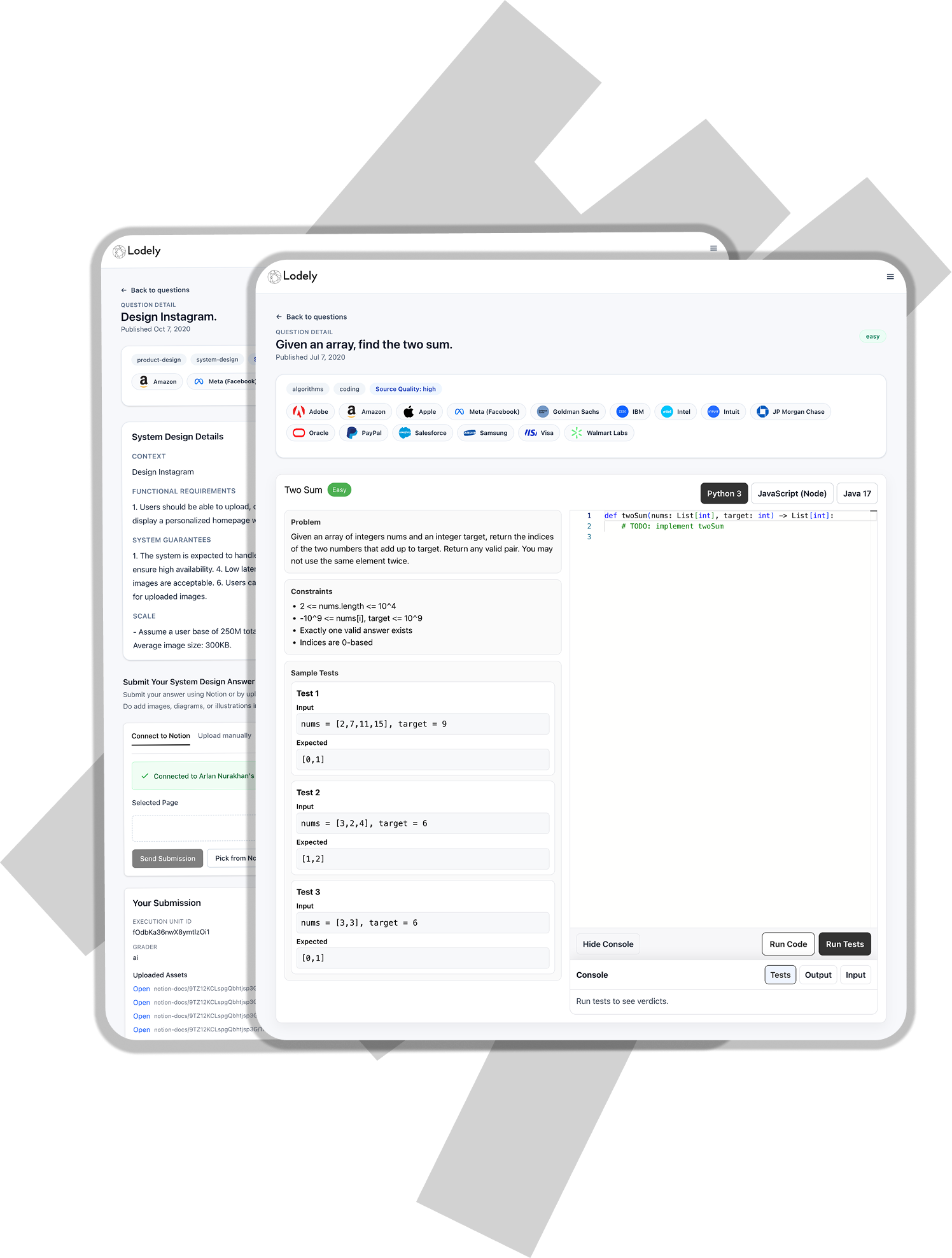
Use Lodely to rotate through NVIDIA-focused coding, system-design, and behavioral prompts, so one strong area doesn't hide another gap.
NVIDIA Interview Breakdown
Design a Low-Latency GPU Inference Serving Platform
Type: Distributed systems and GPU-serving design.
The Trick: Batching improves throughput but can hurt tail latency. Define the request lifecycle, idempotency, queueing, worker health, and failure recovery before optimizing GPU use.
What It Tests: Requirement setting, resource scheduling, latency tradeoffs, observability, and retry design across a GPU fleet.
Build a Basic Regex Parser
function isRegexMatch(s, p)- Implement regex matching with support for '.' and '*'.
- '.' matches any single character. '*' matches zero or more of the preceding element.
- Match must cover the entire string.
0 <= s.length <= 2000 <= p.length <= 200
s="aa", p="a"
false
s="aab", p="c*a*b"
true
Type: Dynamic programming or memoized recursion over a string and pattern.
The Trick: The * operator applies to the preceding element and can match zero or more copies. Your state must handle empty strings and repeated pattern elements without skipping valid paths.
What It Tests: Exact state definitions, branching, boundary conditions, and a correctness explanation.
Describe the Most Technically Complex Project You Have Worked On
Type: Technical behavioral deep dive.
The Trick: Explain the constraint, alternatives, your decision, and the measured outcome. Separate your contribution from the team's work.
What It Tests: Technical judgment, ownership, communication, and scope.
Seven more questions cover additional skills. Design a Distributed Training System for a Trillion-Parameter Language Model covers parallelism, GPU coordination, checkpointing, and recovery. Serialize and Deserialize a List of Strings requires safe encoding of empty values and delimiters. How Do You Set Priorities With Limited Resources? tests how you protect high-value work.
A Tight Deadline covers scope and risk communication. Resolving Conflict asks for accountability and lasting change. Log Aggregation by Status Code tests grouping and ordering at scale. A Technical Challenge You Overcame connects a hard decision to a concrete result.
What Comes After The Interview
If you receive an offer, confirm the level before comparing packages. September 2026 U.S. data shows compensation rising sharply from early-career to senior roles, with annualized equity becoming a major component. Compare base, stock, bonus, vesting, and refresh expectations separately.
If the promised update date passes, send one direct follow-up. NVIDIA says decisions usually arrive within weeks, though team scheduling can change the timeline.
Candidate Experiences
One recent candidate for a senior LLM applications role described four back-to-back virtual onsite sessions. The loop covered fast-paced coding, distributed training design, LLM fundamentals, and a behavioral scenario about allocating resources. The design discussion moved into benchmarking and debugging GPU utilization. For a specialized role, prepare to move from general concepts to tools you've used.
Conclusion
NVIDIA interviews assess clean code, depth in your specialty, and decisions grounded in performance and reliability. Practice the 10 selected questions on Lodely, explain every tradeoff aloud, and prepare a project story that can withstand detailed follow-up questions.
✉️ Get free faang interview cheat sheet and interview tips weekly
✉️ Get free faang interview cheat sheet and interview tips weekly