


Pinterest Interview Questions: 9 Questions to Prepare for in 2026

Pinterest software-engineering candidates report an initial recruiter or technical screen followed by coding, system design, and competency interviews. The process often spans five to six rounds, with an extra design session for senior roles.
You need to clarify problems, handle edge cases, explain tradeoffs, and show how you work through difficult decisions with others. The nine questions below cover those signals.
What to Expect: Pinterest Interview Process
Current Pinterest software-engineer interview reports describe an early recruiter conversation followed by an assessment or live technical screen. Some five-session loops include three coding interviews, one design interview, and one competency interview; senior candidates may instead have two coding and two design sessions.
Coding topics may include graphs, arrays, strings, queues, heaps, and data transformations. System-design topics may include rate limiting, search, feeds, ranking, and high-volume content systems. Competency-round stories may cover ownership, feedback, collaboration, ambiguity, and measurable impact.
How to Prepare and Pass Pinterest Interviews
Plan four to six weeks if your foundations are current, or eight to twelve weeks if you need to review graph traversal or distributed systems.
- Finish the entire coding round. Analyze the inputs, choose the right data structure, write and test the code, and state the solution's complexity. Do not spend time optimizing the initial solution, and leave room for the next question.
- Make product-scale design concrete. Start with traffic, latency, consistency, and failure requirements. Then cover APIs, storage, partitioning, caching, abuse controls, and observability.
- Treat competency as a scored round. Build a small story bank with specific decisions and outcomes that show your individual scope.
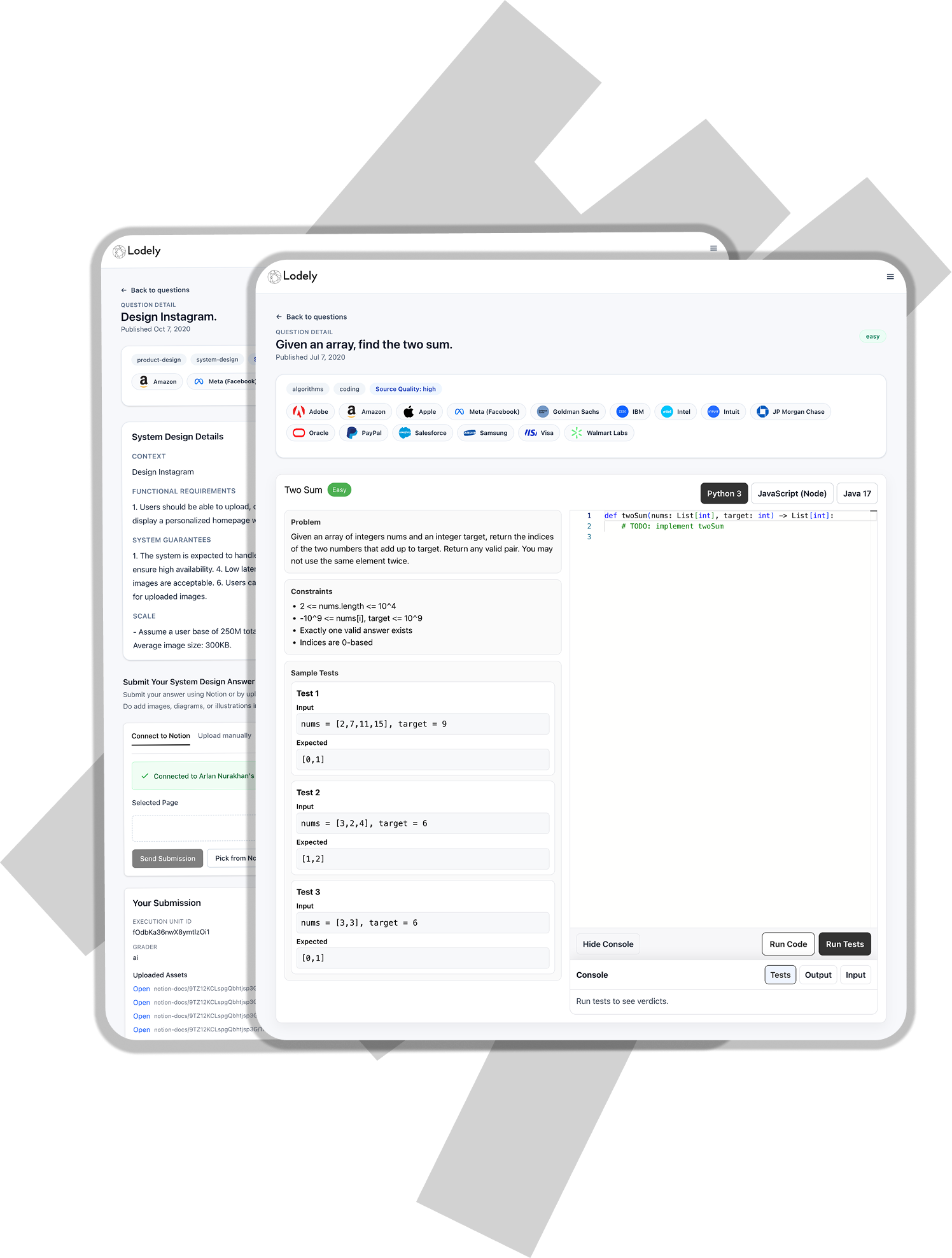
Use Lodely for mixed practice: complete coding questions under timed conditions, then switch to a design prompt and one behavioral answer.

Pinterest Interview Breakdown
Design a Rate Limiter
Type: Distributed system design on the request path
A local counter fails when one user accesses several servers. Define the rate-limiting key, algorithm, shared state, atomic-update behavior, and failure policy while minimizing added latency.
What It Tests: Requirements, distributed consistency, hot-key handling, reliability, and clear operational judgment.
Tell Me About the Most Challenging Situation in Your Career
Type: Behavioral and competency discussion.
Choose a situation with real stakes and separate your actions from the team's. Explain the decision you made under pressure and how it improved the outcome.
Tested Skills: Resilience, responsibility, prioritization, and self-awareness.
Delayed Queue
Data structure and concurrency implementation.
The trick is that tasks must run at the scheduled time, but can be scheduled again after their execution (allowing the same task ID to be scheduled multiple times while executing it once). Define task ordering, cancellation/deduplication state, and safe asynchronous behavior.
What It Tests: Interface design, priority ordering, race condition handling, and edge cases.
The remaining six questions cover additional topics. Count Connected Pixels traverses a grid through an object-matching API. Customer Service Time assigns agents with different service times using a priority queue and careful tie-breaking. Hiking Trail chooses rest stops to minimize the longest day.
Pin Violation Analysis indexes logs by policy, Pin, and date range. Maze Game adds limited-life state to shortest-path search. Spam Caller Counter matches reports to calls within a short time window.
What Comes After The Interview
Level has a large impact on the offer. September 2026 U.S. reports put average yearly total compensation near $207,000 for IC13, $293,000 for IC14, $429,000 for IC15, and $702,000 for IC16. Equity drives much of the senior-level increase, so compare base, annualized stock, bonus, vesting, and refresh grants separately.
Ask when the debrief will finish and when you should follow up. A brief note can mention one substantive conversation without repeating your answer.
Candidate Experiences
One recent U.S. IC15 candidate described a phone screen followed by five onsite interviews: three 45-minute coding rounds, one behavioral round, and a system-design session close to an hour. The candidate completed a graph-traversal problem and its shortest-path follow-up, but received a rejection three days later. Budget time for follow-up questions and prepare behavioral evidence as carefully as your technical answers.
Conclusion
Pinterest is incentivized to reward complete coding solutions, scalable designs, and specific competency stories. Practice the nine selected questions on Lodely.com, explain each answer aloud, and confirm your interview format with the interviewer before creating your study plan.
✉️ Get free faang interview cheat sheet and interview tips weekly
✉️ Get free faang interview cheat sheet and interview tips weekly

